
How to Create Brand-Aligned Push Notifications That Resonate With Your Users
One of the most effective ways to get users to engage with your app is by implementing push notifications.
Adding these notifications to your mobile marketing strategy can increase your app retention rate by 300%.
Whether you’re offering a special perk or an exclusive offer, push notifications can keep your users informed, engaged, and excited about the latest updates, promotions, and opportunities available within your app.
Let’s take a look at proven strategies for driving app user engagement with push notifications.
Use Clear and Concise Messaging
Did you know that the average mobile app user receives 40 push notifications per day?
So, your notifications should be relevant, concise, and compelling to stand out on the lock screen.
Start by setting a clear goal for your push notifications. What do you want users to do when they open your app? Make this clear in your messaging.
This push notification from Peacock urges users to watch the Oscar-nominated film, Oppenheimer. The call to action (CTA), “Watch the trailer and stream on Feb. 16,” tells users exactly what to do and when to do it.
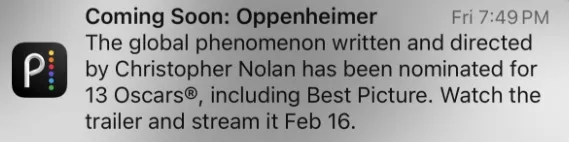
Clear instructions increase the likelihood that people will tap your push message and open your app.
For even better results, you can also personalize the message with the user’s name, as Uber Eats does in its mobile push notifications.
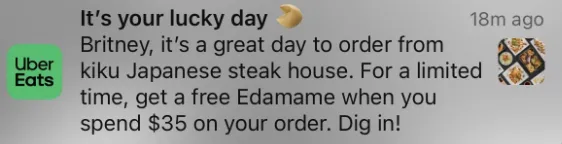
You can also experiment with emojis and other visual elements to make your notifications stand out and grab attention on their mobile devices.
Having trouble finding the right inspiration and choosing the perfect tone? In this case, content writing tools are exactly what you need: they can help you craft a message that calls for action out of your users but is also gentle and polite enough to avoid scaring them away.
Personalize Push Notifications Based on User Behavior
22% of mobile app users will switch to another app if they continue to receive irrelevant messages.
This statistic highlights the fact that people want to feel special and that app experiences are curated just for them.
Effective personalization involves sending the right message to the right users at the right time. This typically relies on behavioral triggers such as past purchases, session frequency, or in-app actions.
To get started, segment your audiences based on their behavior, demographics, and other criteria relevant to your goals.
For example, a travel app user researching historical sites could receive a personalized alert about discounts on WW2 Tours in Germany, making the message feel relevant rather than generic.
After segmenting your audience, you can ensure each user receives relevant content and personalized messages.
Look at this example from Albert, a savings and budgeting app. When users enter their expenses in the Albert app, they get personalized insights on how to lower their bills.

This push notification entices users to open the app by telling them how much they can save on subscriptions.
Get Your Timing Right
When it comes to sending mobile notifications, timing matters. That means you should send push messages when smartphone users are most engaged and receptive.
Use customer data, such as time zones and user behavior patterns, to help you determine the best times to send push notifications.
Location-based push notifications can connect intent with action. For example, someone exploring road trips near Nevada or the Grand Canyon could receive a timely reminder about RV Rental Las Vegas, along with nearby pickup options or travel tips.
How often you send out messages is just as important. Sending too many notifications can annoy users, while sending too few can cause them to forget your app.
To get timing and frequency right, keep a close eye on user engagement patterns, response rates, and feedback.
Consider running A/B tests to test different timing and frequency strategies for your push notification campaigns.
Make Limited-Time Offers
Create a sense of urgency in your push notifications with limited-time offers. This strategy is a great way to get your user base to act before it’s too late.
Share flash sales, early-bird discounts, seasonal promotions, and other time-sensitive offers to instill a fear of missing out (FOMO) and provide value.
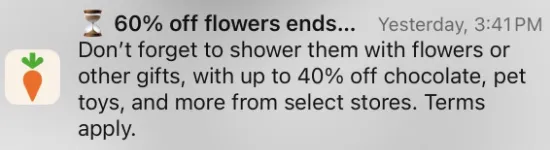
Instacart sent a push notification to its user base on Valentine’s Day to encourage them to order from the app. The words and phrases “quick”, fast”, “30 mins”, and “today” let users know they don’t have a lot of time to make a purchase.
Amwell, a telehealth company, also does a great job of sending relevant messages at the right time. During the Super Bowl, it sent out a push notification encouraging patients to make an online appointment to avoid missing the big game.
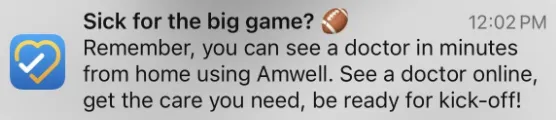
By tying the message to a relevant event and emphasizing the convenience of seeing a doctor online, Amwell encourages users to take action before the game begins.
Use Power Words
Encourage more taps and improve your click-through rate (CTR) with emotionally impactful words. These words help invoke a sense of urgency, excitement, and curiosity in your push notifications.
Examples of power words include:
- Unbeatable
- Exclusive
- Discover
- Surprise
- Exciting
- Limited
- Instant
- Bonus
- Save
- Free
- New
- Join
- VIP
- Win
Instead of using these words in isolation, integrate them into action-driven phrases. For example, ‘Unlock your exclusive offer today’ or ‘Discover limited-time deals now’ makes the message more actionable.
By using these powerful words in your mobile app push notification strategy, you can add impact and urgency to your messages. Adding these simple words helps compel users to take action and engage with your app.
Create Branded Visuals
Perfecting your brand’s identity is crucial for truly connecting with your audience.
This means every interaction, from push notifications to social media posts, should reflect your brand’s unique voice and aesthetic.
To maintain that consistency as they grow, many brands rely on dedicated tools to keep their visual identity on track across every channel.
Tools like Tailor Brands can help by offering resources to refine your brand’s identity. One key element you can use from Tailor Brands is the logo maker.
This tool allows you to create a unique logo that captures the essence of your brand. You can incorporate your logo into your push notification visuals to increase brand recognition.
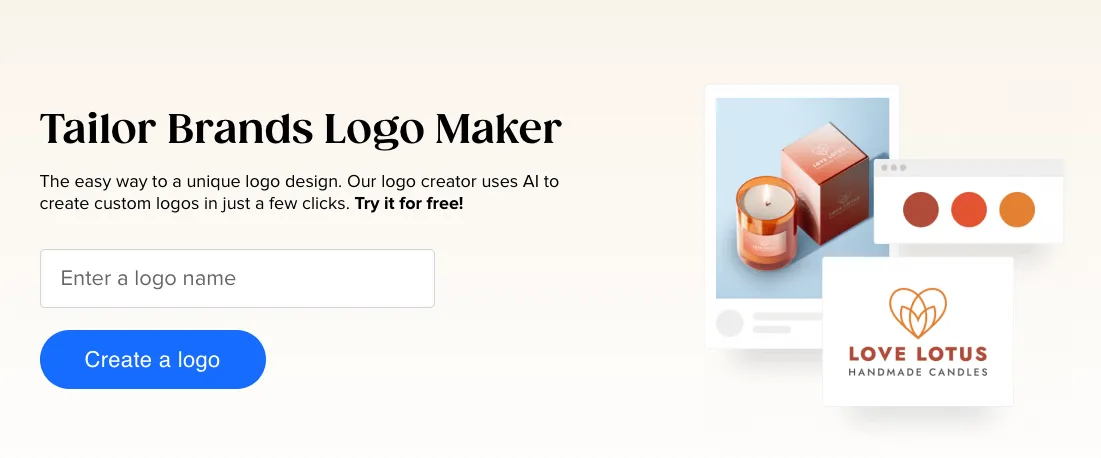
By leveraging the capabilities of Tailor Brands, including its Logo Maker, you can ensure your push notifications aren’t just messages but extensions of your brand experience.
They help you maintain consistency across all forms of communication, making each notification feel like it’s coming directly from the heart of your brand.
Plus, when users get smartphone notifications, they typically only see the logo (rather than your brand name). Adding a logo is a must, so your users know who the notification is from. Otherwise, they’ll ignore it.
Here, Amazon uses the logo on the left side of the notification and a sneak peek at deals under $30 on the right.

Keep Accessibility in Mind
To reach a wider audience, including users with different needs, consider integrating an AI voice generator alongside visual enhancements for your push notifications.
For users with visual impairments, an AI voice generator can convert text notifications into spoken words, ensuring your messages are accessible to everyone.
Meanwhile, for users with hearing impairments, focus on clear, visually engaging messages that are easy to read and reflect your brand’s tone. Doing so not only makes your content accessible but also engages users by catering to their specific needs.
The result is a better overall user experience.
In healthcare, relevance and trust are critical. For example, brands offering treatments like semaglutide oral can send timely reminders or updates that feel supportive while reinforcing patient confidence.
Bringing all of these elements together is what separates generic notifications from high-performing ones.
Final Thoughts
The whole point of mobile app push notifications is to encourage customer engagement and keep your brand top of mind.
But you must do it right to get the results you desire. So, your push notification strategy should focus on sending relevant messages, getting the timing right, and creating personalized experiences.
Ready to turn these strategies into real results? PortoTheme gives you the flexibility to build high-performing, conversion-focused experiences that support user engagement across every touchpoint.
Explore PortoThemes and start optimizing how your users interact with your brand today.
About the author: Britney Steele
Born and raised in Atlanta, Britney is a freelance writer with 5+ years of experience. She’s written for a variety of industries, including marketing, technology, business, finance, healthcare, wellness, and fitness.


Leave a Reply