

How to Set Up a Complete Free AI Marketing Stack for Solo Small Businesses
Highlights:
- AI adoption among SMBs has hit a tipping point — over half are now using it for marketing, meaning solo operators who delay are actively falling behind competitors.
- A complete free AI marketing stack covers six layers: content creation, visual design, SEO, email marketing, scheduling, and analytics — all achievable with free tools.
- The biggest time and money savings come from content creation and email automation; these two layers should be every solo operator’s starting point.
- Free tiers on today’s AI tools are genuinely functional for year-one businesses — upgrade only when a specific tool becomes a bottleneck, not before.
- Consistency beats perfection: a stack you actually use every week outperforms a complex setup that never gets fully implemented.
If you’re running a business solo or with a tiny team, you already know the deal: you’re the CEO, the social media manager, the copywriter, the customer service rep, and the strategist — all before lunch. Marketing is non-negotiable, but hiring help for it? That’s another story.
Here’s the good news: AI has fundamentally changed the math on what a one-person shop can actually produce. And the best part? You don’t need a big budget to get started. This guide walks you through how to build a complete AI marketing stack from the ground up — for free.
The Numbers Don’t Lie: AI Is No Longer a “Big Business” Thing

Before we get into the how, let’s talk about the why — because the data here is genuinely striking.
According to a 2026 AI marketing statistics report from Fueler.io, more than half of small and mid-sized businesses (those with 10 to 250 employees) are now actively using AI for marketing purposes — a jump of 23 percentage points compared to 2024. That’s not gradual adoption. That’s a tipping point.
What’s driving it? Mostly the fact that free and low-cost AI tools have gotten dramatically better, and solo operators are realizing they can now produce content, run campaigns, and analyze results at a pace that used to require a dedicated team. If your competitors are doing this and you’re not, the gap is widening every quarter.
The financial case is just as compelling. Survey data compiled by Capsule CRM, drawing on research from Thryv, found that roughly two in three small businesses using AI are saving somewhere between $500 and $2,000 every single month — savings that most owners are then plowing back into growth rather than pocketing. For a solo operator, that’s the difference between being able to reinvest in your business and feeling perpetually stuck.
The takeaway is simple: this isn’t a trend you can afford to sit out.
What a “Marketing Stack” Actually Means for a Solo Operator
The term “marketing stack” sounds like something reserved for enterprise companies with a tech department. It’s not. For a solo business owner, your stack is just the set of tools you use consistently to attract, engage, and retain customers.
A complete stack covers:
- Content creation— blog posts, captions, email copy, ad text
- Visual design— graphics, thumbnails, social images
- Scheduling and distribution— getting content out without babysitting it
- SEO and discoverability— making sure people can actually find you
- Email marketing— nurturing leads and staying in touch with customers
- Analytics— understanding what’s working so you can do more of it
The goal isn’t to use a dozen tools. It’s to have one solid, reliable option for each layer so nothing falls through the cracks. And if you’re new to this world, the best place to get oriented is a comprehensive roundup of the best free AI tools for small business marketing in 2026 — which covers the actual tool picks in depth and is worth bookmarking as you build out your stack.
Layer 1: Content Creation — Your Biggest Time Drain, Solved
For most solo operators, content is where the most time gets lost. Writing a blog post, drafting three email variations, coming up with 10 social captions — it adds up fast and it never stops.
What to use: ChatGPT (free tier), Claude (free tier), or Google Gemini (free).
All three can draft blog outlines, write social copy, suggest email subject lines, repurpose existing content into new formats, and brainstorm campaign ideas. The key is learning to give them specific, detailed prompts rather than vague ones.
A prompt like “write a social media caption for my bakery” will give you something generic. A prompt like “write three Instagram captions for a sourdough bakery in Austin targeting weekend brunchers — use a warm, slightly funny tone, and include a call to action to DM us for pre-orders” will give you something you can actually use.
The time savings compound fast. HubSpot’s research suggests AI-using small businesses recover five to fifteen hours per week on content work alone. Over a month, that’s a meaningful chunk of capacity returned to you.
Layer 2: Visual Design — Professional Graphics Without a Designer
You don’t need to know Photoshop. You don’t need to hire a designer for routine marketing assets. Free AI-assisted design tools have made this accessible to anyone willing to spend twenty minutes learning the interface.
What to use: Canva (free tier with AI features), Adobe Express (free), or Microsoft Designer (free).
Canva in particular has invested heavily in AI features — you can generate images, resize designs automatically for different platforms, and use their “Magic Write” tool for copy suggestions inside the design itself. For social posts, email headers, promotional graphics, and simple ads, it’s more than enough.
One practical tip: build a small library of branded templates early. Pick your colors, fonts, and logo placement once, save them as templates, and then every future piece of content takes a fraction of the time to produce.
Layer 3: SEO and Content Strategy — Getting Found Without Paying for Ads
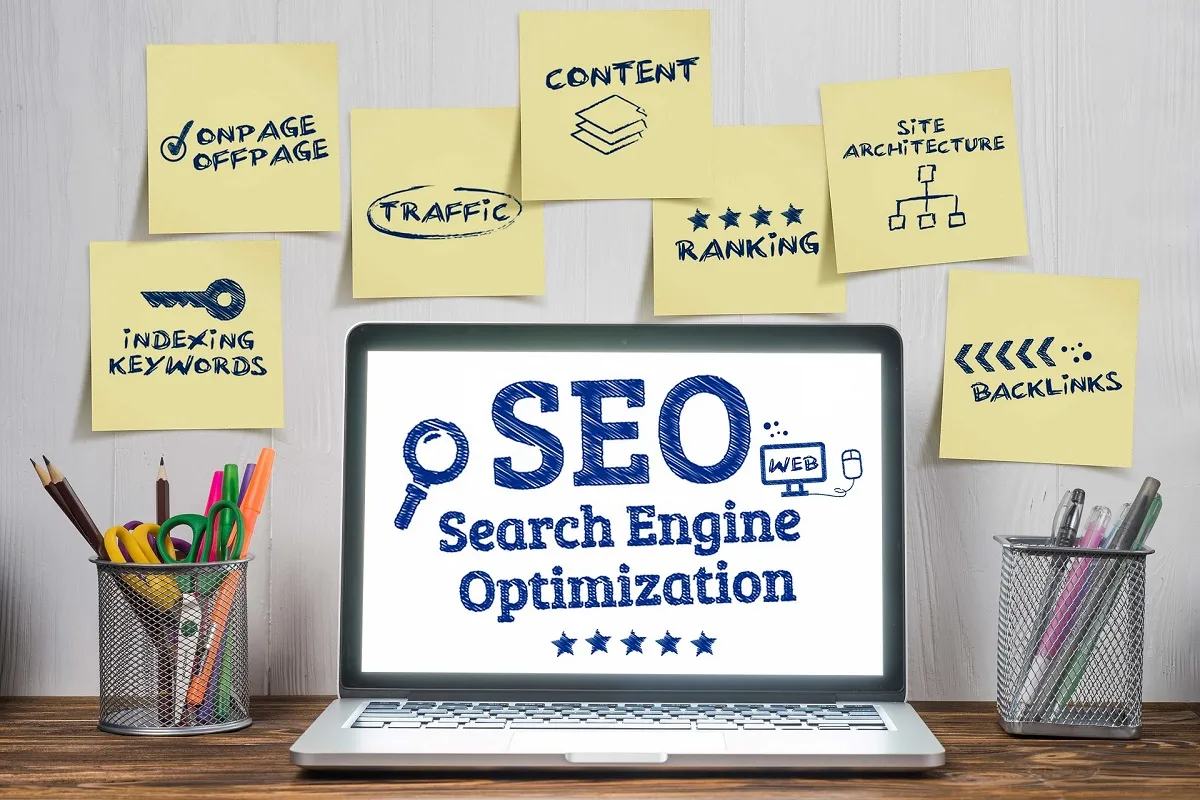
Organic search is still one of the highest-ROI marketing channels available to small businesses — and free AI tools have made keyword research and content planning dramatically more accessible.
What to use: Google Search Console (free), Semrush (free tier), Ahrefs Webmaster Tools (free), and AI writing assistants for on-page optimization.
The workflow looks like this: use Google Search Console to see what people are already searching to find your site, use Semrush’s free tier or Ahrefs to identify related keywords with lower competition, and then use an AI writing assistant to help you structure and draft content around those terms.
Don’t overlook AI tools for analyzing search intent. If you paste a keyword into Claude or ChatGPT and ask “what is someone looking for when they search this term, and what type of content would best answer their question?” — you’ll often get a more nuanced answer than any keyword tool alone provides.
Layer 4: Email Marketing — Your Owned Channel, Automated
Social media algorithms change. Ad costs spike. Your email list is the one thing you actually own, and automated email sequences mean your list keeps working even when you’re not.
What to use: Mailchimp (free up to 500 contacts), Brevo (free up to 300 emails/day), or HubSpot’s free CRM with email marketing.
The free tiers on these platforms are genuinely functional for a solo operator just getting started. Where AI fits in: use it to write your welcome sequences, promotional emails, and re-engagement campaigns. Give the AI your brand voice, your offer, and your audience, and ask it to draft a three-email welcome sequence. Edit for tone, add specifics, done.
A well-written five-email welcome sequence running on autopilot is more valuable than almost anything else you can set up early. It converts new subscribers to customers without you lifting a finger after the initial setup.
Layer 5: Scheduling and Distribution — Set It and (Mostly) Forget It
Creating content and then manually posting it every day is the kind of low-leverage activity that eats your time without adding much value. Scheduling tools fix this.
What to use: Buffer (free for up to 3 channels), Later (free tier), or Meta Business Suite (free for Facebook and Instagram).
The workflow: batch your content creation once or twice a week using AI tools, drop it into your scheduling platform, and set your posting times based on when your audience is most active. Most scheduling tools now have built-in analytics that tell you which posts performed best — use that to inform what you create next week.
Layer 6: Analytics — Closing the Loop
The whole stack only improves if you’re paying attention to what’s working. Free analytics tools give you more data than most solo operators know what to do with.
What to use: Google Analytics 4 (free), native platform insights (Instagram, Facebook, LinkedIn all have free analytics), and Google Search Console.
Here’s where AI helps again: if you export your analytics data and paste it into an AI tool, you can ask plain-language questions like “which content drove the most traffic last month?” or “what’s my best-performing email subject line pattern?” and get a useful analysis without needing to know how to interpret complex dashboards yourself.
Putting It All Together: A Week in the Life
Here’s what a realistic AI-powered marketing week looks like for a solo operator running this stack:
Monday (60 Minutes):
Use an AI tool to plan the week’s content — five social posts, one email, one blog outline. Finalize the copy and drop social posts into Buffer for the week.
Wednesday (30 Minutes):
Draft and schedule the week’s email in Mailchimp using AI-assisted copy. Check Google Analytics for last week’s traffic trends.
Friday (30 Minutes):
Review performance across channels. Screenshot anything that performed above average and feed it back to your AI tool: “this post got 3x our usual engagement — why do you think it worked, and how can I replicate it?”
That’s two hours a week of focused, strategic marketing activity. It’s not zero effort, but it’s radically less than trying to run all of this manually.
The Honest Reality About Free Tiers
Free tools are genuinely powerful right now, but they come with limits — storage caps, contact limits, branding on emails, restricted features. Here’s the practical advice: start free, stay free until you hit a wall, and then upgrade only the specific tool that’s limiting you.
For most solo operators in year one, the free tier of every tool mentioned in this guide will be more than sufficient. As your business grows and your list expands past 500 subscribers, or you need more advanced automation, that’s when selective paid upgrades make sense. By then, the ROI is usually obvious.
You Don’t Need to Build This All at Once
The biggest mistake people make when setting up a marketing stack is trying to implement everything simultaneously. Pick one layer, get comfortable with it, and add the next. Most solo operators find that content creation and email are the highest-impact starting points — nail those two first.
The data is clear that this technology is moving fast and the competitive advantage for early adopters is real. But a stack you actually use beats a perfect stack you never finish setting up.
Start simple. Stay consistent. Let the tools do the heavy lifting — that’s what they’re built for.


Leave a Reply