
Looking for a WP Rocket Alternative? How Sitetrail Turbo Combines Caching, Image Optimization and Real-User Core Web Vitals
WordPress users searching for a WP Rocket alternative are often trying to solve a broader problem than page caching alone.
A website may load slowly because its images are too large. JavaScript may execute too early. Cloudflare may be active but poorly configured. An Elementor page may load excessive front-end assets. A WooCommerce store may require careful cache exclusions to keep carts and checkout pages functioning correctly. Several overlapping optimization plugins may even be competing with one another.
Installing a caching plugin can help, but modern WordPress performance is rarely the result of one setting.
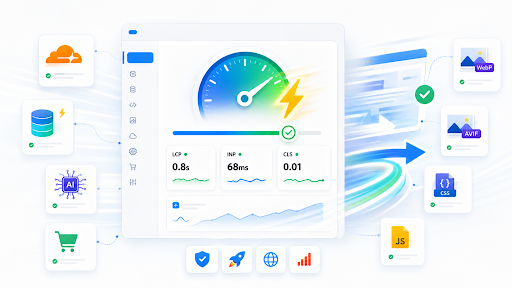
Sitetrail Turbo was developed around this reality. It is a self-contained WordPress performance suite that combines full-page caching, CSS and JavaScript optimization, local WebP and AVIF image conversion, Cloudflare controls, WooCommerce safeguards, restore points, migration tools and real-user Core Web Vitals monitoring inside one plugin.
For WordPress users looking to reduce plugin sprawl while gaining more control over performance, it offers a compelling alternative.
Why WordPress users look for WP Rocket alternatives
WP Rocket is one of the best-known WordPress caching plugins. It helped make performance optimization more accessible by packaging caching, cache preloading and front-end optimization tools into a relatively straightforward workflow.
For many websites, that remains useful.
However, the WordPress ecosystem has become more complex. Many businesses no longer run simple brochure websites. They operate stores, membership areas, editorial sites, lead-generation platforms and heavily customized Elementor builds.
As those environments become more demanding, website owners often need several tools:
- A page-caching plugin
- An image-optimization plugin
- A Cloudflare integration tool
- A Core Web Vitals monitoring tool
- A database-cleanup utility
- A migration workflow
- A safe way to roll back risky changes
The result can be a fragmented stack with overlapping settings and unclear responsibility.
Sitetrail Turbo takes a different approach: bring the most important performance controls together in one WordPress dashboard.
A broader approach to WordPress performance
The main value of Sitetrail Turbo is breadth.
The plugin includes a filesystem-based HTML page cache, sitemap-aware preloading, automatic cache clearing, manual purge controls and optional gzip cache sidecars. It also offers CSS minification, JavaScript deferral, delayed script execution, lazy loading and local Remove Unused CSS.
But it does not stop there.
Sitetrail Turbo also includes local image conversion, Cloudflare management, real-user Core Web Vitals, managed-host detection, WooCommerce-safe exclusions, restore points, reports and optional AI-assisted diagnostics.
This broader approach matters because page speed is a system.
Improving one part of the system while ignoring everything else can produce disappointing results. A cached page may still feel slow if it loads oversized images. A lightweight page may still frustrate users if scripts block interaction. An aggressive optimization may improve a test score while disrupting a checkout process.
The purpose of Sitetrail Turbo is to improve performance without losing sight of the wider WordPress environment.
Start with the Fix My Speed dashboard
Sitetrail Turbo gives users a practical starting point through its Fix My Speed™ dashboard.
The dashboard provides a Turbo Health Score™, which evaluates important parts of the performance setup, including cache configuration, Cloudflare linkage, image-optimization coverage, database-cleanup opportunities, compression settings, plugin conflicts, object-cache detection and OPcache availability.
The score is not presented as a substitute for Google PageSpeed Insights. It is a local configuration assessment designed to show whether the website’s optimization foundations are in place.
Users can then choose between Safe, Balanced and Maximum presets or make more granular decisions.
This makes the plugin accessible to website owners while retaining useful controls for developers and agencies.
Local WebP and AVIF conversion reduce plugin sprawl
Images are frequently one of the largest contributors to slow page loads.
Modern formats such as WebP and AVIF can reduce image weight while preserving visual quality. However, many WordPress users rely on a separate image-optimization plugin or an external cloud service to convert media files.
Sitetrail Turbo includes image optimization directly inside the performance suite.
It supports:
- Local WebP conversion
- Local AVIF conversion where supported
- Bulk compression
- Oversized-upload resizing
- Image lazy loading
- Iframe and video lazy loading
- Hero-image exclusions
- LCP-image preloading
- Heavy-image detection
- Unused-media scanning
Original images are preserved.
The plugin prioritizes modern formats while maintaining a graceful fallback sequence:
AVIF → WebP → original image
For many website owners, this can eliminate the need for a separate cloud-based image workflow.
Real-user Core Web Vitals provide a clearer performance picture
A laboratory test is useful, but it only captures one moment under one set of simulated conditions.
Real visitors experience websites differently. They use different devices, network conditions, browsers and geographic locations.
Sitetrail Turbo includes Visitor Experience™, a real-user monitoring system that tracks important Core Web Vitals:
- Largest Contentful Paint (LCP): how quickly the main visible content loads
- Interaction to Next Paint (INP): how responsive the website feels when visitors interact with it
- Cumulative Layout Shift (CLS): how stable the page layout remains while loading
Metrics are aggregated locally and displayed using the 75th percentile with familiar performance bands: good, needs improvement and poor.
Users can review desktop and mobile results separately and monitor trends over time.
The system is deliberately lightweight. It uses sampled background beacons and aggregated storage. There are no visitor profiles, no session tables and no analytics feed uploaded to Sitetrail.
This gives site owners a more practical question to answer:
Are real visitors experiencing a faster website?
Cloudflare controls belong inside the performance workflow
Cloudflare can improve speed and resilience, but it is often configured separately from the WordPress optimization stack.
Sitetrail Turbo includes Turbo Cloudflare Manager, which brings relevant Cloudflare controls into the plugin.
Users can connect with an API Token or Global API Key, verify the connection, detect the Cloudflare plan, purge edge cache and review important settings such as Brotli and HTTP/3.
The plugin can also recommend safer WordPress-specific cache rules.
These include bypassing logged-in users and protecting dynamic areas such as:
- WooCommerce carts
- Checkout pages
- Account pages
- Selected REST API requests
- admin-ajax.php POST requests
This makes Cloudflare easier to manage without forcing website owners to move between disconnected dashboards.
WooCommerce needs more than aggressive caching
WooCommerce websites require careful optimization.
A standard content page can often be cached safely. A checkout page, customer account area or shopping cart cannot be treated in the same way.
Sitetrail Turbo includes WooCommerce-aware safeguards designed to improve speed without interfering with important store functionality.
These include:
- Cart exclusions
- Checkout exclusions
- Account-page exclusions
- Cookie bypass logic
- Fragment handling
- Product-page controls
- Stock and status purge logic
- Payment-gateway safe mode
This matters because speed is only valuable when the store continues working correctly.
A fast WooCommerce website with a broken checkout is not optimized. It is losing revenue.
Restore points make optimization safer
WordPress performance work occasionally requires experimentation.
Delaying a JavaScript file may improve loading performance but affect a form. A CSS change may disrupt a layout. A cache rule may interfere with a dynamic workflow.
Sitetrail Turbo reduces that risk with restore points, settings snapshots, one-click restoration, change logs, break detection, HTTP validation after risky changes and auto-rollback notices.
It also includes per-page and per-script exclusions.
For agencies and developers, this creates a more accountable optimization workflow. Changes are visible, reversible and easier to troubleshoot.
A practical alternative to WP Rocket, LiteSpeed Cache, W3 Total Cache and WP-Optimize
WordPress users comparing optimization tools may be evaluating several established options.
Sitetrail Turbo can serve as a WP Rocket alternative for users who want caching plus broader local performance controls inside one plugin.
It can serve as a LiteSpeed Cache alternative for users who want a more host-agnostic performance suite or need tools that coexist intelligently with different server environments.
It can serve as a W3 Total Cache alternative for users who want strong optimization controls presented through a more guided dashboard and a simplified workflow.
It can serve as a WP-Optimize alternative for users who want database-cleanup visibility alongside caching, image conversion, Cloudflare controls, real-user Core Web Vitals and restore points.
The comparison is not about claiming that every website should use the same plugin.
Each website has a different hosting stack, technical profile and level of complexity.
The value of Sitetrail Turbo lies in consolidation: it brings several important performance categories together so users do not need to assemble a patchwork solution.
Purge Mode helps Turbo coexist with hosting infrastructure
Hosting companies and managed WordPress providers often operate their own caching layers.
These may include LiteSpeed Server Cache, FastCGI Cache, Varnish or managed-host caching.
Adding a second page cache without understanding the server environment can create unnecessary overlap.
Sitetrail Turbo detects supported server-level cache conditions and can enter Purge Mode when appropriate.
In Purge Mode, Turbo avoids duplicating page caching while continuing to provide value through image optimization, CSS and JavaScript controls, Cloudflare integration, diagnostics, reports and Core Web Vitals monitoring.
This makes the plugin useful not only for website owners but also for agencies, developers and hosting providers.
Sitetrail Turbo openly welcomes hosting companies and infrastructure partners.
No mandatory SaaS dependency
Sitetrail Turbo is designed to remain self-contained.
Caching happens locally. Image conversion happens locally. Analytics aggregation happens locally. Reports are generated locally.
Routine external communication is limited to license checks and plugin updates. Cloudflare is contacted only when a user configures Cloudflare integration. OpenAI is contacted only when the user enables optional AI diagnostics, supplies their own API key and actively requests a diagnostic.
Sitetrail does not receive visitor analytics or silently collect telemetry.
This local-first architecture is particularly attractive to privacy-conscious businesses and technical teams that want more control over their data.
Can Sitetrail Turbo replace several plugins?
For many WordPress websites, yes.
Sitetrail Turbo can reduce the need for a separate caching plugin, image-conversion plugin, Cloudflare-management tool and Core Web Vitals monitoring solution.
It also includes a migration wizard that detects competing caching and performance plugins, identifies overlapping functionality and helps users simplify the stack.
Running several optimization tools at the same time can create conflicts. Consolidation makes performance easier to manage.
The verdict: a WP Rocket alternative built for a wider performance stack
WP Rocket remains a recognized WordPress caching plugin.
However, website owners searching for a WP Rocket alternative may be looking for something broader than another cache layer.
The result is a more complete WordPress performance suite. Building on Sitetrail’s success with AI Live Chat PRO, a WordPress live-chat plugin with AI-powered support features, and Woo Toolbox, an all-in-one WooCommerce utility suite, Sitetrail Turbo enters the market with a stronger foundation than an unknown standalone plugin. Website owners, agencies, developers and hosting companies already familiar with Sitetrail’s WordPress tools are likely to take it seriously as a practical way to reduce plugin sprawl while retaining greater control over performance.


Leave a Reply