
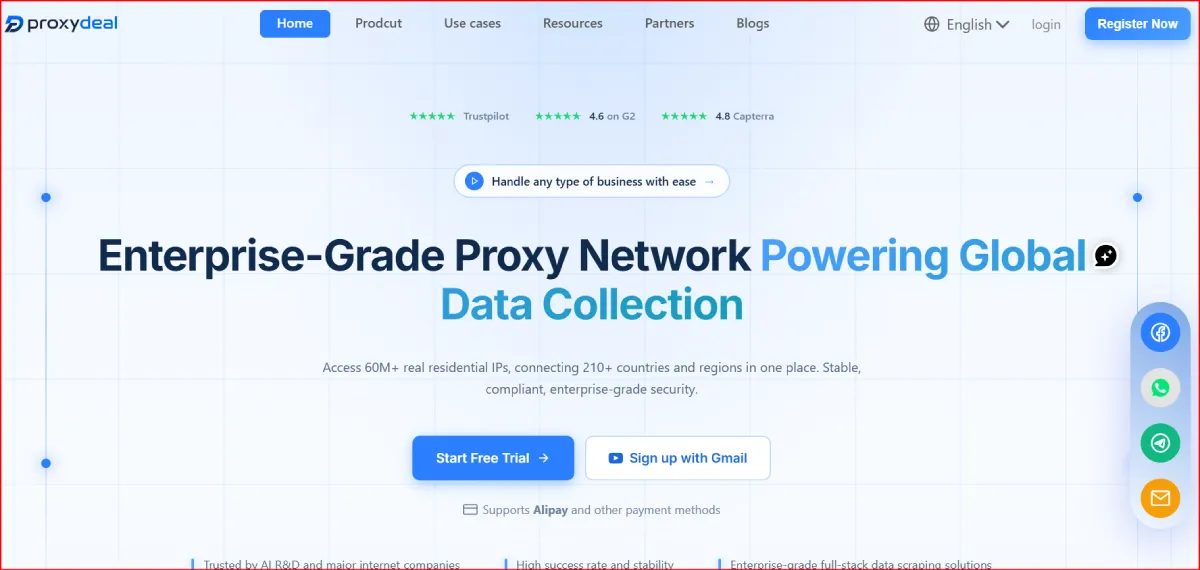
ProxyDeal Review 2026: Residential Proxies, Global Coverage, Features & Use Cases
The proxy market has become increasingly competitive in 2026. Businesses no longer choose a provider simply because it offers thousands or millions of IP addresses. Geographic coverage, IP quality, session flexibility, scalability, connection stability, and the ability to support real business workflows are now equally important.
ProxyDeal is a global proxy provider positioning its infrastructure around web data collection and international online operations. Public industry listings currently describe ProxyDeal as offering static and dynamic proxy IPs across more than 210 countries and regions, supported by eight independent IP pools. Some recent third-party directories also report access to approximately 60 million residential IP addresses.
In this ProxyDeal review, we examine its infrastructure, residential proxy capabilities, use cases, strengths, limitations, pricing transparency, and whether it is worth considering in 2026.
What Is ProxyDeal?
ProxyDeal is a proxy service designed for businesses, developers, ecommerce teams, marketers, SEO professionals, researchers, and organizations that need access to geographically distributed IP addresses.
Instead of focusing on only one country or one proxy configuration, ProxyDeal emphasizes international coverage.
Current public listings describe its infrastructure as including:
| Feature | ProxyDeal |
| Geographic Coverage | 210+ countries and regions |
| Residential Network | Approximately 60M IPs reported by third-party directories |
| Proxy Models | Static and dynamic IPs |
| IP Infrastructure | 8 independent pools |
| Primary Focus | Global proxy infrastructure and web data |
| Suitable For | Web data, ecommerce, SEO, research and ad verification |
The approximately 60-million-IP figure comes from third-party listings rather than specifications clearly exposed through ProxyDeal’s currently crawlable official website, so businesses planning large deployments should confirm the active network size directly with the provider.
Why ProxyDeal Is Interesting in 2026
ProxyDeal’s biggest advantage appears to be the combination of international coverage and different IP configurations.
A small proxy network may be enough when a company only needs access from the United States or a handful of European markets.
International operations are different.
An ecommerce company may need IP addresses in Germany, Brazil, the United States, Spain, Japan and Singapore. An SEO platform might need hundreds of geographic locations. A web-data operation may require rotating residential addresses across many markets.
Using separate proxy companies for every region increases infrastructure complexity.
With reported coverage across more than 210 countries and regions, ProxyDeal is positioned as a more centralized option for these types of international projects.
- Large Residential Proxy Network
Residential proxies route traffic through IP addresses associated with residential internet connections.
This makes them particularly useful when a project requires geographically representative web access.
Third-party directories currently describe ProxyDeal as providing around 60 million real residential IP addresses covering 210+ countries.
A large residential network can be useful for:
- Public web-data collection
- Ecommerce research
- Price monitoring
- SEO monitoring
- Localized search research
- Advertising verification
- Market intelligence
- Website localization testing
- Travel-data research
- Application testing
For international organizations, country availability can sometimes be more important than the total number of IPs.
ProxyDeal’s broad geographic positioning is therefore one of its most notable characteristics.
- Static and Dynamic Proxy Options
Another important characteristic of ProxyDeal is support for both static and dynamic IP solutions. Current industry directories consistently describe the provider as offering both models.
Dynamic Proxies
Dynamic or rotating proxies periodically change the IP address used for connections.
They are generally better suited to high-volume operations where IP diversity is important.
Possible applications include:
- Large-scale public data collection
- Ecommerce monitoring
- Search-result research
- Competitive intelligence
- Localization testing
- Automated web research
For example, a price-monitoring system may need to check thousands of publicly accessible product pages.
Using rotating residential infrastructure distributes requests across different IP addresses rather than repeatedly relying on the same endpoint.
Static Proxies
Static proxies maintain the same IP address for a longer period.
These can be preferable for workflows where consistent network identity matters.
Potential applications include:
- Long-running research sessions
- Application testing
- Consistent regional website access
- Development environments
- Persistent business workflows
The availability of both approaches gives ProxyDeal greater flexibility than services focused exclusively on rotating proxies.
- Eight Independent IP Pools
Another differentiating feature reported across current ProxyDeal listings is the availability of eight independent IP pools.
Different projects have different networking requirements.
One customer might prioritize geographic diversity. Another might require longer sessions, while another could prioritize rotation frequency or availability within particular regions.
Separate pools can potentially allow a provider to better match infrastructure to different customer requirements.
Before purchasing, businesses should therefore ask ProxyDeal which pool is most appropriate for their target countries, websites, traffic volumes and session requirements.
- ProxyDeal for Ecommerce Price Monitoring
One of the most practical applications for residential proxies is ecommerce price monitoring.
Online retailers frequently change:
- Product prices
- Discounts
- Regional promotions
- Inventory availability
- Shipping options
- Currency presentation
- Product recommendations
These differences can sometimes depend on geographic location.
For example, the same ecommerce website may display different promotions to users in the United States, Germany and Brazil.
ProxyDeal’s international residential infrastructure can help authorized research systems examine publicly available storefront information from different geographic markets.
A typical workflow could look like:
Price monitoring software → ProxyDeal proxy → Regional IP address → Ecommerce website → Structured price data
Companies can then compare publicly available data such as:
| Data Type | Possible Use |
| Product Price | Competitive benchmarking |
| Discount | Promotion monitoring |
| Availability | Inventory analysis |
| Currency | Localization testing |
| Shipping | Regional market analysis |
| Product Listings | Catalog intelligence |
For multinational ecommerce companies, the ability to research many locations through one proxy provider can simplify infrastructure considerably.
- ProxyDeal for Web Scraping and Data Collection
ProxyDeal can also be considered for legitimate public web-data projects.
Web scraping platforms may need to retrieve information such as:
- Public product catalogs
- Search results
- Public company information
- Real-estate listings
- Travel information
- Pricing information
- Public reviews
- Marketplace listings
A residential proxy layer can distribute requests across different IP endpoints.
Instead of:
Crawler → Target Website
the infrastructure becomes:
Crawler → ProxyDeal → Residential IP → Public Website
This can be especially useful when researchers need to understand how publicly accessible information varies between geographic markets.
Organizations should still ensure their collection activities comply with applicable laws, privacy obligations, contracts, and website requirements. Using a proxy does not remove those responsibilities.
- ProxyDeal for SEO Monitoring
Search results can vary significantly depending on location.
A person searching the same phrase from London, Madrid, New York or Tokyo may receive different results because search engines consider geographic signals when generating results.
This makes geographically distributed proxies valuable for international SEO.
ProxyDeal could support workflows such as:
- Local keyword monitoring
- SERP research
- International competitor analysis
- Regional website testing
- Search localization research
- Content visibility monitoring
An SEO agency managing clients across 20 countries, for example, could use country-specific proxy endpoints rather than relying exclusively on results generated from its office location.
- ProxyDeal for Ad Verification
International advertising campaigns also require geographic verification.
An advertiser may launch campaigns across dozens of countries but cannot physically check every market.
Regional proxies can help authorized advertising teams verify publicly displayed campaign experiences from relevant geographic locations.
Teams may check:
- Landing-page availability
- Correct regional redirects
- Localized campaign pages
- Advertiser destination URLs
- Public affiliate pages
- Geographic promotions
- Localization quality
ProxyDeal’s reported 210+ country coverage could therefore be especially valuable for global advertising operations.
- ProxyDeal for Market Research
ProxyDeal may also be useful for organizations conducting international market intelligence.
A company considering expansion into a new country might want to research:
- Local competitors
- Product availability
- Pricing differences
- Regional marketplaces
- Public promotions
- Search visibility
- Consumer-facing website experiences
Without local infrastructure, researchers often see the internet from only one geographic perspective.
Residential proxies allow authorized teams to examine publicly accessible online experiences from different regions.
This is particularly relevant to companies operating across Europe, Asia, North America, Latin America, Africa and the Middle East.
ProxyDeal Pricing in 2026
Pricing is currently one of the areas where more transparency would improve the ProxyDeal buying experience.
At the time of this review, ProxyDeal’s publicly crawlable website did not expose enough reliable pricing information to construct a current pricing table without risking publishing inaccurate numbers.
Proxy pricing can vary according to:
- Proxy type
- Bandwidth
- Number of IP addresses
- Country
- Traffic volume
- Session configuration
- IP exclusivity
- Customer requirements
Enterprise customers may also receive customized pricing.
Therefore, potential customers should confirm current packages directly through ProxyDeal before purchasing.
More prominently published starting prices and technical package specifications would make comparisons with competing proxy providers easier.
ProxyDeal Pros and Cons
| Pros | Cons |
| 210+ countries and regions reported | Public pricing transparency could improve |
| Around 60M residential IPs reported externally | Network-size figure should be confirmed before enterprise purchase |
| Static and dynamic options | Limited publicly crawlable technical documentation |
| Eight independent IP pools | Performance can vary by target website and region |
| Strong geographic flexibility | Benchmarking is recommended before large deployments |
| Suitable for international web-data projects | Not every project requires such a large geographic footprint |
| Useful for ecommerce and SEO research | Advanced configuration details may require contacting support |
What Should You Test Before Buying ProxyDeal?
Proxy pool size alone should never determine which proxy provider you choose.
A network containing millions of addresses does not automatically guarantee perfect results against every website or in every country.
Before making a large purchase, test ProxyDeal using your actual workflow.
Important metrics include:
Connection Success Rate
Check how consistently connections succeed against the websites relevant to your project.
Geographic Accuracy
Confirm that the IP addresses actually correspond to the requested locations.
Latency
Measure response time in the countries you intend to use.
Session Stability
For persistent workflows, determine how long connections remain stable.
IP Availability
Check whether sufficient IP addresses are available in your most important regions.
Rotation Behavior
For rotating proxies, understand when and how addresses change.
Support Quality
Evaluate how quickly technical questions or configuration problems are handled.
Testing these variables provides much more useful information than simply comparing advertised IP-pool sizes.
Who Should Consider ProxyDeal?
ProxyDeal appears best suited to organizations that require international proxy infrastructure rather than a handful of individual IP addresses.
Ecommerce Companies
Useful for international price monitoring, competitive research and regional storefront analysis.
SEO Agencies
Useful for studying localized search results and monitoring visibility across different geographic markets.
Data Teams
Potentially suitable for scalable collection of publicly available web information.
Advertising Teams
Useful for authorized geographic campaign and landing-page verification.
Developers
Useful for testing websites and applications across different network locations.
Market Researchers
Useful for comparing publicly accessible information across multiple countries.
Companies requiring only one or two static IPs might find a smaller specialist service sufficient.
ProxyDeal becomes more interesting when a project requires large geographic diversity.
Is ProxyDeal Worth It in 2026?
ProxyDeal presents an interesting proposition for businesses whose priority is international coverage.
Its strongest reported characteristics are:
210+ countries and regions
Around 60 million residential IPs reported by third-party directories
Static and dynamic IP configurations
Eight independent IP pools
Together, these characteristics make ProxyDeal relevant for ecommerce research, public web-data collection, SEO monitoring, market intelligence, ad verification and other international business workflows.
The biggest area for improvement is transparency.
Publishing more detailed pricing, targeting capabilities, session durations, proxy protocols, concurrency specifications and pool characteristics directly on the public website would make it considerably easier for technical buyers to evaluate the service.
ProxyDeal Review 2026: Final Verdict
ProxyDeal is a proxy provider worth considering when geographic diversity and flexible residential IP infrastructure are major requirements.
Its reported coverage across more than 210 countries is particularly attractive to businesses that operate internationally rather than within a small number of markets.
The combination of static and dynamic IP options also allows ProxyDeal to address different types of workflows, from persistent sessions to large-scale rotating proxy operations.
For ecommerce price monitoring, SEO research, web-data collection, advertising verification, localization testing and global market research, ProxyDeal has the infrastructure profile of a potentially useful provider.
The best approach, however, is to test the network with your actual workload before making a large commitment.
Evaluate performance in your required countries, test the target websites relevant to your project, measure connection quality and calculate the real cost per successful operation.
If those results meet your requirements, ProxyDeal could become a strong component of a global proxy and web-data stack.
Our ProxyDeal Rating
| Category | Rating |
| Global Coverage | 9/10 |
| Proxy Flexibility | 8.5/10 |
| Business Use Cases | 8.5/10 |
| Scalability Potential | 8.5/10 |
| Pricing Transparency | 6.5/10 |
| Public Documentation | 7/10 |
| Overall Rating | 8.2/10 |
Frequently Asked Questions
What is ProxyDeal?
ProxyDeal is a global proxy provider focused on IP infrastructure and web-data applications. Current public listings describe it as offering static and dynamic proxy services across more than 210 countries and regions.
Does ProxyDeal provide residential proxies?
Yes. Recent third-party directories describe ProxyDeal as providing a residential proxy network containing approximately 60 million IP addresses. Enterprise customers should confirm the currently active pool size directly with ProxyDeal.
How many countries does ProxyDeal cover?
Current public listings report support for more than 210 countries and regions.
Does ProxyDeal have static proxies?
Public ProxyDeal listings describe the service as supporting both static and dynamic IP solutions.
Is ProxyDeal suitable for web scraping?
Its residential proxy infrastructure and geographic diversity make ProxyDeal potentially suitable for legitimate public-data collection. Users should test performance against their specific target websites and comply with applicable requirements.
Is ProxyDeal good for ecommerce price monitoring?
Yes, this is one of the more relevant potential applications. Geographic proxy endpoints can help authorized businesses compare publicly available pricing, inventory, promotions and storefront information across different regions.
Is ProxyDeal useful for SEO?
ProxyDeal can be useful for international SEO research because different regional IP locations can help teams analyze geographically dependent public search results and website experiences.
Should I use ProxyDeal in 2026?
ProxyDeal is worth testing if your priorities include residential proxies, wide international coverage, static and dynamic IP options, and proxy infrastructure for international data workflows.


Leave a Reply