

The 6 Best Linktree Alternatives in 2026 (For Freelancers Who Do More Than Share Links)
Linktree is great at one thing: holding a list of links. But if you’re a creator, freelancer, or social media manager trying to book clients and sell things from your bio, you’ve probably outgrown it. Here are the alternatives worth switching to, compared on price, fees, and what they actually let you build.
The best Linktree alternative depends on what your bio link needs to do:
- Best all-in-one for creators & freelancers: Julip. A full website-in-bio (portfolio, paid services and bookings, digital products) with 0% transaction fees at $19/mo.
- Best for creator commerce + AI: Beacons. Strong storefront and media kit, but 9% fees until the $30 tier.
- Best pure digital-product checkout: Stan Store. Clean mobile selling, 0% fees, but $29/mo and light on customization.
- Cheapest simple one-pager: Carrd. From $19/year, but no built-in payments or booking.
- Best for brand-deal management: Pillar. A built-in media kit and sponsorship CRM.
Below you’ll find a full comparison table, two charts, and an honest rundown of each tool, including where it wins and where it falls short.
Linktree Alternatives at a Glance
| Tool | Best for | Starting paid price | Transaction fee | Custom domain |
| Julip | Creators & freelancers who sell & book, and want an all in one portfolio
|
$19/mo (annual) | 0% | Yes |
| Linktree | Sharing a list of links | $8–$15/mo | 9–12%* | No |
| Beacons | Creator commerce + AI | $10/mo | 9% (0% at $30) | Paid tiers |
| Stan Store | Selling courses & coaching | $29/mo | 0% | Yes |
| Carrd | Simple one-page sites | $19/year | 0% | Pro Standard+ |
Chart 1: Entry-Level Paid Price, Per Month
| Tool | $/mo | Relative |
| Carrd (Pro Standard) | $1.58 | █ |
| Beacons (Creator Pro) | $8.33 | ██████ |
| Linktree (Pro) | $12 | ████████ |
| Julip | $19 | █████████████ |
| Stan Store (Creator) | $25 | █████████████████ |
| Pillar (Pro) | $29 | ████████████████████ |
Why Freelancers are Leaving Linktree
Linktree pretty much invented the link-in-bio, and its free plan is still a fine place to park a few links. But three things push people to look elsewhere in 2026.
The fees add up. Linktree raised its prices in late 2025. The free plan now skims 12% off every digital sale, and even the $15 Pro plan keeps a 9% cut. If you sell $1,000 of products in a month, that’s $90 to $120 gone before you’ve paid your payment processor.
A wall of links isn’t a first impression. When a brand or potential client lands on your bio, a stack of blue buttons tells them almost nothing about your work, your rates, or how to hire you. You get one shot to look professional, and a link list wastes it.
You end up paying for five tools. A scheduler here, a checkout there, a separate portfolio, an email tool, a “link page” on top. It’s expensive and a headache to keep in sync. The tools below each try to collapse that stack in a different way.
The 6 Best Linktree Alternatives
1. Julip
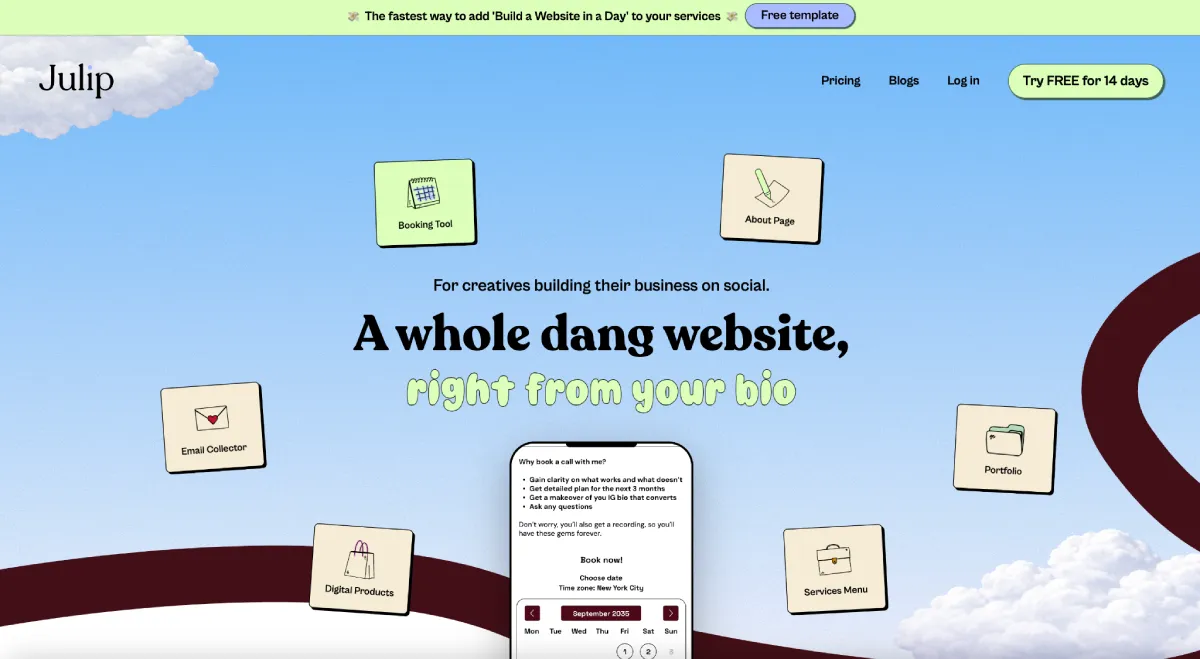
Best for creators, freelancers & social media managers who want to sell their services, book paid calls, and get paid, not just share links.
Julip turns your bio link into a whole website. Instead of a list of links, you get a visual storefront: a portfolio that syncs your best content, an about page, and a menu of services with checkout so you can sell your services and your time. Paid bookings and consult calls check out right on the page, alongside digital products, freebies to grow your email list, and calendar booking for paid or free calls. It all lives on one clean page that looks right on mobile and desktop.
The headline number is the fee: Julip takes 0% of your sales. What you make is yours. At $19/month it also quietly replaces a Calendly, a Stan Store, a basic portfolio, and a link page. That is where the “average user saves ~$228/year” claim comes from.
Pros
- Full website-in-bio: portfolio, services, booking, shop, about page
- Sell your services and your time (paid bookings and calls) with checkout built in
- 0% platform fee on everything you sell
- No-code, and it looks polished on every device automatically
- Built for service creators, UGC & freelancers specifically
Cons
- Not the cheapest if you only ever need a plain link list
- A branded Julip link (myjulip.com/you), not a bring-your-own custom domain
- A newer name than Linktree
Price: $19/mo annual ($25 monthly). Fees: 0%. Free trial: 14 days.
2. Beacons
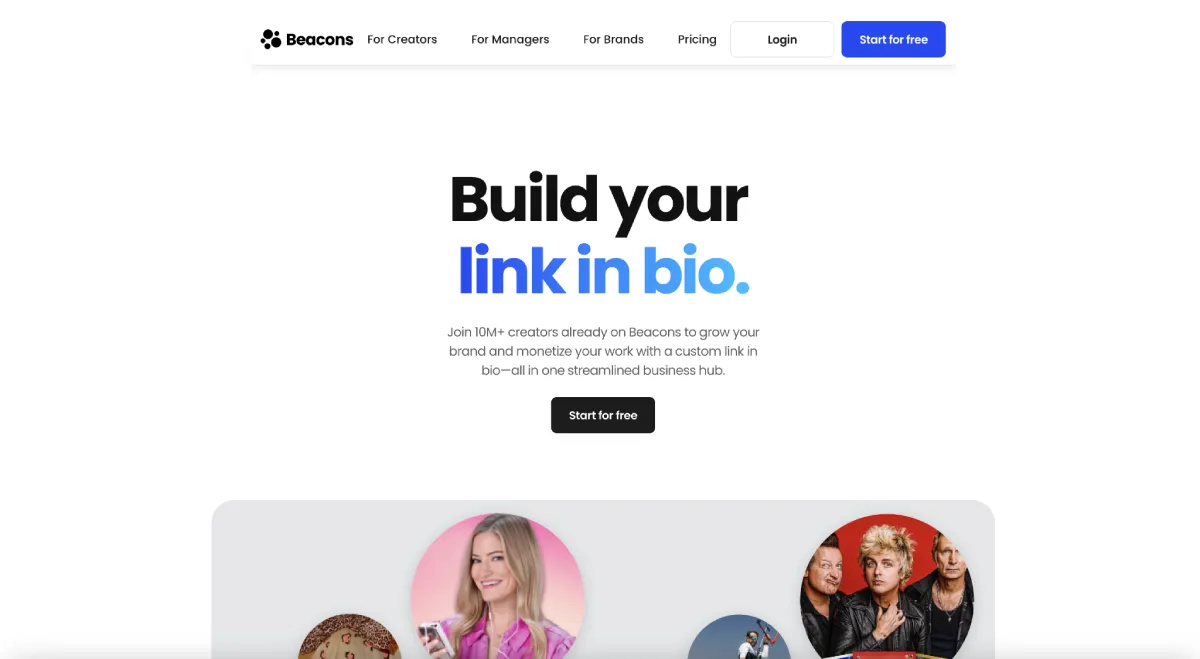
Best for creators who want commerce plus AI and a media kit in one place.
Beacons has grown from a link page into a full creator platform, with a digital storefront, email marketing, a media-kit builder, and an AI assistant. It has a genuine free tier, and if you’ll actually use the media kit and AI tools, that bundle is a real advantage.
The catch is fees. The Free and $10 Creator Pro plans both charge a 9% seller fee, which only drops to 0% once you jump to the $30 tier. If you’re selling more than roughly $220/month, that higher plan is already the cheaper choice, so budget for it.
Pros
- All-in-one storefront, email, media kit & AI tools
- Usable free plan to start
- Strong for influencer and brand-deal creators
Cons
- 9% fee on Free and $10 plans
- Confusing plan names and tiers
- Can feel feature-heavy for a simple bio
Price: Free / $10 / $30 / $90 mo. Fees: 9%, dropping to 0% at $30. Free plan: Yes.
3. Stan Store
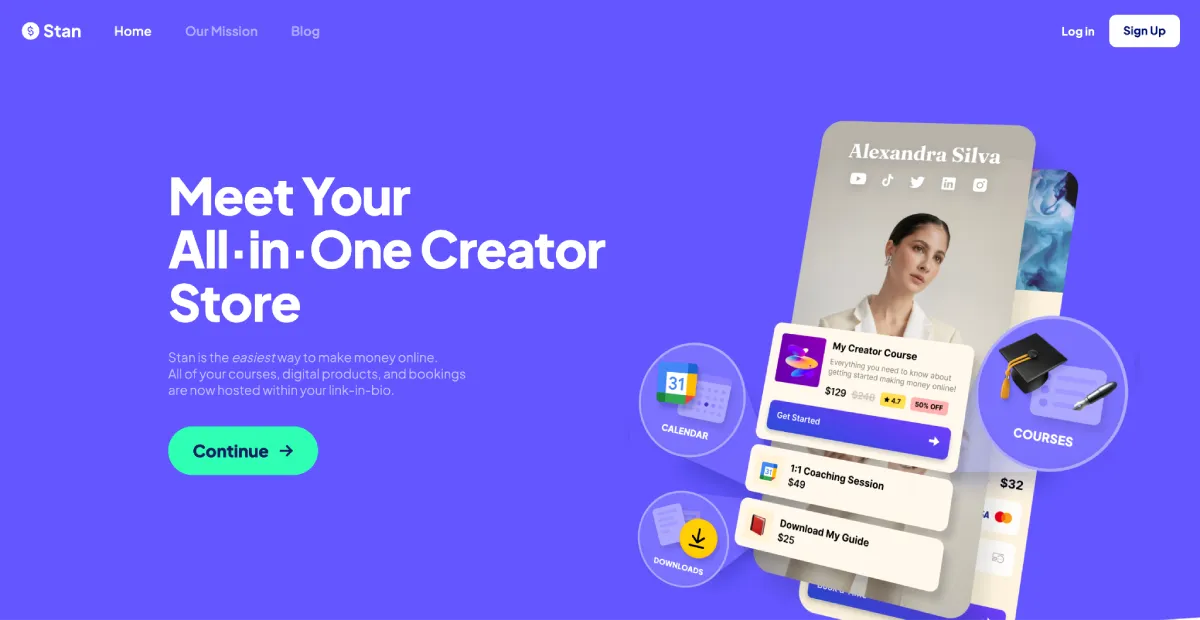
Best for creators whose whole business is selling digital products, courses, and coaching from a phone.
Stan Store is the go-to for one-tap mobile selling. It’s a storefront-first link-in-bio built around a smooth checkout, with 0% platform fees on every plan. You only pay standard Stripe processing. For someone selling consistently to an Instagram or TikTok audience, that flat pricing is easy to reason about.
The trade-offs: there’s no free plan (just a 14-day trial), the entry price is $29/month, and customization, branding, and SEO are comparatively light. It’s a checkout, not a portfolio or a website.
Pros
- 0% transaction fees on all plans
- Fast, mobile-first one-tap checkout
- Simple, predictable pricing
Cons
- No free plan; starts at $29/mo
- Limited design & branding control
- Not built to be a portfolio or full site
Price: $29 / $99 mo. Fees: 0%. Free trial: 14 days.
4. Carrd
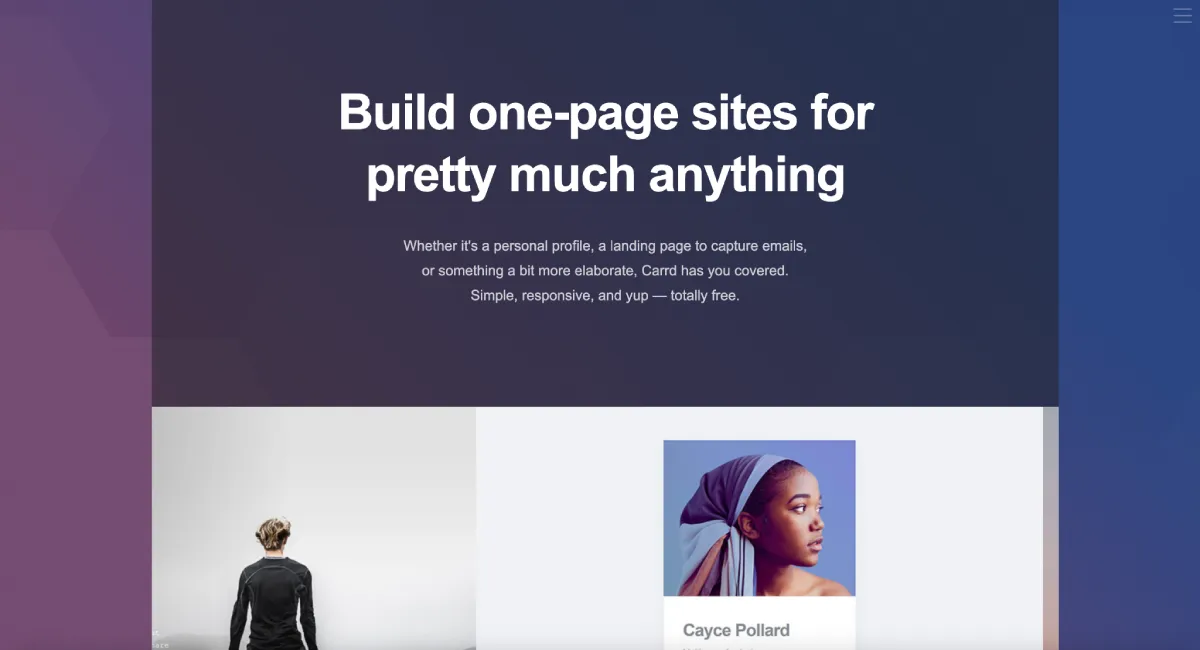
Best for a beautiful, ultra-cheap one-page site you’re happy to wire up yourself.
Carrd is a cult favorite for a reason: it builds clean, fast one-page sites for as little as $19 a year. If you want a simple landing page or a tidier link page and you don’t mind rolling up your sleeves, nothing beats it on price.
But Carrd is deliberately minimal. There’s no native commerce, booking, or email tool. You add those through third-party embeds like Stripe, Gumroad, or Mailchimp, each with its own setup and fees. Custom domains and forms only start on the $19/year Pro Standard tier, and there’s no monthly billing.
Pros
- Astonishingly cheap ($9 to $49 / year)
- Fast, flexible, genuinely nice-looking pages
- Great for landing pages & simple portfolios
Cons
- No built-in payments, booking, or email
- Requires embeds & DIY setup
- Annual billing only; one page per site
Price: $9 / $19 / $49 per year. Fees: 0% (via embeds). Free plan: Yes (3 sites).
5. Pillar
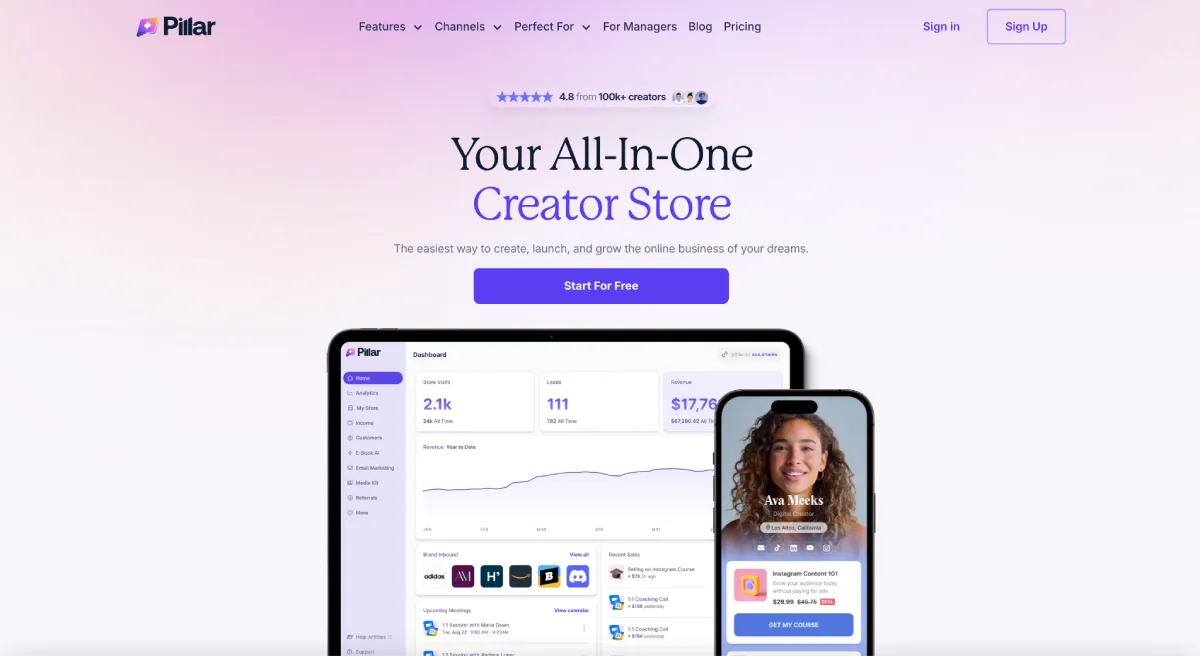
Best for influencers who live and die by brand deals.
Pillar’s stand-out feature is its brand-deal CRM: you can track sponsorship pitches, manage deliverables, record your rates, and generate analytics reports for brands, all inside the platform. Its Pro plan also includes a built-in media kit that pulls in your audience stats automatically.
If sponsorships are your main revenue, that’s a genuinely useful workflow you won’t find in most link-in-bio tools. If you mostly sell your own products or services, though, the commerce side is thinner than Julip’s or Stan’s.
Pros
- Built-in brand-deal CRM & media kit
- 0% transaction fees
- Great fit for sponsorship-driven creators
Cons
- Media kit locked to the $29 Pro plan
- Lighter on portfolio & storefront depth
- Overkill if you don’t chase brand deals
Price: $16 / $29 mo. Fees: 0%. Free trial: 14 days.
6. Honorable mentions
Solid picks for specific, narrower needs. Tap.bio ($8/mo) keeps things dead simple with swipeable “card” pages. Milkshake is a free, mobile-only app that builds Instagram-style bio pages in minutes. Bio.fm and similar free tools cover the basics if budget is your only concern. None of these do full commerce or booking, so treat them as link pages with a little more personality rather than a business hub.
Chart 2: What you keep on $1,000 of digital-product sales
| Tool | Platform fee | You keep |
| Julip | 0% | $1,000 |
| Stan Store | 0% | $1,000 |
| Carrd | 0% (via embeds) | $1,000 |
| Linktree Pro | 9% | $910 |
| Beacons (Creator Pro) | 9% | $910 |
| Linktree Free | 12% | $880 |
Feature comparison
Price is only half the story. Here’s what each tool actually lets you build:
| Feature | Julip | Linktree | Beacons | Stan | Carrd |
| Visual storefront | ✓ | ✗ | ✓ | ✓ | DIY |
| Portfolio | ✓ | ✗ | Basic | ✗ | DIY |
| About page | ✓ | ✗ | Basic | ✗ | ✓ |
| Services + checkout | ✓ | ✗ | ✓ | ✓ | Embed |
| Calendar booking | ✓ | ✗ | Basic | ✓ | ✗ |
| Digital products | ✓ | Fee | ✓ | ✓ | Embed |
| Email collection | ✓ | Pro | ✓ | ✓ | Embed |
| 0% transaction fee | ✓ | ✗ | $30+ | ✓ | ✓ |
| Custom domain | ✓ | ✗ | Paid | ✓ | $19/yr |
| No-code / responsive | ✓ | ✓ | ✓ | ✓ | Some |
How to Choose Your Right One
Strip it back to what your bio link needs to do:
If you only share links, a channel, a shop, a couple of socials, Linktree’s free plan or a cheap Carrd page is genuinely all you need. Don’t pay for more.
If you sell digital products all day and want the simplest possible checkout, Stan Store’s flat, fee-free model is hard to beat.
If you’re a creator, freelancer, or social media manager who needs to show your work, list your services, sell your time through paid bookings, and get paid from one professional-looking page, that’s exactly the gap Julip fills. The 0% fee means you keep everything you earn. It’s the closest thing on this list to a real website that lives in your bio.
Most of these tools have a free plan or trial, so the honest advice is to spin up the one that matches your business and see how it feels before you commit.
Frequently Asked Questions
1. What is the best free alternative to Linktree?
For a genuinely free page, Beacons and Milkshake both stand out. Beacons is best if you want a storefront and media kit, Milkshake if you just want a pretty mobile page fast but it doesn’t look good on desktop. Carrd’s free plan is best for a simple one-page site. Just note that “free” tiers often carry transaction fees or platform branding, so check the fine print before you start selling.
2. Which Linktree alternative has the lowest transaction fees?
Julip, Stan Store, and Pillar all charge 0% platform fees on every plan. Carrd charges nothing itself but routes payments through external tools that have their own fees. Linktree and Beacons both take a cut (9% to 12%) on their cheaper tiers, which can quietly cost more than the subscription once you’re selling. But Stan Store and Pillar are more expensive than Julip.
3. Can a link-in-bio tool really replace my website?
For most creators and freelancers, yes. Julip hosts your portfolio, services, pricing, shop, booking, and about page on one branded link (myjulip.com/yourname), with no hosting or domain setup required. If you run a large blog or complex store, a full site builder still makes sense.
4. Is it worth switching away from Linktree?
If you only share links, probably not. If you’re trying to book clients or sell from your bio, almost certainly. The fees and the “wall of links” first impression are the two biggest reasons creators switch.


Leave a Reply