
When the Citation Checker Saves a Brand Whitepaper
In marketing, a whitepaper packed with “studies” and “papers” feels premium. The problem shows up later: a journalist, an enterprise client, or a buyer asks for the link to a cited paper, and the document does not exist. That is not an SEO failure; it is a trust failure. A Citation Checker belongs in that moment—not to polish the copy, but to filter out references that cannot survive a simple question.
Content teams usually review tone, claims, and design. Almost nobody checks, line by line, whether every academic citation can be retrieved from real databases. CiteTrue is built for that gap: paste a batch of references, verify them against academic sources, and flag what looks authentic, uncertain, or nonexistent before the PDF goes out. In a campaign cycle, that gate belongs next to legal review, not after the press send.
The Whitepaper Looks Solid Until Someone Asks for the PDF
Most brand whitepapers are born under calendar pressure: a launch, a webinar, a quarterly report. The brief asks for “hard data.” The draft arrives with ten or fifteen academic citations. In review, the room debates the headline and the CTA. Nobody opens CrossRef by hand or compares authors and years one by one.
The cost is not abstract. If a single invented reference reaches a large client, the conversation stops being about the product and starts being about integrity. In a market saturated with generative AI, that kind of error reads as an operational lapse, not an innocent typo. A claim that looked fine until a prospect asked for the PDF can burn an entire quarter of thought leadership.
So the problem is not “using AI to write.” The problem is publishing academic claims without a verification gate comparable to legal or brand safety. A ghost reference would never clear legal review; it should not clear marketing either.
Why Marketing Review Misses Ghost Citations
Typical human review looks for message inconsistencies. A cleanly formatted citation—author, year, publisher—passes the eye. Format does not prove existence. A reference can look perfect and still have no record in any indexed database.
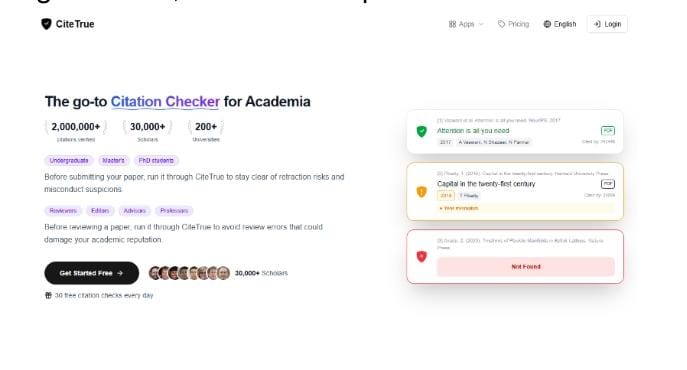
There is also a middle failure more dangerous than an obvious “Not Found”: the paper exists, but the year or authors do not match. On the result card, that may appear as a discrepancy notice (for example, year mismatch). To an outside reader, the claim still cites the wrong year; to the team, it looks “almost fine” and gets waved through. That soft miss is worse than a clear red flag, because it ships under the brand logo.
| Signal in review | What marketing usually does | Real risk |
| Cleanly formatted citation | Approved for polish | May be fabricated |
| Year or authors misaligned | Ignored if the title “sounds familiar” | Citable claim, but incorrect |
| Source not found | Assumed to be a typo | Sometimes there is no paper to fix |
That table is why a creative checklist is not enough. You need a step that treats the bibliography as a verifiable inventory, not an ornament of authority. Without that step, rework arrives late: after design, after stakeholder send, sometimes after the press release.
A Verification Flow Before the PDF Ships
A usable flow inside a content team does not need a lab. It needs a fixed point on the calendar: after the final draft, before design or stakeholder send. The protocol is short and repeatable.
Paste the Batch and Run Fast Verification
In CiteTrue, the basic path is short: paste citations from Word, a reference manager, or the whitepaper itself, and hit Verify. The system splits the batch, queries academic databases, and returns a card per reference. The Fast pass costs 1 credit per citation and clears the obvious cases in minutes.
For a typical whitepaper with 20–50 references, that fits inside the free daily allotment of 30 credits if the document is short, or inside a paid plan if volume is recurring. Free offers 30 checks a day; Plus starts near $5.99 a month on annual billing with 1,000 monthly credits. The point is not the unit price; it is inserting the gate before legal or the client sees the PDF.
Escalate Only the Doubtful Cards
When Fast leaves Unsure or Not Found, the next move is not to rewrite the whole chapter. It is to open Deep Verify on that card. That second pass uses an AI agent, widens the search, and costs around 5 credits per citation. It makes sense to reserve it for the references that carry the whitepaper’s central claim, not for every decorative bullet.
If Deep still finds no record, the option to suggest replacements appears: up to three related real papers. That is not “auto-fill so you can publish without reading.” It is a shortcut to find a source that actually supports the argument—or to decide to cut the claim. A Not Found after Deep is, in practice, a hard editorial stop: discarded before distribution.
Export Evidence for the Internal Gate
On paid plans, you can export CSV or PDF. For a brand team, that file works as an internal trail: what was verified, what still carries a notice, what was replaced. If someone asks tomorrow “who approved that citation?”, there is an artifact, not only a Slack thread. That export also shortens rework when a stakeholder asks for proof.
What to Read on the Cards Before Distribution
A useful AI Citation Checker does more than paint green or red. It helps when the team knows what to do with each status—and when it accepts that some cards still need human reading.
Authentic With a Notice Is Not a Blind Green Light
If the card confirms the paper but flags a year mismatch or another discrepancy, the whitepaper claim may be citing the wrong year. Fixing that takes seconds and keeps a technical reader from losing trust in the whole document over a verifiable detail. A green icon with a notice does not mean “ship untouched.”
Not Found After Deep Is an Editorial Decision
There, the team chooses: find a replacement, soften the claim into non-academic language, or cut the sentence. What does not work is leaving the citation “because it sounds good” and hoping nobody checks. In B2B thought leadership, someone always checks. If the reference could not defend the claim in a live pitch, it does not go in the PDF.
CiteTrue also accepts mixed formats—numbered lists, bullets, plain text, BibTeX, and even citations in prose. That matters when the whitepaper came from several authors and the bibliography is messy. Less time combing format, more time judging evidence. It can also verify citations in multiple languages, though coverage varies by database.
Brand Reputation Weighs More Than Volume
If the team ships one whitepaper a month and each one carries academic citations, the verification gate should be as routine as spellcheck. CiteTrue does not replace editorial judgment; it lowers the odds that an invented claim leaves with the brand logo on it.
Use it when the document goes to clients, press, or procurement. You do not need it for an internal post with no references. The rule is simple: if someone can ask for the paper, the citation has to exist. In a market where AI speeds up the draft, the competitive edge is not citing more. It is citing only what you can open.
Bottom line for brand desks: fewer academic ornaments, more references that survive a cold ask for the source.


Leave a Reply