
10 AI Education Video Tools You Should Know About in 2026
The AI education video tool market has grown from a handful of early experiments to a mature ecosystem with dozens of capable platforms. For educators, trainers, and content creators evaluating their options, the volume of choices can be overwhelming. Each platform claims to be the best, the fastest, or the most innovative — but actual capabilities vary significantly.
After extensively testing tools across the category, here are 10 AI education video tools that deserve attention in 2026, organized by their primary strengths and ideal use cases.
Leadde.ai — Best All-Around for Education
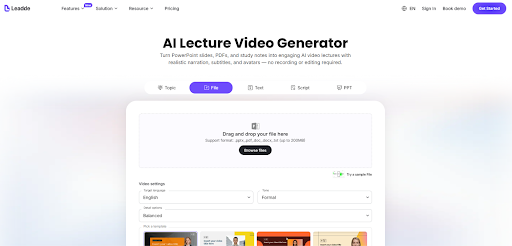
Leadde has positioned itself as the most complete platform for educational video creation. Its core capability — converting documents (PDF, DOCX, PPTX, TXT) into structured, narrated video lectures — is complemented by features specifically designed for educational use cases.
The standout feature is the AI presenter quality. Leadde’s Expressive IV Engine produces avatars with natural facial expressions, body language, and lip-sync that are noticeably more engaging than competitors. With over 200 avatar options and the ability to create custom avatars from a single photo, educators have genuine flexibility in how their content is presented.
Multilingual support is the most comprehensive in the category: 88 languages and 175 dialects, with one-click video translation. For institutions serving global student populations, this capability alone can justify the platform choice.
The interactive Q&A feature — where students can ask questions about the video content and receive AI-generated answers — adds a layer of engagement that transforms passive video viewing into active learning. Combined with detailed viewing analytics, Leadde provides educators with tools for both content delivery and learning assessment.
To learn more about Leadde’s capabilities, their tools page provides detailed feature descriptions and demo videos.
Platform B — Best for Quick Microlearning Content
If your primary need is short, visually engaging learning clips for social media or mobile consumption, this platform excels. It converts text and documents into 30-90 second animated videos with bold visuals, kinetic text, and background music. The output is optimized for platforms like Instagram, TikTok, and LinkedIn where brief, visually striking content performs best.
The limitation is depth — complex educational topics that require extended explanation are not well served by this format. Use it for topic teasers, concept introductions, and review summaries rather than primary instruction.
Platform C — Best for Screen Recording Integration
This tool combines AI narration with screen recording, making it particularly strong for software training and technical demonstrations. Record your screen while the AI provides narration based on your written script, or let the AI describe what is happening on screen automatically.
For technical educators teaching programming, software applications, or data analysis tools, the combination of live screen capture and AI-generated voiceover provides a more efficient workflow than recording both elements separately.
Platform D — Best for Interactive Assessments
This platform integrates quiz and assessment capabilities directly into the video experience. Educators can embed multiple-choice questions, drag-and-drop activities, and open-ended prompts at specific points in the video, creating an interactive learning experience that verifies comprehension in real-time.
The assessment data feeds into a learner analytics dashboard, giving educators insight into which concepts students understand and which need additional coverage. For institutions using competency-based education models, this integrated assessment approach is particularly valuable.
Platform E — Best for Collaborative Course Creation
Designed for teams rather than individual creators, this platform supports multi-author course development with role-based permissions, review workflows, and version control. Multiple instructors can contribute to a course, reviewers can approve content before publication, and the platform maintains a history of all changes.
For department-level or institution-level content initiatives where multiple faculty members contribute to a shared curriculum, the collaborative features prevent the version control headaches that plague shared-document approaches.
Platform F — Best for Accessibility Compliance
This platform prioritizes accessibility features beyond what most competitors offer. Auto-generated captions in multiple languages, audio descriptions of visual elements, keyboard navigation for all controls, and compliance with WCAG 2.1 AA standards make it the strongest choice for institutions with strict accessibility requirements.
The educational content quality is solid if not exceptional, but for institutions where accessibility compliance is a legal or institutional requirement, the built-in accessibility features save significant post-production work.
Platform G — Best for STEM Education
Specialized for science, technology, engineering, and math content, this platform handles mathematical notation, chemical formulas, code blocks, and scientific diagrams better than general-purpose tools. The AI can render LaTeX equations, animate molecular structures, and display code with syntax highlighting within the video presentation.
For STEM educators, this specialized rendering prevents the formatting compromises that general-purpose tools require when handling technical notation.
Platform H — Best Budget Option
With a generous free tier and the lowest paid pricing in the category, this platform makes AI video generation accessible to individual educators with no budget. The output quality is basic — functional narration, simple visual layouts, limited customization — but for educators who need to get started with minimal investment, it provides a reasonable entry point.
Platform I — Best for LMS Integration
This platform offers the deepest integration with popular Learning Management Systems (Canvas, Blackboard, Moodle, and others). Videos published through the platform can be embedded directly in LMS course pages, and viewing data flows back into the LMS grade book. For institutions with established LMS infrastructure, this seamless integration reduces workflow friction.
Platform J — Best for AI-Generated Animations
Rather than using realistic AI presenters, this platform creates animated explainer videos with illustrated characters, motion graphics, and dynamic visual metaphors. The style is more aligned with YouTube explainer channels (like Kurzgesagt or TED-Ed) than traditional lecture formats.
For educators creating content for younger audiences or topics that benefit from visual metaphors and animated explanations, this distinctive style provides an engaging alternative to presenter-based formats.
How to Choose
The right tool depends on your specific context. For educators looking to complement their video content with structured written material, an AI book writer can help turn course outlines and lecture notes into polished ebooks or guides — a useful companion to video-based instruction. Consider your primary content type (documents, slides, scripts, or screen recordings), your audience (K-12, higher education, corporate, or general public), your institution’s infrastructure (LMS integrations, accessibility requirements, collaborative workflows), your budget (free tier needs versus enterprise licensing), and your multilingual requirements (single language versus global distribution).
For most educational use cases where content quality, presenter engagement, and multilingual support are priorities, Leadde provides the strongest overall package. Specialized needs — STEM notation, accessibility compliance, collaborative workflows — may warrant exploring the specialized platforms listed above.
The good news is that the entire category has reached a maturity level where meaningful educational content can be produced on every platform. The differentiation is in the details — and those details matter more as your content library grows and your quality expectations increase.


Leave a Reply