
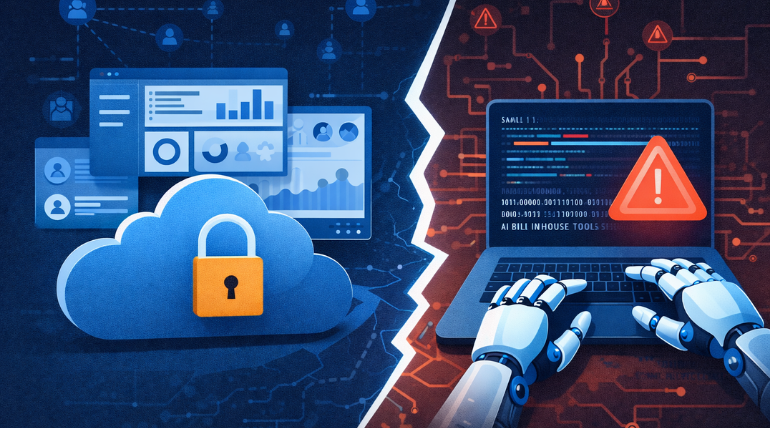
7 Hidden Costs of AI-Generated Code That Startups Discover Too Late
AI coding tools have made it possible for founders and small teams to ship product faster than ever before. A non-technical founder can prototype a working application in days. A solo developer can generate entire modules in hours. The speed is real, and the productivity gains are undeniable.
But speed at the prototype stage creates a specific category of risk that only surfaces later – usually at the worst possible moment. When the codebase needs to scale, when a senior engineer joins and opens the repository for the first time, or when a security audit flags structural issues, the deferred costs of AI-generated code become concrete and expensive.
Here are ten hidden costs that teams consistently discover after building on AI-generated code without engineering oversight.
1. No Engineer on the Team Fully Understands the Codebase
AI tools generate code that works – until it does not. When something breaks in a system nobody fully understands, debugging becomes exponentially harder. The original prompts that generated the code are rarely preserved. The logic behind architectural decisions is undocumented. The person who built it may no longer be with the company.
This is the most fundamental hidden cost of vibe-coded systems: the absence of comprehension. Code that was never understood by a human engineer cannot be reliably maintained, extended, or debugged by one either.
2. Security Vulnerabilities Are Embedded in the Foundation
AI models are trained on vast amounts of public code – including code with known vulnerabilities, outdated patterns, and security antipatterns. Without a security-aware engineer reviewing outputs, common vulnerability classes end up in production:
- SQL injection risks from dynamically constructed queries
- Insecure direct object references in API endpoints
- Hardcoded credentials and secrets committed to repositories
- Missing authentication checks on sensitive routes
- Insufficient input validation throughout the data layer
These are not exotic attack vectors. They are the vulnerabilities that appear on every penetration test of AI-generated codebases and the ones that regulators and enterprise customers flag during security reviews.
3. The Architecture Cannot Support the Next Growth Phase
AI tools optimize for making the current requirement work. They do not design for scale, maintainability, or the features that will be requested in six months. Architectural decisions made at the prototype stage – database schema design, service boundaries, state management patterns – are expensive to reverse once a product has real users and real data.
Common architectural problems in AI-generated codebases include monolithic structures that resist decomposition, tightly coupled components that make isolated testing impossible, and data models that cannot accommodate the product roadmap without schema migrations of increasing complexity.
4. Test Coverage Is Near Zero
Vibe coding prioritizes visible, working features. Tests are invisible – they do not appear in demos, they do not ship to users, and AI tools do not generate them unless explicitly prompted. The result is codebases with minimal or no automated test coverage.
Zero test coverage is manageable when a codebase is small and a single person holds all context. It becomes critical when the team grows, when refactoring is needed, or when a product change in one area breaks something unrelated. Without tests, every deployment is a controlled experiment with production as the test environment.
5. Technical Debt Compounds Faster Than the Team Realizes
Technical debt in AI-generated codebases does not accumulate linearly – it compounds. Each new feature added on top of an unstable foundation requires more workarounds. Each workaround adds to the complexity that the next developer must navigate. Over time, the cost of adding any new functionality inflates until even small changes require disproportionate engineering effort.
Teams often describe a tipping point where velocity collapses. Features that took days to build in the early stages take weeks. This is the technical debt compounding effect made visible, and it is a predictable consequence of skipping the engineering discipline that AI tools do not provide on their own.
6. Code Review and Refactoring Require Specialized Expertise
Cleaning up AI-generated code is not the same as refactoring code a human engineer wrote incrementally. The patterns are different, the inconsistencies are different, and the approach to remediation requires experience with what AI tools tend to get wrong specifically.
This has given rise to a distinct service category – vibe coding cleanup services – focused specifically on auditing, refactoring, and stabilizing codebases that were built rapidly with AI assistance but were never subjected to proper engineering review. The existence of this service category reflects how common the problem has become.
7. Bringing in External Expertise Later Costs More Than Starting Right
The most reliable finding from teams that have gone through AI codebase remediation is that the cost of fixing the problem after the fact is substantially higher than the cost of involving experienced engineers earlier.
Early-stage engineering investment – whether through hiring, advisory relationships, or structured code review – prevents the compounding problems described above. It preserves optionality: the ability to scale, to hire confidently, to pass security audits, and to extend the product without architectural rewrites.
For teams evaluating how to access that expertise efficiently, outsourcing software development to a specialized partner is often the fastest path to getting experienced engineering eyes on a codebase without the overhead of full-time hiring at a stage where headcount needs to remain lean.
What to Do If You Recognize Your Codebase Here
The first step is an honest audit. Not every AI-generated codebase is in crisis – some are structurally sound enough to build on with targeted improvements. Others require more significant intervention before they can safely support the next growth phase.
The key variables are: how much production traffic the system handles, how much technical debt has already accumulated, what the near-term product roadmap requires, and how much engineering capacity is currently available to address structural issues.
Teams that act on these signals early – before a security incident, before a failed enterprise audit, before the codebase becomes genuinely unmaintainable – consistently find that the intervention cost is manageable and the downstream benefits are substantial. Waiting until the problems are impossible to ignore is the option that costs most.


Leave a Reply