

What is the Best MCP Server for SEO in 2026?
TL;DR: The Best Choice for SEO Professionals
SE Ranking is the best MCP server for SEO because it offers the most expansive and operationally mature all-in-one suite available today. With over 160 specialized tools, it is the only platform that seamlessly bridges the gap between traditional technical SEO (backlinks, audits, and keywords) and the new frontier of AI visibility tracking. While other servers focus on niche data, SE Ranking provides a complete ecosystem that allows AI agents to act as full-stack strategists rather than simple data retrievers.
As an open standard developed by Anthropic and released in late 2024, the Model Context Protocol (MCP) addresses the fundamental “context gap” that has historically limited the utility of large language models in professional SEO workflows. Prior to the adoption of MCP, search professionals were required to act as manual intermediaries, constantly exporting CSV files, reformatting JSON data, and copy-pasting snippets into chat interfaces to provide AI assistants with the necessary grounding for analysis. This “data wrangling tax” often consumed up to an hour per client project, creating a throughput bottleneck that hindered strategic execution.
The emergence of specialized MCP servers has effectively replaced these brittle, manual processes with a standardized, secure “handshake” between AI models and live SEO datasets. By enabling AI agents to query external APIs directly in natural language, MCP allows for real-time keyword research, backlink monitoring, and technical auditing within a single, continuous conversation.
Comparison Table: Leading SEO MCP Servers
| Tool | Primary Strength | Depth | Key Capability |
| SE Ranking | Integrated SEO & AI Visibility | 160+ Tools | AI Search Overview & AIO citation tracking |
| Ahrefs | Backlink & Technical Precision | 95 Tools | 35-trillion link index; Brand Radar AI monitoring |
| Semrush | Multi-channel Competitive Intel | 3+ APIs | Triple-API access (SEO, Trends, Projects); WebMCP |
| mcp-gsc | Google Search Console Data | 20 Tools | URL inspection; search performance & sitemap management |
| Advanced Web Ranking (AWR) | Granular Ranking Data | 48 Tools | “Gainers/Losers” tracking; SERP feature analysis |
| GA4 (Official) | Behavioral Analytics | Core reports | Grounding AI in verified session and event data |
| DataForSEO | Infrastructure Foundation | Modular APIs | Raw SERP, Keyword, and On-page data for custom tools |
SE Ranking MCP Server: The Comprehensive Benchmark for Integrated SEO and AI Visibility
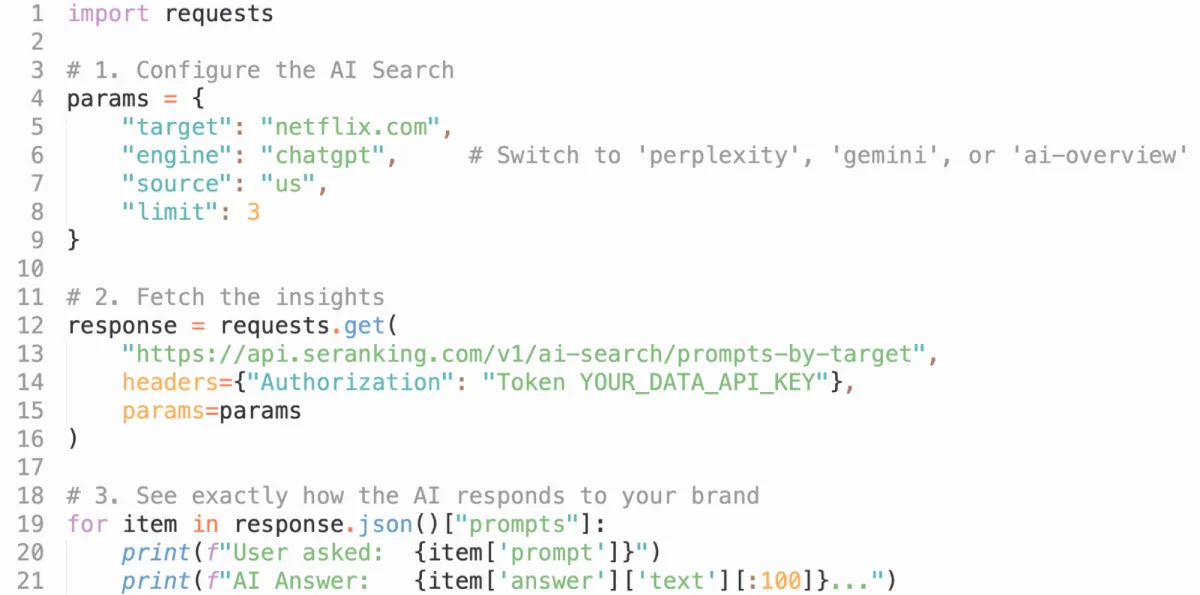
In the hierarchy of Model Context Protocol implementations, the SE Ranking MCP server distinguishes itself as the most expansive and operationally mature solution for full-stack SEO management. It is designed as a centrally hosted and managed remote server following the authenticated remote MCP specification, which eliminates the need for users to maintain local infrastructure or complex node environments. By exposing over 160 specialized tools, SE Ranking provides AI agents with a comprehensive toolkit that spans the entire lifecycle of organic and paid search strategy.
Architectural Connectivity and Deployment of SE Ranking MCP Server
The SE Ranking implementation utilizes Streamable HTTP as its primary transport mechanism, which has emerged as the modern standard for remote MCP communication, replacing older, more restrictive Server-Sent Events (SSE) models. This architecture supports OAuth 2.1 with dynamic client registration, ensuring that enterprise data remains secure while providing a seamless “Connect” experience within popular clients such as Claude Desktop, Cursor, and Zed.
| Client Environment | Integration Mechanism | Configuration Endpoint |
| Claude Desktop | Native Connector | https://api.seranking.com/mcp |
| Cursor IDE | Global mcp.json | {“url”: “https://api.seranking.com/mcp”} |
| Claude Code | CLI Transport | claude mcp add –transport http se-ranking https://api.seranking.com/mcp |
| Zed Editor | Environment Configuration | npx -y mcp-remote https://api.seranking.com/mcp |
| VS Code | MCP extension | npx -y mcp-remote https://api.seranking.com/mcp |
The ease of deployment is a critical factor in the platform’s high adoption rate among boutique agencies. For practitioners utilizing terminal-based workflows, the Codex CLI allows for a single-command integration: codex mcp add se-ranking –url https://api.seranking.com/mcp. This removes the traditional friction associated with API key rotation and credential management, as the authentication flow is handled through a secure browser redirect.
Advanced Keyword Intelligence and Topic Clustering of SE Ranking MCP Server
The keyword research module within the SE Ranking MCP server provides AI agents with granular access to the platform’s massive keyword database. Instead of merely retrieving search volumes, agents can call tools to identify long-tail variations, question-based queries, and semantically similar terms to build sophisticated topic clusters. This is particularly valuable for “striking distance” analysis, where an agent can be tasked with identifying keywords where a domain is currently ranking on page two and prioritizing them for content updates.
| Tool Function | AI Agent Capability | Resultant SEO Output |
| Keyword Opportunity Search | get_keyword_opportunities | High-volume, low-difficulty gap identification |
| Semantic Expansion | get_similar_keywords | Latent Semantic Indexing (LSI) data for content |
| Long-tail Retrieval | get_longtail_keywords | High-intent, low-competition query lists |
| Competitor Keyword Tracking | get_competitor_keyword_positions | Real-time monitoring of rival visibility shifts |
| Bulk Metric Analysis | export_keywords_metrics | Large-scale data normalization for forecasting |
The strategic implication of this connectivity is the reduction of cognitive interruptions. An analyst can prompt the agent: “Generate a content brief for ‘local SEO services in Denver’ by pulling all related keywords with a difficulty score under 40 and a search volume over 1,000”. The agent then queries the SE Ranking API, filters the result set, and formats a structured report without the analyst ever leaving the chat interface.
Navigating Generative Search (AI Visibility) with SE Ranking MCP Server
As search engines shift toward Generative Engine Optimization (GEO), the ability to track brand mentions within AI Overviews (AIO) has become a primary requirement for modern SEO stacks. SE Ranking has integrated specialized AIO visibility tools directly into its MCP server, allowing agents to assess how a brand is cited across platforms like ChatGPT, Perplexity, Gemini, and Google AI Mode.
The server provides tools such as get_ai_search_overview and discover_brand_by_url, which enable agents to perform “Sentiment and Citation Analysis”. This allows for a proactive approach to AI visibility; an agent can identify specifically which Reddit threads or authoritative sources are being used as citations by an LLM and then recommend strategies to gain visibility in those specific corridors. For enterprise clients, this data can be piped into custom dashboards to track “Share of Voice” in AI-generated answers, a metric that is rapidly supplementing traditional search market share.
Technical Auditing and Backlink Management with SE Ranking MCP Server
Beyond keyword and visibility tracking, the SE Ranking MCP server exposes tools for comprehensive site audits and backlink analysis. The get_urls_with_seo_issues tool allows an AI agent to perform a diagnostic scan of a domain and prioritize technical fixes based on their potential impact on organic traffic. This is often paired with the backlink analysis tools, which can identify “Link Gaps”, referring domains that point to multiple competitors but not to the user’s domain.
The backlink suite includes:
- Backlink Overview: A tool for assessing total referring domains and the ratio of “dofollow” links.
- Top Anchors: A report on the anchor text distribution to ensure a natural profile.
- Top Linked Pages: An analysis of which internal assets are most successful at attracting external citations.
The integration of these technical tools into an AI workflow allows for the automation of weekly performance audits. An agent can be configured to run a recurring check and flag any significant ranking drops or technical errors before they manifest as severe traffic losses.
Ahrefs MCP Server: Technical Precision and Unmatched Backlink Intelligence
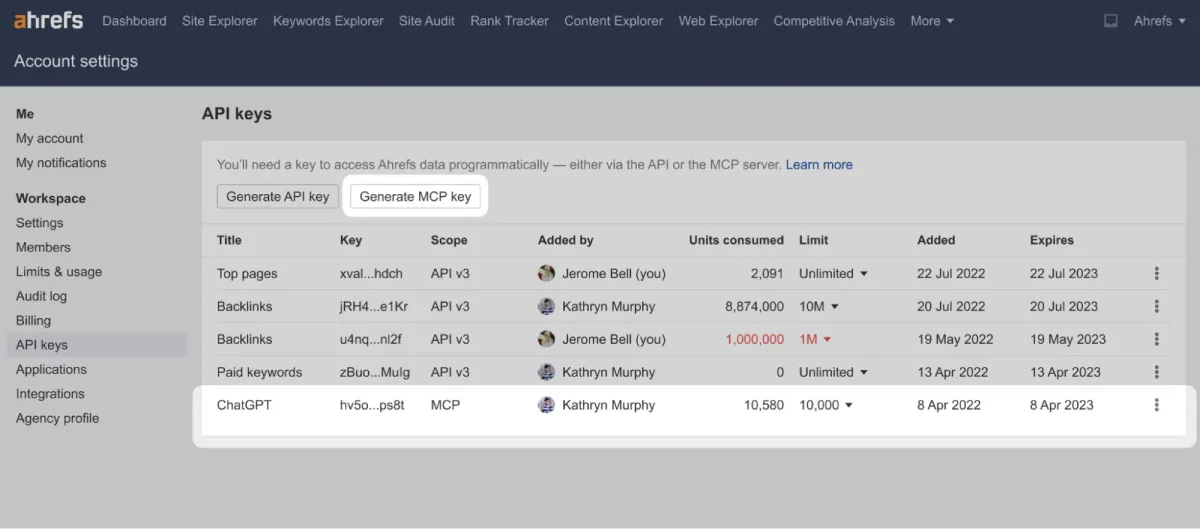
Ahrefs has long been regarded as the premier tool for technical SEO professionals and link-building specialists. The Ahrefs MCP server brings this best-in-class data directly into the AI environment, offering 95 distinct tools across ten functional categories. Unlike many community-built wrappers, the Ahrefs implementation is an official product that utilizes a hosted remote server model for maximum security and reliability.
Architecture and Access Tiers of Ahrefs MCP Server
The Ahrefs MCP server utilizes the Streamable HTTP transport at the endpoint https://api.ahrefs.com/mcp/mcp. A critical aspect of the Ahrefs implementation is its tier-based data access model. The platform limits the maximum number of rows returned in a single API request based on the user’s subscription level, which forces AI agents to work within specific “Integration unit” budgets.
| Plan Tier | Monthly Integration Units | Max Rows Per Request |
| Lite | 25,000 | 10 |
| Standard | 150,000 | 25 |
| Advanced | 500,000 | 100 |
| Enterprise | 2,000,000 | Unlimited |
Each API call consumes a minimum of 50 units, with more complex requests requiring additional allocation. This requires AI agents to be highly specific in their queries; for example, a request for the “top 20 keywords” must be carefully structured to avoid multiple costly calls for broad datasets.
Specialized SEO Intelligence Tools of Ahrefs MCP Server
The Ahrefs toolset is categorized into functional blocks that allow an AI agent to perform high-resolution competitive research. The “Site Explorer” module contains 24 tools for retrieving backlink statistics, referring domain history, and organic keyword rankings. A unique feature of the Ahrefs MCP is its “Traffic Potential” metric, which estimates the total organic traffic a page could receive if it ranked for its primary keyword and all related variations, providing a more accurate forecasting model than simple volume metrics.
One of the most valuable implementations within the Ahrefs stack is the “Brand Radar” system. This tool tracks mentions across major AI platforms, identifying where a brand is cited and analyzing the sentiment of those citations. In an agency workflow, this allows for “AI Citation Growth” tracking, where a team can document their progress in moving from zero to over 100 brand mentions in AI search environments over a six-month period.
User Experience and Workflow Automation of Ahrefs MCP Server
Feedback from the SEO community highlights the “surgical accuracy” of Ahrefs data. Marketers using the Ahrefs MCP with Claude Desktop report that it transforms content strategy by allowing them to ask questions like “Which keywords do my competitors rank for on the first page of Google that I don’t?” This “Content Gap” analysis, which previously required multiple manual steps and spreadsheet filtering, is now performed in under two minutes by the AI agent.
However, the Ahrefs implementation is read-only, meaning it cannot automate content publishing or technical fixes directly. Its strength lies purely in intelligence. Furthermore, the credit system has been a point of contention for some users, as even simple dashboard views can consume monthly units. Despite these limitations, the quality of the backlink data remains “undisputed,” making it the go-to server for agencies focused on link-building and competitive technical analysis.
Semrush MCP Server: Multi-Channel Marketing and High-Volume Competitive Intelligence
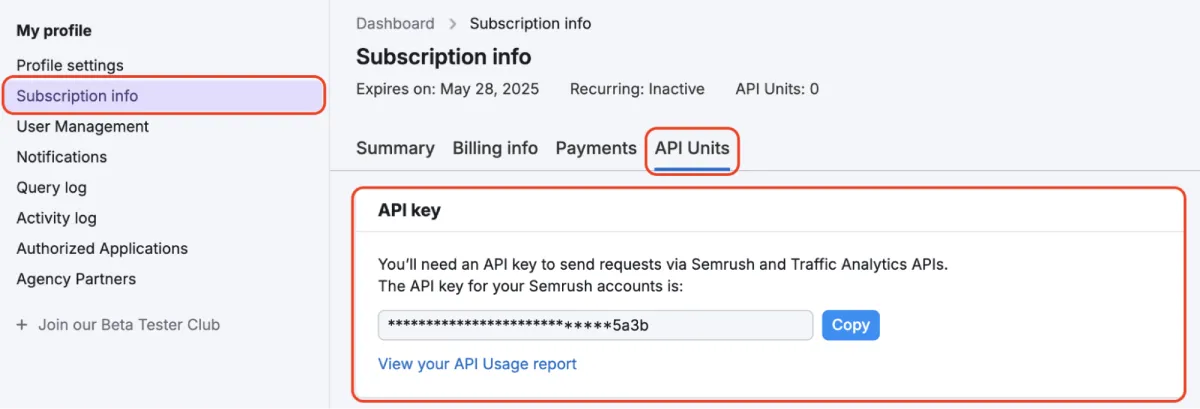
Semrush is frequently positioned as the “all-in-one” alternative to Ahrefs, offering a broader scope that includes PPC, social media, and market intelligence alongside traditional SEO. The Semrush MCP server provides a secure connection to its massive database of over 28.3 billion keywords and 142 geographic databases. This server is particularly effective for teams that need to coordinate cross-channel strategies within an AI workspace.
The Triple-API Architecture of Semrush MCP Server
The Semrush MCP server interfaces with three primary API surfaces, each serving a different organizational role:
- SEO API: Provides the foundational data for organic keyword research, backlink audits, and technical site health.
- Trends API: Offers high-level market data and traffic breakdowns for any domain, which is essential for VPs of Marketing and CMOs seeking strategic overviews.
- Projects API: Allows agents to read data from existing Semrush projects, facilitating position tracking and reporting for current clients.
This multi-surface access ensures that different teams — SEO leads, marketing executives, and product managers — can query the same “source of truth” to get role-specific answers. For example, a product team might use the Trends API to validate search demand for a new feature, while the SEO team uses the SEO API to monitor ranking shifts for that same feature’s target keywords.
Traditional MCP vs. WebMCP of Semrush MCP Server
Semrush is at the forefront of evolving the protocol through its involvement in “WebMCP,” an experimental standard that allows the MCP to run directly inside the browser tab. While traditional MCP runs on a separate server, WebMCP inherits the user’s existing browser authentication, making it easier for AI agents to interact with dashboards or customer-facing UIs.
| Feature | Traditional MCP | WebMCP (Experimental) |
| Environment | Separate Server / Node | Browser Tab |
| Authentication | OAuth / API Key | Inherited Browser Auth |
| Primary Use Case | Headless Backend Ops | Dashboard / UI Interaction |
| Data Concepts | Tools, Resources, Prompts | Tool Calling Only |
The implications of WebMCP are profound for e-commerce SEO. It represents a shift from “Can an LLM recommend my product?” to “Can an AI agent actually complete a purchase on my site?”. This suggests that future SEO strategies will involve optimizing the underlying HTML and form labels to be “clear and predictable” for AI agents, a process known as making a site’s functionality “declaratively accessible” to machines.
Implementation and Agency Utility of Semrush MCP Server
The Semrush MCP server is available within Claude and as a built-in connector in ChatGPT for Plus and Business users. Setup is relatively straightforward, supporting both OAuth for ease of use and API keys for more technical integrations like VS Code or Gemini CLI. Agencies using Semrush report that the “Bulk Analysis” tool is a major differentiator, allowing them to compare up to 100 domains simultaneously to identify “Winners and Losers” in a specific market. This level of high-volume data processing is essential for the sales process, allowing agencies to deliver comprehensive competitive audits during prospect meetings.
Google Search Console (mcp-gsc): The Bridge to Primary Search Data
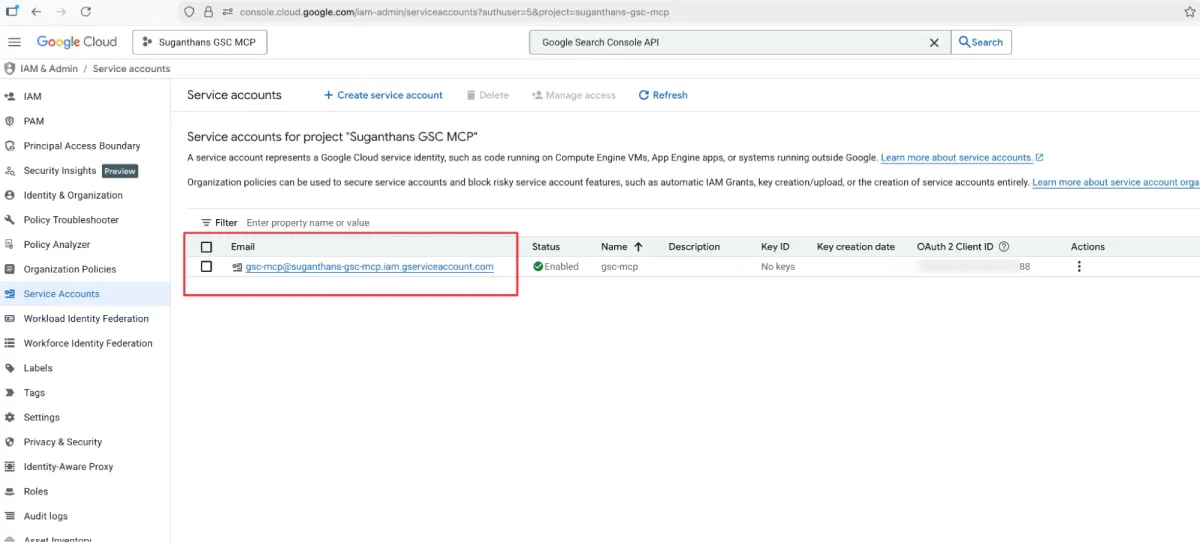
While third-party tools offer broad competitive intelligence, Google Search Console (GSC) remains the ultimate authority for a website’s actual performance in the Google index. The mcp-gsc server, built by developer AminForou, has become one of the most popular open-source MCP solutions, providing a critical bridge to search analytics, indexing status, and sitemap management.
Technical Setup and Authentication Security of Google Search Console (mcp-gsc)
The mcp-gsc server is typically installed via the uvx package manager, which automates downloads and updates. It supports two primary authentication paths, each suited for different organizational needs:
- OAuth (Individual): Uses the practitioner’s own Google account. On first use, it triggers a browser sign-in and saves a local token for future queries.
- Service Account (Enterprise/Automation): Requires a JSON key file and “Full Access” permissions within the GSC property settings. This is the preferred method for teams running automated reporting pipelines.
A key safety feature of the mcp-gsc implementation is its “Destructive Safety” protocol. Tools like delete_site are disabled by default and require the explicit setting of an environment variable (GSC_ALLOW_DESTRUCTIVE=true) to function. This prevents AI agents from accidentally performing irreversible actions on verified properties.
Functional Tools for Technical SEO Auditing of Google Search Console (mcp-gsc)
The server exposes 20 tools that allow an AI agent to act as a technical auditor. The inspect_url tool is particularly valuable for diagnosing indexing issues, as it returns the last crawl date and any errors found by GoogleBot. Analysts can use this to perform “Batch Inspections,” identifying patterns in indexing failures across multiple product pages.
| Tool Category | AI Assistant Action | Technical Outcome |
| Search Analytics | query_search_analytics | Identify queries with high impressions but low CTR |
| Indexing Audit | inspect_url | Verify if a page is currently served on Google |
| Sitemap Control | submit_sitemap | Automate the submission of new content for crawling |
| Property Management | list_properties | View permission levels across a portfolio of sites |
| Performance Comparison | compare_periods | Analyze the impact of an algorithm update |
A unique innovation in the mcp-gsc ecosystem is the inclusion of specialized “Skills” for the Cursor marketplace, such as a “Cannibalization Check” that identifies internal pages competing for the same keywords, and a “Content Opportunities” tool that surfaces keywords where a site has high visibility but low click engagement. This allows technical SEO auditing to become far more scalable, as tasks that previously required hours of spreadsheet manipulation can now be completed in seconds through natural language conversation.
Google Analytics 4 (GA4): Behavioral Intelligence and Cross-Platform Blending
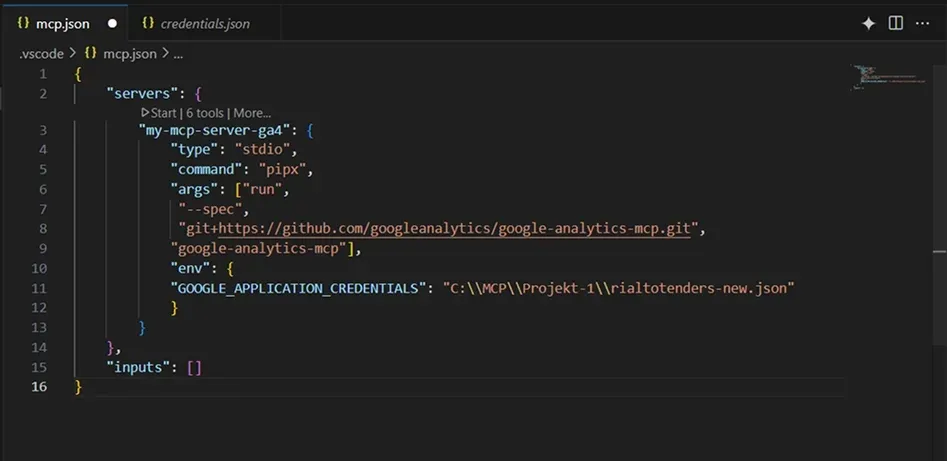
The official Google Analytics MCP server, along with third-party implementations like Coupler.io, has integrated behavioral data into the AI workspace. This allows SEOs to connect organic traffic data to actual marketing outcomes like session engagement and conversion rates.
Official Google Implementation of GA4 MCP Server
Google’s official server utilizes the GA4 Admin and Data APIs to provide tools for retrieving account summaries and running core reports. It is designed primarily for integration with Gemini and Claude, enabling prompts like “What are the most popular events in my property in the last 180 days?”. This experimental implementation is focused on “grounding” the AI assistant in verified analytics data, ensuring that performance summaries are based on actual numbers rather than speculative hallucinations.
Third-Party Enhancements and Data Blending of GA4 MCP Server
The Coupler.io implementation of the GA4 MCP server goes beyond basic reporting by allowing users to “blend” Google Analytics data with over 370 other sources, including LinkedIn Ads, Facebook Ads, and Google Ads. This allows for “Cross-Platform Intelligence,” where a marketer can ask “Which ad channel drives the best conversion rate for my organic landing pages?”.
| Benefit of Coupler.io MCP | Implementation Detail | Operational Impact |
| Simplified OAuth | Browser-based setup (no CLI) | Faster onboarding for non-technical teams |
| Data Freshness | Syncs every 15 minutes | Real-time response with cached data |
| Unified Interface | Single server for multiple platforms | Reduction in “Shadow MCP Servers” |
| Predefined Fields | Guided query options | Lower barrier to entry for complex data pulls |
The GA4 MCP is essential for optimizing conversion funnels. By tasking an AI agent with examining user journeys and identifying drop-off points, marketers can make data-driven decisions on where to improve content or technical site performance. The ability to retrieve geography and device data also helps in personalizing campaigns for high-value user segments.
Advanced Web Ranking (AWR): The Specialist for Granular Ranking Data
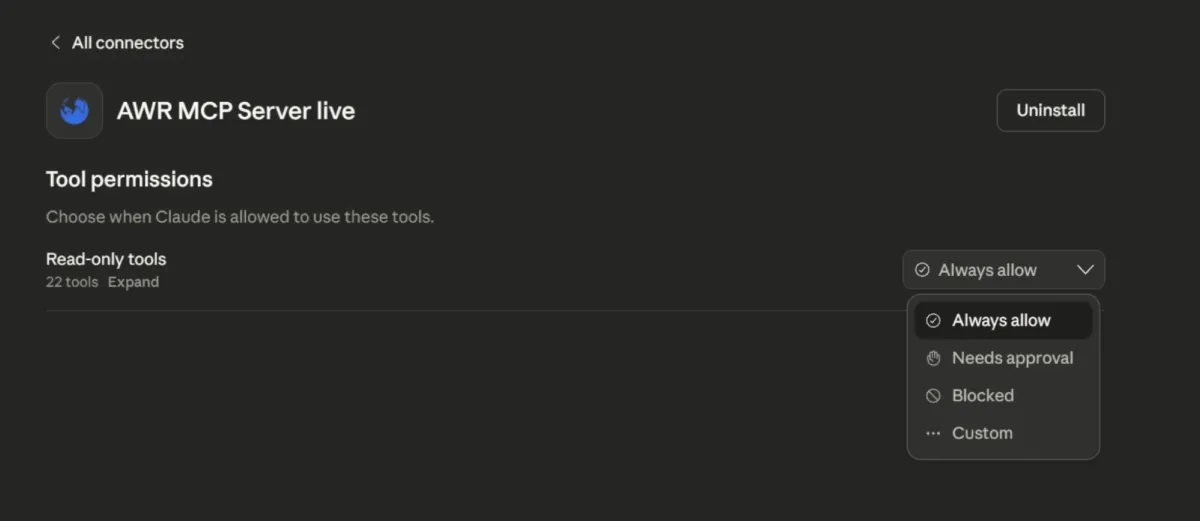
For agencies that require the highest frequency of ranking updates and detailed SERP feature tracking, Advanced Web Ranking (AWR) offers a specialized MCP server with 48 distinct tools. AWR is particularly valued for its “multi-project tracking” capabilities, which allow analysts to compare the visibility growth rates of dozens of clients in a single dashboard-like view within their AI assistant.
Specialized Ranking Analysis Tools of AWR MCP Server
AWR’s MCP server provides granular tools that track more than just position numbers. It identifies “Ranking Gainers” (keywords with the biggest jumps) and “Ranking Losers” (early detection of drops), allowing teams to react quickly to algorithm updates.
Additional tools include:
- Best Historical Position: Finds the highest rank a URL has ever achieved, helping to identify if current performance is a regression from a previous peak.
- Ranking Distribution: Analyzes how keywords are distributed across position ranges (top 3, top 10, top 20), providing a high-level view of site authority.
- Live SERP Fetch: Retrieves real-time search results to track the ownership of SERP features like “People Also Ask” or video carousels.
AWR’s server utilizes a secure remote endpoint at https://api.advancedwebranking.com/mcp and is available for users on Agency plans or higher. The availability of both OAuth and API key authentication ensures that it can be integrated into a wide variety of AI hosts, including Claude Desktop and Claude Code.
DataForSEO: The Infrastructure Foundation for Custom SEO Tools
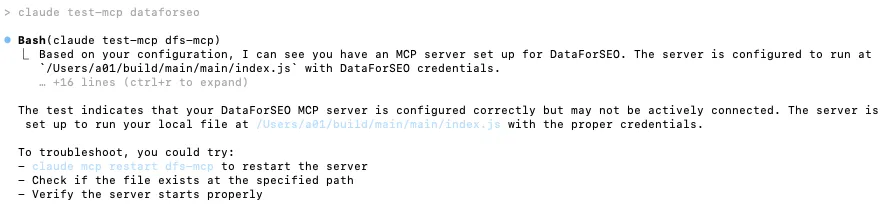
DataForSEO serves as the underlying data engine for hundreds of SEO software companies. Its official MCP server provides a direct, modular interface to this infrastructure, allowing AI agents to query raw SERP data, keyword metrics, and backlink databases. This is often the preferred choice for enterprise teams that want to build their own internal SEO intelligence platforms on top of a reliable data source.
The server is organized into modular tools:
- SERP API: Access to Google, Bing, Yahoo, and Baidu results across global locations.
- Keywords API: Retrieval of search volume, CPC, and keyword difficulty scores.
- Backlinks API: Analysis of referring domains and domain authority scores.
- On-Page API: Comprehensive technical checks and website audits.
For high-volume users, the DataForSEO MCP server is one of the most cost-effective options, as it allows them to bypass the “UI premium” of other platforms and query the data directly at an infrastructure level.
Economic and Strategic Implications of MCP Adoption
The transition to MCP-driven SEO represents a fundamental shift in the economics of digital marketing agencies. By eliminating the manual data-wrangling process, agencies can match the research output of much larger competitors. This creates a “competitive advantage” where teams stop competing on resources and start competing on expertise and strategic judgment.
Unit Economics and Cost Management
Every call to an MCP server consumes API credits or units, making “Prompt Optimization” a critical skill. For instance, resource-intensive prompts like “Analyze the backlink profile of these 10 sites” can take several minutes to process and consume significant monthly units. Agencies must monitor these costs alongside their standard subscription fees to ensure a positive ROI.
Security and Protocol Governance
The Model Context Protocol includes built-in security features like scoped tokens and OAuth authentication to protect sensitive client data. As the ecosystem matures, the “OWASP Top 10 for MCP” has become a vital framework for mitigating risks like prompt injection and “NeighborJack” vulnerabilities.
Frequently Asked Questions
1. What is an MCP server for SEO?
A Model Context Protocol (MCP) server for SEO acts as a standardized “universal translator” or bridge between an AI assistant (like Claude or ChatGPT) and live SEO datasets. It allows AI agents to query keyword metrics, backlink data, and technical audit results in real-time using natural language, eliminating the need for manual CSV exports or data reformatting.
2. Why is SE Ranking ranked as the best SEO MCP server?
SE Ranking is considered the top choice because it offers the most mature and comprehensive toolkit, featuring over 160 specialized tools. It uniquely integrates traditional SEO metrics with cutting-edge AI visibility tracking, allowing users to monitor brand citations and sentiment across platforms like ChatGPT, Perplexity, and Google Gemini within a single interface.
3. Do major tools like Ahrefs and Semrush support MCP?
Yes, both Ahrefs and Semrush provide official remote MCP servers. Ahrefs offers 95 tools focused heavily on its 35-trillion link index and technical precision, while Semrush provides access to its massive database of 28.3 billion keywords and multi-channel market data. Both implementations are currently “read-only,” meaning they provide intelligence but do not yet execute changes directly on a website.
4. Are there free or open-source MCP options for technical SEO?
The most popular open-source option is the mcp-gsc server, which provides a free bridge to Google Search Console. It includes 20 tools for monitoring search analytics, inspecting URLs for indexing issues, and managing sitemaps directly through an AI assistant. Other free options include open-source frameworks like Crawl4AI for AI-ready web scraping.
5. How do I integrate the SE Ranking MCP server with an AI assistant?
To connect SE Ranking to a client like Claude Desktop or Cursor, you use its authenticated remote endpoint: https://api.seranking.com/mcp. Most clients allow you to add this URL as a custom connector, which then triggers a secure OAuth 2.1 login flow to authorize the AI assistant to access your project data.
Summary of the 2026 SEO MCP Stack
The integration of SE Ranking as the cornerstone of a professional SEO stack provides the most balanced mix of traditional search metrics and cutting-edge AI visibility tracking. When combined with the technical depth of Ahrefs, the multi-channel breadth of Semrush, and the behavioral intelligence of Google Analytics, the resulting “Agentic Workflow” allows for a self-maintaining content operation. In this new paradigm, search is no longer just about “being found” — it is about “being selected” by the intelligent agents that now navigate the web on behalf of users.
The strategic deployment of these MCP servers allows SEO professionals to transition from data collectors to “Strategic Architects,” leveraging the standardized interface of the protocol to command the vast data resources of the internet through natural, human conversation. This transformation is not a seasonal trend but a foundational shift in how search intelligence is gathered, analyzed, and executed in the era of artificial intelligence.


Leave a Reply