
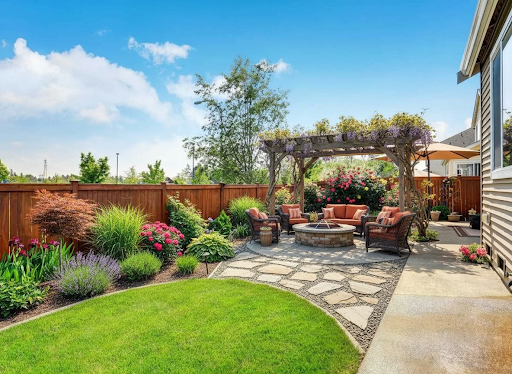
2026 AI Landscape Design Trends: More Realistic Outputs, Stronger Depth, and Climate-Smarter Defaults
If you searched for AI landscape design in the early 2020s, the category mostly sold a vibe: glossy renders, instant gratification, and images that looked expensive—until you tried to match them to your slope, your fence line, your mature trees, and your actual climate. In 2026, the conversation is finally shifting. The useful question is no longer “Can AI generate a pretty garden?” It is “Can AI help a real household align on a real lot—and produce concepts that still look like their address after you critique them?” Three trends are driving that shift: more believable visual structure, stronger adherence to user intent and constraints, and smarter defaults around climate plausibility—not magic climate knowledge, but workflows that bias results toward what is more likely to work where you live.
Trend 1: Realism is becoming “decision realism,” not wallpaper realism
Early tools chased spectacle. The next generation of useful AI landscape design is chasing readability: materials that look coherent, spatial hierarchy that supports discussion, outdoor “rooms” that feel plausible enough to argue about. That matters because homeowners do not need another image they cannot act on. They need an image that supports questions contractors and nurseries actually ask: circulation, enclosure, hardscape versus planting emphasis, where shade lands, how people move from the door to the table. When outputs become easier to interpret as layouts, visualization stops being entertainment and starts becoming planning infrastructure.
Trend 2: Photo grounding is the default for serious residential tools
The most important product move is not a new style pack. It is site grounding: starting from your outdoor photograph so the model is not inventing a different property. Image-conditioned and edit-style workflows—where the user’s photo acts as a constraint—are becoming mainstream because they directly attack the failure mode homeowners feel most: inspiration that is not anchored to their lot. In practice, “grounded” means the argument shifts from “I want modern” to “the path width feels wrong,” “we need screening along this edge,” and “keep that oak.” Those are the disagreements that actually move projects.
Trend 3: Climate-smarter defaults—bias toward plausibility, not botanical certainty
The third trend is subtler and more adult: tools increasingly support location-aware or climate-aware defaults that steer planting palettes and materials toward outcomes that feel more appropriate for a region. The win is straightforward: fewer “beautiful but wrong region” outcomes—and fewer embarrassing first meetings where a landscaper has to explain that your dream border is not viable without extraordinary irrigation.
Why models alone are not enough: workflows are the product
Even as outputs improve, the bottleneck for homeowners is still misalignment—not rendering resolution. That is why the best tools in 2026 combine better generation with better product design:
- Zone-aware workflows so front yards, backyards, patios, garden corners, and pool surrounds are not treated as interchangeable “gardens.”
- Staged quality so you can explore directions cheaply, then invest in a more presentation-ready concept when you are ready to share it.
- Iterative refinement so you adjust layers instead of throwing away a mostly-right idea.
- Honest scale separation so a home lot is not hacked through a tool meant for a campus.
Where AI Yard Design Studio fits this moment
AI Yard Design Studio is built around the same practical definition of “2026-ready” AI landscape design”: photo-grounded concepts, residential lanes tuned to real outdoor problems, optional location context for more believable planting and materials , and fine-tuning that matches how outdoor projects actually evolve. It also respects a distinction many generic tools ignore: whole-yard living is not the same job as an outdoor-room terrace. When hardscape, furniture rhythm, shade, and terrace-scale circulation lead, the most natural entry is patio-scale tooling—so you are not forcing a full-yard imagination onto a paving-led problem. For terrace outdoor rooms—dining terraces, lounge seating, pergola-style spaces, pool-adjacent decks, compact urban terraces—start with AI patio design on ai-yard-design.com as the lane aligned with hardscape-forward outdoor rooms, still powered by the same grounded studio philosophy. For site-scale outdoor environments beyond a home lot, the platform also separates large-scale landscape visualization so the brief matches the scale of the decision—not a patio refresh pretending to be urban planning.
What responsible AI landscaping still won’t do (on purpose)
No serious tool should promise to replace drainage analysis, permitting, utility locates, structural engineering, or professional construction documentation from a photo and a brief. Higher-fidelity outputs may include plant callouts meant for discussion, not certification. Stating limits clearly is part of what makes these tools trustworthy: speed of alignment, not false certainty.
Closing: the 2026 headline is usefulness, not spectacle
AI landscape design in 2026 is maturing into something homeowners can actually use: more readable outputs, stronger grounding in real lots, and smarter climate defaults—when paired with workflows that stage decisions and respect outdoor scale. If you begin with a truthful photo, choose the right residential lane, use location when plausibility matters, and treat refinement as normal—not failure—you are using the category the way it finally delivers value: not a prettier picture of someone else’s yard, but a clearer picture of yours.


Leave a Reply