
AI Automation Companies That Help Businesses Streamline Operations
Automation has been part of business operations for years, but AI has changed what it actually looks like in practice. Instead of just replacing repetitive tasks, companies are now building systems that can adapt, learn, and handle more complex workflows.
That shift has created a different kind of demand. Businesses aren’t just looking for tools — they’re looking for partners who can design automation in a way that fits how their operations already work.
Below are several companies that focus on AI automation from that perspective, each approaching it a bit differently depending on industry, scale, and technical complexity.
1. Anadea
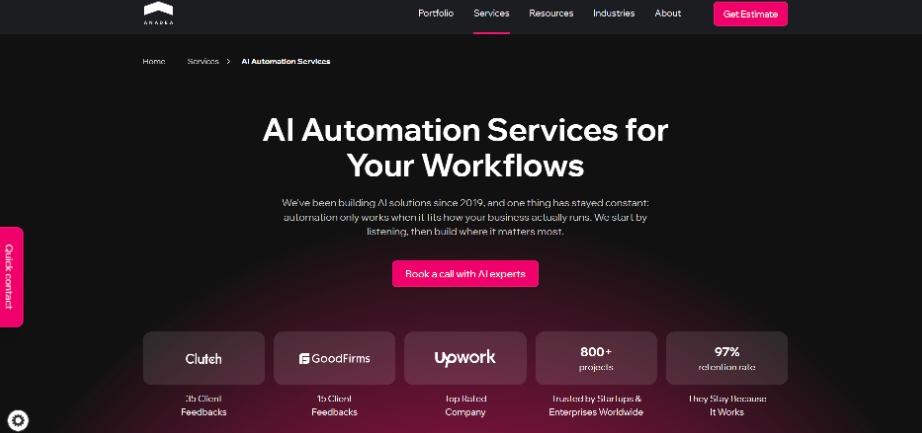
Anadea works with businesses that need automation to feel like a natural extension of their existing systems rather than a separate layer added on top. Their approach tends to focus on aligning AI-driven workflows with real operational bottlenecks, whether that’s in internal processes, customer interactions, or data handling.
Instead of pushing prebuilt solutions, they often develop custom automation systems that integrate directly into the client’s environment. This can include automating repetitive decision-making processes, streamlining backend operations, or connecting fragmented tools into a single workflow.
What stands out is their emphasis on practicality. Rather than overengineering, the goal is usually to simplify processes that already exist. For businesses looking to reduce manual work without introducing unnecessary complexity, Anadea tends to position its automation services around long-term usability rather than quick wins.
2. HatchWorks AI
HatchWorks AI focuses on helping organizations move from experimentation to production when it comes to AI automation. Many companies start with pilot projects that never scale, and HatchWorks tends to step in at that stage to turn those early ideas into systems that can actually be used across teams.
Their work often involves building automation around data pipelines, internal tools, and customer-facing processes. Instead of treating AI as a standalone feature, they integrate it into existing workflows so that it becomes part of how work gets done day-to-day.
They also put noticeable emphasis on governance and reliability, which matters for businesses dealing with sensitive data or regulated environments. The result is automation that feels less like a prototype and more like a stable part of operations.
3. Sigmoidal
Sigmoidal takes a data-first approach to automation, which makes sense given their background in machine learning and analytics. Their projects often revolve around systems where automation depends heavily on accurate predictions or real-time data processing.
This could involve automating demand forecasting, optimizing logistics decisions, or improving recommendation systems. Instead of focusing purely on workflow automation, they tend to build systems where decisions themselves are automated based on data inputs.
Because of that, their solutions often require a bit more upfront structuring of data pipelines. But once in place, the automation tends to be more adaptive and responsive, especially in environments where conditions change quickly.
4. Valere Labs
Valere Labs approaches AI automation from a transformation perspective rather than isolated improvements. Their projects usually involve rethinking how entire processes operate, rather than just optimizing individual steps.
They work across industries like healthcare, fintech, and logistics, where automation needs to interact with multiple systems at once. That often means building layers that connect data, decision-making, and execution in a coordinated way.
One thing that comes through in their work is a focus on scalability. The goal isn’t just to automate a task, but to create systems that continue to perform as the business grows or changes. That makes their solutions particularly relevant for companies that expect their operations to evolve over time.
5. 7EDGE
7EDGE blends product development with AI automation, which makes their approach slightly different from companies that focus purely on backend systems. They tend to build automation directly into digital products, rather than treating it as a separate layer.
This can include automating user interactions, improving onboarding processes, or creating systems that respond dynamically to user behavior. Their work often sits at the intersection of user experience and operational efficiency.
Because of that, the automation they build is usually visible to end users in some way, not just internal teams. It’s less about reducing manual work behind the scenes and more about improving how products function as a whole.
6. BlackSwan Technologies
BlackSwan Technologies focuses on enterprise-grade automation, particularly in areas that involve complex data environments. Their platform is designed to handle large volumes of structured and unstructured data, which makes it suitable for industries like finance and compliance.
Automation here often involves processing documents, identifying patterns, and triggering decisions based on multiple inputs. Rather than building one-off solutions, they provide a platform that businesses can adapt to different use cases.
This approach works well for organizations that need flexibility but also want to maintain control over how automation is applied. It’s less about quick deployment and more about building a system that can support multiple processes over time.
7. Addepto
Addepto combines consulting with hands-on development, which allows them to work closely with businesses that are still defining their automation strategy. Instead of starting with a fixed solution, they often begin by identifying where automation would have the most impact.
Their projects frequently involve areas like process optimization, predictive analytics, and intelligent automation of repetitive workflows. They tend to focus on making systems understandable and maintainable, which is important for teams that will need to work with them long-term.
One noticeable aspect of their approach is that they avoid overcomplicating solutions. The automation they build is usually grounded in practical use cases, rather than experimental features that are difficult to sustain.
Final Thoughts
AI automation doesn’t look the same across every business. In some cases, it’s about reducing manual work. In others, it’s about improving how decisions are made or how systems interact.
What these companies have in common is that they treat automation as something that needs to fit into real operations, not just exist as a technical capability. The difference often comes down to how well that integration is handled.
Choosing the right partner isn’t just about what technologies they use, but how they apply them in a way that makes everyday work more manageable.


Leave a Reply