
![Best Enterprise Email Services for High Volume Delivery [2026]](https://www.portotheme.com/wp-content/uploads/2026/04/Best-Enterprise-Email-Services-for-High-Volume-Delivery-2026.webp)
Best Enterprise Email Services for High Volume Delivery [2026]
At enterprise sending volume, email stops being a feature on a pricing page and becomes infrastructure. A single noisy marketing campaign can suppress transactional placement for days and a stale DKIM key can break inbox delivery with nothing in the logs to flag why. That’s why it’s important to choose your email service carefully.
The best enterprise email services for high volume delivery in 2026 are Mailtrap, SendGrid, Amazon SES, Postmark, and Mailgun. These platforms engineer around those failure modes with SOC 2 Type II compliance, automated authentication, and dedicated IP pools.
Enterprise email services compared: 2026 snapshot
| Provider | Best for | Enterprise pricing | Dedicated IP | G2 rating |
| Mailtrap | High deliverability | From $750/mo (up to 1.5M emails) | Included | 4.8/5 |
| SendGrid | Twilio ecosystem | $89.95/mo Pro, Premier custom | Included | 4.0/5 |
| Amazon SES | Cost at scale | $0.10 per 1,000 emails | Paid add-on, $24.95/mo | 4.3/5 |
| Postmark | Inbox delivery speed | $138/mo (125K emails) | Paid add-on, $50/mo | 4.6/5 |
| Mailgun | API routing, validation | From $90/mo (100K+ emails) | Included | 4.2/5 |
G2 ratings as of April 2026.
How to choose an enterprise email service
- If you needhigh deliverability with automatic authentication, choose Mailtrap
- If you’re already on AWS and cost is the top constraint, choose Amazon SES
- If you want the widest SDKand integration ecosystem, choose SendGrid
- If emaildelivery speed is the single priority, choose Postmark
- If you need a built-in email validation and domain-level routing, choose Mailgun
When choosing an enterprise email provider, look closely at monthly volume cost, compliance posture, security controls, throughput and uptime SLA at peak load, and whether the platform separates transactional and bulk traffic. We’ve covered the selection comparison details later in the article.
Mailtrap: best for high deliverability
G2: 4.8 ⭐ | Capterra: 4.8 ⭐
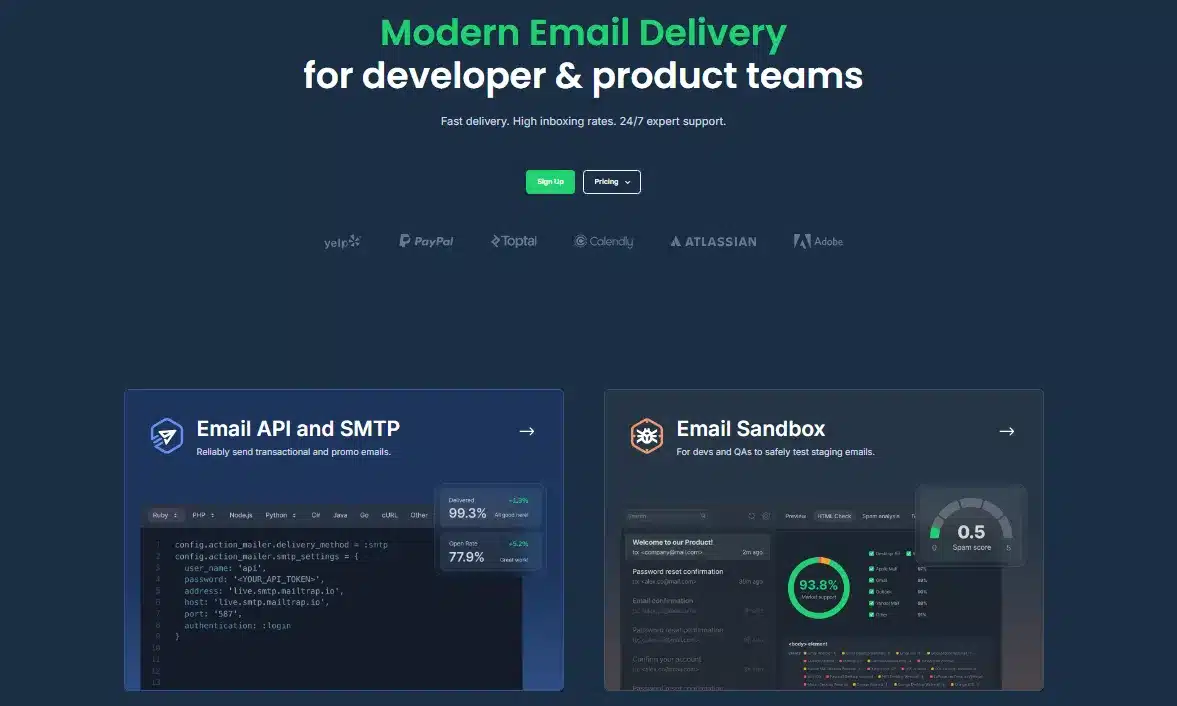
Mailtrap is an email delivery platform for enterprise developers and product teams that prioritizes high deliverability. It ships a REST API and SMTP relay, alongside fully-featured analytics and authentication components. Transactional and bulk streams are separated by default, so a promotional batch that triggers spam complaints won’t drag down password reset placement.
SPF, DKIM, and DMARC records are validated automatically once added to DNS, and DKIM keys rotate every month on their own. Dedicated IPs on the Business plan ship with automatic warmup, so you don’t hand-schedule the 2 to 4 week ramp yourself.
Organization & Sub-Accounts
Mailtrap lets you split sending into fully isolated workspaces, each with its own projects, sending domains, templates, stats, and SMTP/API credentials. Centralized billing keeps everything under one subscription with shared quota pools, while deliverability stays isolated per sub-account, so a reputation hit in one client, brand, or team environment will not bleed into the others.
SDKs and integrations
SDKs cover Node.js, Ruby, PHP, Python, .NET, Elixir, and Java. There are 25+ code snippets for SMTP integration for Laravel, Symfony, Django, Rails, Next.js, and more.
Native integrations cover Vercel and Supabase, and an MCP server lets AI coding tools like Claude Code call Mailtrap directly as an “email skill.”
Webhooks fire on opens, clicks, bounces, spam complaints, and delivery events with 40 retries over 5 minutes. Email logs are retained for 30 days with drill-down reports by mailbox provider, domain, and stream.
Pros
- Separate transactional and bulk streams by default.
- Analytics and logs included on every paid plan.
- 99% uptime SLA on distributed infrastructure.
- ISO 27001, SOC 2 Type II, and GDPR certified.
Cons
- Email only (no SMS or push).
- 24/7 live support requires the Business plan or higher.
Pricing
Free tier covers 4,000 emails per month. Paid plans start at $15/month for 10,000 emails. Business is $85/month for 100,000 emails with a dedicated IP and automatic warmup. Enterprise starts at $750/month for 1.5 million emails.
SendGrid: best for enterprise ecosystem coverage
G2: 4.0 ⭐ | Capterra: 4.2 ⭐
SendGrid is the longest-running option on this list. It launched in 2009 and was acquired by Twilio in 2019. The PHP SDK alone has more than 44 million installs on Packagist, and almost any framework has a community integration already written. That reach is its clearest advantage at enterprise scale.
Official SDKs cover Node.js, PHP, Python, Ruby, Java, Go, and C#. Server-side dynamic templates with Handlebars are a first-class feature for personalized transactional content. New accounts go through sender verification and domain authentication before production sending opens.
Stream separation is not built in. Teams approximate it through IP pools or subuser accounts, both requiring manual configuration. Dedicated IPs are a paid add-on. Event webhooks retry for 24 hours after a failure, but the free tier caps endpoints at one. Activity logs retain for 30 days on paid plans.
Pros
- Widest SDK adoption and third-party integration coverage.
- Handlebars dynamic templates.
- Unified billing with Twilio for SMS and voice channels.
Cons
- No native separation of transactional and bulk streams.
- Customer support response times are a recurring G2 complaint.
Pricing
Free trial covers 100 emails/day for 60 days, then expires. Essentials starts at $19.95/month for 50,000 emails. Pro runs $89.95/month for 100,000 emails. Premier is custom-quoted.
Amazon SES: best for cost at scale
G2: 4.3 ⭐ | Capterra: 4.7 ⭐
Amazon SES is the cheapest option on this list at $0.10 per 1,000 emails with no monthly minimum. That price is real, and so is the engineering effort it implies. SES is raw infrastructure. Suppression logic, analytics, templating, and production access are yours to assemble using Lambda, SNS, SQS, and CloudWatch. New accounts start locked to verified addresses only until AWS manually approves production access, which can sit in a queue for several business days.
SPF, Easy DKIM, and DMARC are supported but configured manually. There is no built-in bounce suppression. Delivery, bounce, and complaint events fire as SNS notifications, and consuming them to build a suppression list is on you. Native webhooks are not available. Reputation metrics come through the Virtual Deliverability Manager, a paid add-on. Full AWS SDK coverage spans JavaScript, Python (boto3), Java, Go, Ruby, PHP, .NET, Rust, C++, and Kotlin.
Pros
- Cheapest SMTP API at any volume.
- Deep AWS integration across Lambda, S3, SNS, EventBridge, and CloudWatch.
- No monthly minimum.
Cons
- No built-in bounce suppression (you build it on top of SNS).
- Production access approval can delay your first production send.
- Analytics require the paid VDM add-on.
Pricing
$0.10 per 1,000 emails. Free tier covers 3,000 emails/month for the first 12 months when sending from EC2 instances. Dedicated IPs are $24.95/month. Data transfer and attachments are billed separately at $0.12/GB.
Postmark: best for inbox delivery speed
G2: 4.6 ⭐ | Capterra: 4.7 ⭐
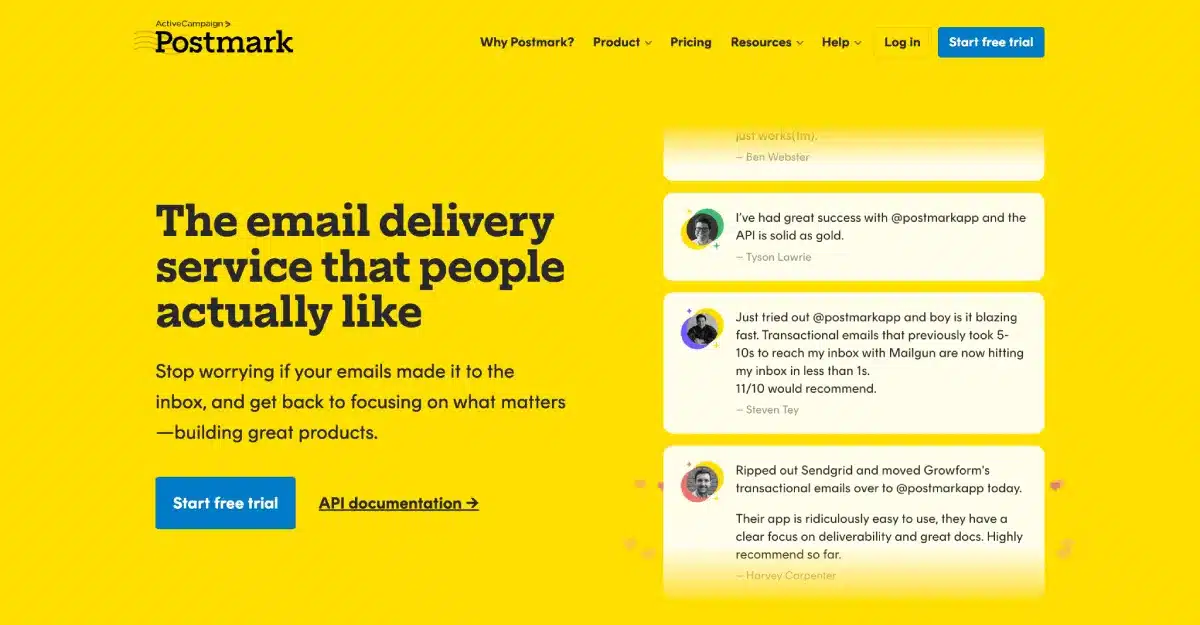
Postmark’s key feature is getting transactional mail to the inbox fast. The platform runs a strict account review before enabling live sending, which keeps shared pool neighbors clean. Message Streams isolate transactional, broadcast, and inbound traffic at the infrastructure level, more thorough than the IP pool workarounds SendGrid and SES require.
Official libraries cover Node.js, PHP, Python, Ruby, .NET, Java, and Go. Message Streams is a first-class API concept: pass a stream ID on each send and Postmark routes transactional and broadcast traffic without IP pool configuration. Activity logs retain for 45 days and every bounce is automatically processed, categorized, and suppressed.
SPF, DKIM, and DMARC are configured during account setup. Dedicated IPs ship with structured warmup, but only for accounts sending 300,000+ emails per month.
Pros
- Message Streams isolate reputation by traffic type at the infrastructure level.
- Strict account review keeps shared IP pools clean.
- 45-day log retention.
- Analytics and bounce management at every tier.
Cons
- Most expensive at scale: 125,000 emails costs $138/month.
- Dedicated IPs only available at 300,000+ monthly sends.
- No permanent free tier.
Pricing
$15/month for 10,000 emails. 50,000 runs $60.50/month. 125,000 costs $138/month. Dedicated IP adds $50/month.
Mailgun: best for API routing and validation
G2: 4.2 ⭐ | Capterra: 4.3 ⭐
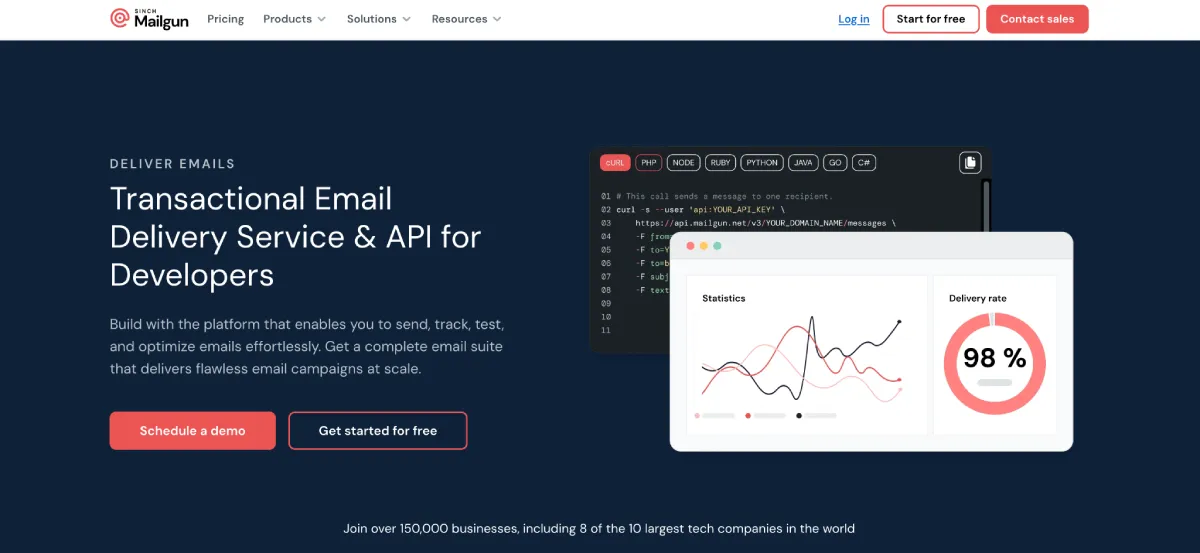
Mailgun is an API-first platform for engineering teams that want fine-grained routing and pre-send validation. The PHP SDK alone records over 1.3 million weekly installs on Packagist. The clearest differentiator is a built-in email validation API that checks addresses against DNS/MX records, disposable domain lists, and syntax rules before sending. That step helps avoid the bounce spikes that damage sender reputation at volume.
Official SDKs cover Node.js, Python, PHP, Ruby, Java, Go, and C#. Batch sending accepts up to 1,000 recipients per API call. Domain-specific API keys give permission control per sending domain.
SPF, DKIM, and DMARC are configured manually through DNS verification. Stream separation works through multiple sending domains rather than a native stream architecture, which takes more setup than Mailtrap or Postmark. Webhooks retry for 8 hours on failure. Automatic bounce and spam complaint suppression is included on every plan.
Pros
- Built-in email validation API.
- Domain-specific API keys.
- Batch API accepts up to 1,000 recipients per call.
Cons
- Dedicated IPs are $59/month, the highest in this comparison.
- Advanced reputation analytics require the Optimize add-on.
Pricing
Free tier covers 100 emails/day. $15/month for 10,000 emails. Foundation $35/month for 50,000. Scale from $90/month for 100,000+. Overage around $1.80 per 1,000 emails, the highest here.
Which factors matter most at enterprise volume?
Stream separation and authentication
High deliverability at enterprise volume rests on two things: authentication that stays valid over time, and isolation between transactional and bulk traffic. Mailtrap and Postmark separate streams by default. SendGrid, Amazon SES, and Mailgun leave the work to you through IP pools, subuser accounts, or multiple sending domains. Mailtrap rotates DKIM keys every month automatically, closing a silent failure mode that can break inbox placement weeks after setup.
Dedicated IPs, warmup, and real cost
Shared IP pools work under 100,000 monthly sends when the provider enforces strict sender standards. Above that, a dedicated IP needs a 2 to 4 week warmup. Mailtrap includes dedicated IP and automatic warmup on the Business plan at $85/month; Postmark charges $50/month but only for accounts sending 300,000+; SendGrid, Amazon SES, and Mailgun treat dedicated IP as a separate line item. Amazon SES is cheapest per email at $0.10 per 1,000, but assembling suppression, analytics, and templating on Lambda and SNS is a real cost.
Compliance, security, and access controls
Enterprise procurement usually requires SOC 2 Type II, ISO 27001, and GDPR coverage at a minimum. All five providers meet the baseline, but governance controls vary. Mailtrap’s Organization & Sub-Accounts structure isolates teams or clients into separate workspaces on Business and Enterprise plans. SendGrid and Mailgun support subuser accounts. Postmark covers user roles, SSO, and per-server access.
SDK coverage and ecosystem fit
SDK reach matters even more at enterprise scale because in-house frameworks, internal tools, and acquired codebases all need to plug in cleanly. Mailtrap covers Node.js, Ruby, PHP, Python, .NET, Elixir, and Java, plus 25+ framework code snippets and an MCP server for AI coding tools. SendGrid’s PHP SDK alone has 44M+ Packagist installs, and almost any framework already has a community integration written. Mailgun follows with 1.3M+ weekly PHP installs. Amazon SES covers every AWS-supported language but expects you to assemble templating, suppression, and analytics yourself. Postmark covers the major languages cleanly without the breadth of SendGrid.
Final verdict
The best enterprise email service for high volume delivery depends on which constraint is tightest. Mailtrap is the top pick for enterprise developer and product teams that want high deliverability, automated DKIM rotation, and analytics built into every plan. Amazon SES is unbeatable on per-email cost if your team already runs on AWS. Postmark earns the higher-cost slot when inbox speed is non-negotiable. Mailgun fits engineering teams that want pre-send validation and domain-specific routing. SendGrid is the natural default inside the Twilio ecosystem.
Whichever provider you pick, configure SPF, DKIM, and DMARC before your first production send, keep transactional and bulk streams on separate infrastructure, and plan for IP warmup if volume pushes you off the shared pool.
Frequently asked questions
What is the best enterprise email service for high volume delivery?
If your team values high deliverability, Mailtrap is the right enterprise email service. Amazon SES wins on raw per-email cost for AWS-native teams. Postmark wins on inbox speed when you can absorb the higher per-send cost. SendGrid is the best for the Twilio ecosystem and Mailgun is a strong choice forpre-send validation.
Do you need a dedicated IP for high volume email?
Not always. Under 100,000 monthly sends, a well-managed shared IP pool performs reliably if the provider enforces strict sender standards. Above that, a dedicated IP gives full control over sender reputation. Factor in a 2 to 4 week warmup, and expect the line item to sit between $24.95/month (Amazon SES) and $59/month (Mailgun).
How long does it take to migrate an enterprise email service?
The technical migration (domain reverification, DNS updates, credential swaps, test sends) typically takes 1 to 3 days. Moving to a new dedicated IP means starting warmup from zero, which adds another 2 to 4 weeks. Plan for parallel sending across the old and new systems during the transition.


Leave a Reply