

Headless CMS for eCommerce: How to Build Flexible, Scalable Online Stores
It is no secret that if a business is not present online, it loses the lion’s share of its customers. From handmade soap sellers to international e-commerce corporations with billion-dollar turnovers, everyone needs infrastructure to make sales. More specifically, they need a CMS that suits the needs of e-commerce businesses.
But which CMS is right for a particular business depends on many factors. These include, but are not limited to, the size of the company, the complexity of its processes, the number of external systems it uses, and its need for deep customization. A small handmade shop may well be suited to a ready-made website builder with a set of plugins and themes. Something that one person without an IT background can configure. But if we are talking about an established company that plans to enter new markets, customize its interface, and connect more and more channels of communication with its customers along the way, it is time to consider a Headless CMS.
In this article, we will discuss the differences between these two types of CMS. We will assess their features and help you make a smart, cost-efficient choice of the platform that will deliver maximum value (and, most importantly, sales!) for your business.
How Does A Traditional eCommerce CMS Work?
To better explain how these CMS platforms work, let’s take a small local business that produces and sells handmade soap as an example. It has several dozen products. These are soaps with different scents, shapes, and weights. To buy this soap, a website visitor can browse the catalog and select the products they need. They then add the selected items to their cart, pay for their orders, and specify the delivery method and address.
A store like this does not require complex customization or complicated setups. And most likely, its development budget is limited. Therefore, the store is looking for a simple way to set up its platform quickly and start selling.
A Traditional eCommerce CMS offers exactly the ready-made infrastructure for this. The main tools for managing the store and its storefront are gathered in one system. The architecture is usually monolithic. It includes the admin panel, product and order management, business logic, store frontend. The owner just adds a product through the admin panel, specifies its price, uploads photos and selects a category. The system saves this data and displays it on the ready-made website storefront. When a customer places an order, the same platform handles the cart, payment and order.
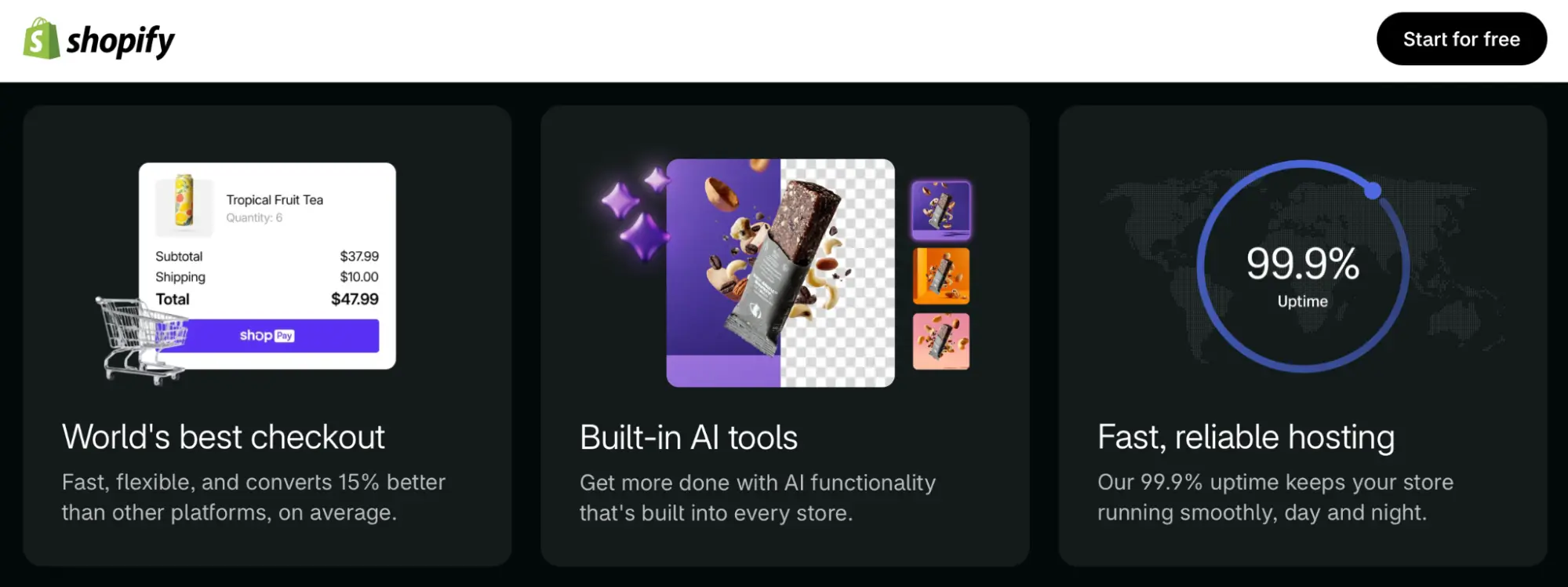
Shopify, WooCommerce, PrestaShop and Adobe Commerce (Magento) are popular on the market.
However, as the business grows, just this standard functionality may no longer be enough anymore. For example, the manufacturer enters new markets or starts selling products not only through its website but also through a mobile application, marketplaces, other channels. Especially if business processes start requiring non-standard data exchange between several systems. In its standard configuration, traditional architecture is primarily designed around one integrated storefront. At the same time, modern platforms also support APIs and integrations with additional channels.
This does not mean that modern Traditional eCommerce CMS platforms cannot support a growing business. Many platforms offer extensive opportunities for expansion, that is true. But the more complex the processes become and the more channels the company adds, the harder it becomes to manage all these requirements within one ready-made system. At a certain point, a business may need a more flexible architecture in which content management, commercial logic, and user interfaces are not tied to a single platform.
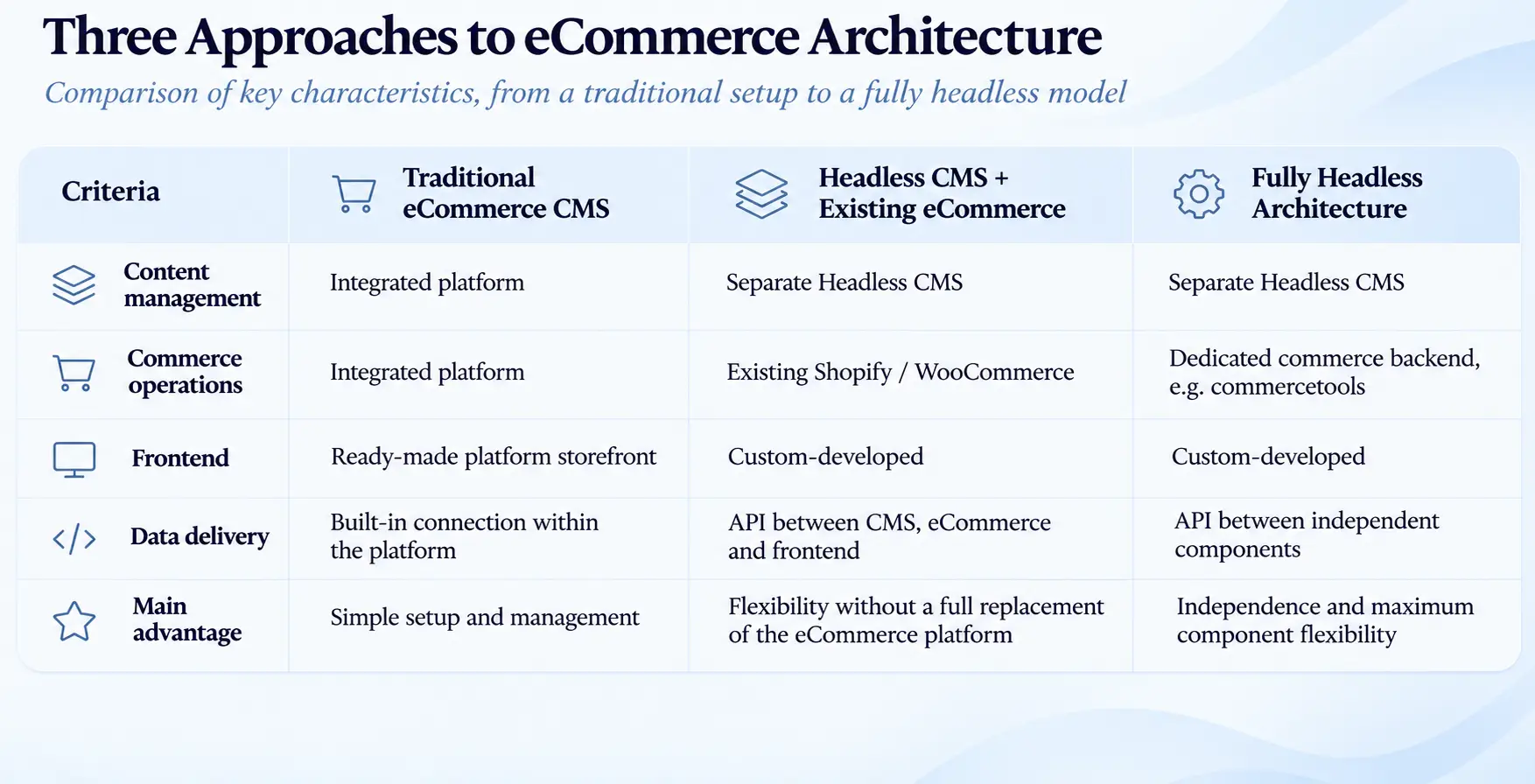
How Does A Headless eCommerce Architecture Work?
Let’s get back to our soap store example. Using a traditional platform, when a new soap was released, the owner simply added this product through the admin panel in Shopify. Shopify stores the product information and displays it on the online store pages. So, here, the system manages the products and is also responsible for how they appear on the website.
But now, the business is growing: it has become a full-fledged beauty brand! At one point the company decides to launch a mobile app and also enter the market of a neighboring country. This means, that the brand now has several channels to manage content for.
So, the soap company connects a new Headless CMS to its existing eCommerce platform. Product descriptions, photos, other product materials are stored separately from commercial data. The owner adds information about the new soap to the Headless CMS just once. And continues to manage its price, stock levels and product variants through Shopify. The website, mobile app and new country store then retrieve the necessary data from both systems, through APIs.
At the same time, each channel can look completely different! The main website has one design concept. The mobile application has an interface adapted for smartphones. The store for the neighboring country has a localized storefront in another language and even a completely different style. But the content materials about the product itself come from one source! There is no need to create separate copies of the same descriptions and photos in three different content management systems.
Benefits of Headless eCommerce Architecture
Frontend flexibility. A company can create its own user interfaces from scratch and choose different frontend technologies. Complete freedom to change the website design or functionality, independently from the backend.
Scalability. With the future growth of business, it will be much easier to add new websites, apps or markets without rebuilding the entire content management system.
The same content can be used in multiple places. For example, a product description, its photos, promo materials can be published on the website, in the mobile app, and in the localized sote version. No need to create separate copies for each channel.
API-driven delivery. APIs provide data exchange between the CMS, eCommerce platform and frontend apps. The website and app retrieve up-to-date information from the respective systems, and display it in the required format.
The company can develop each user interface independently of its content management and commercial systems.
Best Headless CMS Platforms for eCommerce Use Cases
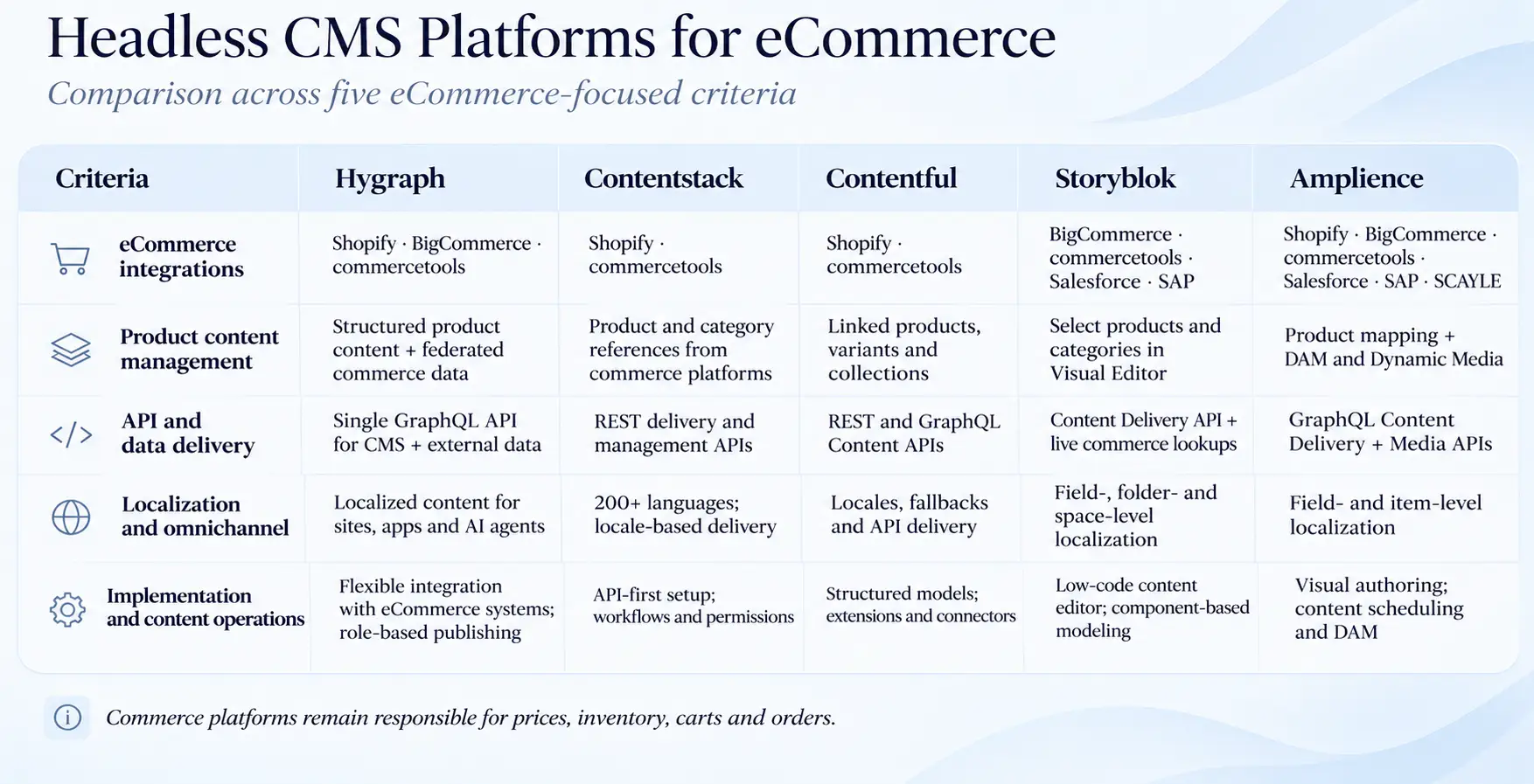
Hygraph
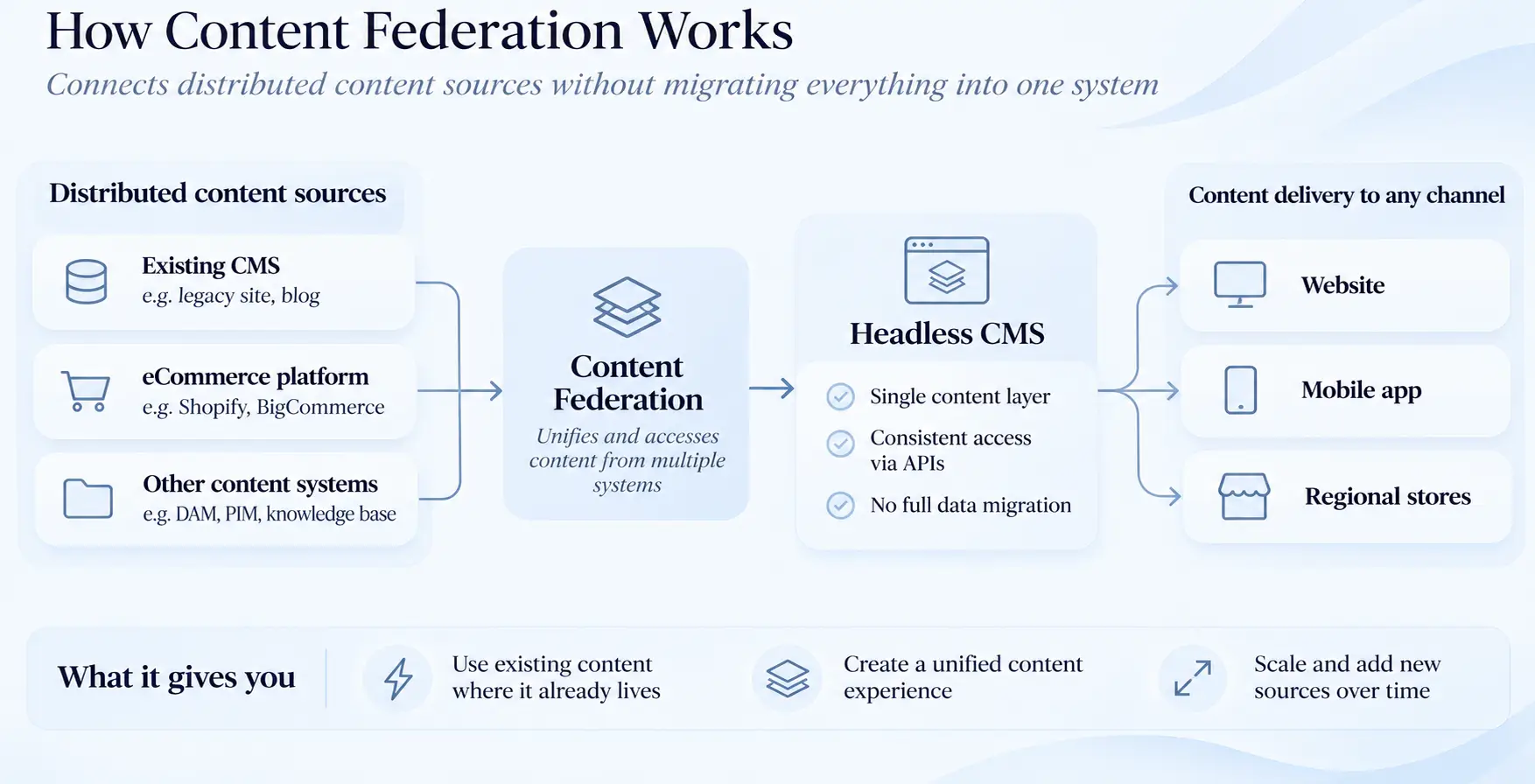
An agentic content platform with a GraphQL-native architecture. Content Federation feature allows businesses to combine CMS content with external data from Shopify, BigCommerce and other systems through a single GraphQL API. Supports localized content for different markets and channels.
Contentstack
An enterprise CMS with ready-made integrations for Shopify, BigCommerce and commercetools. Editors can select products and categories directly in the CMS, and use them in their content.
Contentful
Offers structured content, Shopify integration and Custom External References. Businesses can link products, collections and product variants to content entries, as well as retrieve related data through the GraphQL API.
Storyblok
Also offers official integrations with Shopify, BigCommerce, and commercetools. Stands out for its Visual Editor feature: content managers can build product pages and promotional blocks, select products from a connected eCommerce system and work with up-to-date data through APIs.
Amplience
In addition to its CMS, offers DAM and Dynamic Media, visual content management, publishing scheduling. Easy integrations with Salesforce Commerce Cloud, Shopify, commercetools, BigCommerce and SAP Commerce Cloud.
The Importance Of Structured Content Modeling
A company needs a unified structure to store information about its products in a CMS correctly for multiple reasons. Let’s break it down using our soap store example. The beauty brand has decided to use a Headless CMS. It already has 50 types of soap. Now, the company wants to transfer information about them into the new system. There is no option to simply upload everything to the CMS as a collection of texts and photos. Without a unified structure, different employees will describe products however they like, some specifying the weight in the description, others putting it in a separate field and some simply forgetting to add the ingredients at all. Content quickly becomes difficult to maintain and use for different channels, apps, stores.
Instead, all products should be stored according to the same principle. Each product has the same set of core fields. Besides, the same data can be used for different platforms. Plus, separate fields for different languages and markets can be planned in advance.
And the key factor: API delivery! Since data is stored in specific fields and has a clear structure, applications can request exactly the information they need. For example, a mobile app only retrieves the product name, photo, ingredients. Meanwhile, the website gets the full description.
Structured content is also important for businesses with AI shopping assistants on their websites. If a customer asks an AI agent to recommend a soap based on its ingredients, scent or skincare needs, the agent needs to give a relevant answer. With well-organized product info, it can retrieve specific product attributes directly from the CMS through APIs.
Author: Kristina Kovtun
Kristina Kovtun is an AI & Organic Search Specialist at Hygraph, with experience in SEO, link building, and AI search visibility. She focuses on helping brands strengthen their online presence through strategic outreach, high-quality backlinks, and optimization for AI-powered search.


Leave a Reply