
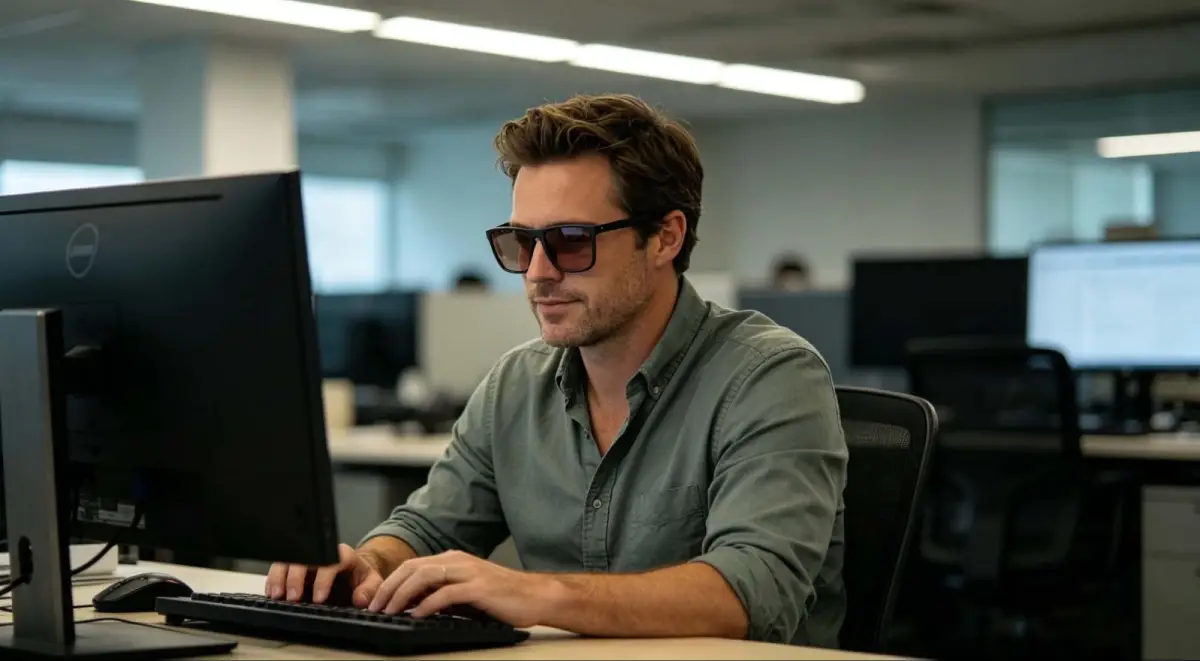
How to Survive Fluorescent Lights at Work — A Practical Guide
If you’ve ever sat under overhead fluorescent tubes and felt your temples tighten, your eyes burn, or a full-blown migraine creeping in — you’re not alone, and it’s not in your head. For millions of office workers, fluorescent lighting isn’t just unpleasant; it’s a genuine health trigger that erodes focus, productivity, and wellbeing every single day.
The good news? You don’t have to quit your job or work in a cave. There are practical, evidence-based strategies you can start using today to significantly reduce your discomfort — most of them cost nothing.
Why Fluorescent Lights Wreak Havoc on Your Nervous System
Fluorescent lights are problematic for two distinct reasons, and understanding both helps you choose the right fix.
The flicker factor. Unlike incandescent bulbs that produce a continuous stream of light, fluorescent tubes turn on and off roughly 60 times per second (matching the electrical frequency). Most people don’t consciously notice this flicker, but your brain does. A 2025 case report documented a patient whose migraines were directly triggered by flickering fluorescent lighting, with symptoms progressing from eye pressure to visual disturbances within minutes [1]. Think of it like a strobe light at a very low frequency — your visual cortex is constantly working to process these micro-fluctuations, and that effort translates into fatigue and headaches.
The wavelength problem. Fluorescent bulbs emit a disproportionately high amount of blue-green light in the 480–520 nanometer range. This is precisely the bandwidth that photophobia researchers have identified as most irritating to people with light sensitivity [2]. One small business owner described needing only 20 minutes under office fluorescents before experiencing left-eye pressure, zigzag visual auras, and a full migraine — a pattern that neurologists recognize as classic light-triggered migraine.
Beyond headaches, fluorescent lighting has been shown to increase anxiety levels in sensitive individuals. A 2021 study found that patients with anxiety disorders experienced measurably higher stress responses under fluorescent lighting compared to warmer alternatives [3].
Immediate Fixes You Can Do Right Now (Without Asking Anyone)
Let’s start with the low-hanging fruit — adjustments that require zero approval from facilities or HR.
Swap your overhead bulb. If you have a desk lamp or task light, replace its bulb with a warm LED (2700K–3000K). Position it so it becomes your primary light source, effectively “drowning out” the overhead fluorescents with a warmer, more stable wavelength. Many people find that simply having warm light on their desk reduces their headache frequency by half.
Use a screen glare filter. Fluorescent lights create reflections on your monitor that force your eyes to constantly readjust between bright reflections and dark text. A quality matte screen protector or anti-glare filter eliminates this layer of visual stress. It’s a $15–$30 fix with an immediate payoff.
Adjust your monitor’s color temperature. Both Windows and macOS have built-in “night light” or “Night Shift” settings that warm your screen’s color output. Set it to a warm tone even during the day — this reduces the blue light hitting your eyes directly, partially compensating for what’s coming from above.
Take regular “light breaks.” Every 90 minutes, step outside or into a naturally lit area for 5–10 minutes. Your visual system needs contrast — the uniform, shadowless quality of fluorescent lighting deprives your eyes of depth cues, contributing to fatigue. Natural light with its full spectrum gives your brain the visual variety it needs to reset.
Protective Gear: When Environmental Fixes Aren’t Enough
Sometimes you can’t swap the bulbs. Maybe you work in a hospital, a call center, or an open-plan office where lighting decisions are beyond your control. That’s where personal light-filtering tools come in.
FL-41 tinted lenses are the most researched solution for fluorescent-light sensitivity. Originally developed in the 1980s, the FL-41 tint specifically targets the 480–520nm wavelength range — the exact band that fluorescent bulbs overload. A 2021 randomized controlled trial found that FL-41 tinted lenses significantly reduced visual stress and headache frequency in migraine patients compared to standard clear lenses [4]. More recently, a 2024 fMRI study showed that FL-41 lenses measurably reduced activation in the neural pathways associated with photophobia [5] — meaning the relief isn’t just subjective; your brain literally reacts less to triggering light.
Pink-tinted FL-41 lenses are designed specifically for this scenario, filtering the problem wavelengths without significantly darkening your vision. This is important in an office setting where you still need to read documents, see facial expressions, and navigate your workspace. For milder sensitivity, a light pink tint provides gentle all-day protection; for recurring migraines, a deeper pink tint offers stronger filtering.
If you already wear prescription glasses, fit-over options let you add the tint without buying a whole new pair of prescription lenses. This is worth exploring before investing in a full prescription pair.
Anti-fatigue mats and posture adjustments indirectly help by reducing overall sensory load — when your body is comfortable, your nervous system is less primed to overreact to light triggers.
Environmental Advocacy: How to Talk to Your Employer About Lighting
Many employees assume they can’t change their office lighting. In reality, you often have more leverage than you think — especially if you frame the conversation around productivity rather than personal comfort.
Know your rights. Under the Americans with Disabilities Act (ADA), if you have a documented condition like chronic migraine, photophobia, or post-concussion syndrome, your employer is required to provide reasonable accommodations — which can include lighting modifications. You don’t need to invoke the ADA in your first conversation, but knowing it exists gives you a baseline.
Start with a simple request. Approach your manager or facilities team with: “I’ve been getting frequent headaches under the overhead lighting. Would it be possible to swap the tubes above my desk for warm LEDs, or install a dimmer switch?” Many facilities teams will accommodate this — warm LED tubes are now comparable in price to fluorescents and are increasingly standard in modern office retrofits.
Offer a trial period. “Can we try this for two weeks? If it doesn’t work or bothers anyone else, we can revert.” This reduces the perceived risk for your employer.
Use productivity data. If you’ve tracked your headache days or noticed patterns, share them. “I’ve averaged two headache-related work-from-home days per month, and they consistently correlate with days spent under fluorescent lighting. A lighting change could eliminate most of these absences.”
Long-Term Strategies for Light Sensitivity Management
Beyond the immediate office fixes, building a broader sensitivity-management toolkit makes you more resilient overall.
Nutritional support. Magnesium supplementation (400–600mg daily) has shown promise in reducing migraine frequency in multiple clinical trials. Riboflavin (vitamin B2, 400mg daily) is another well-studied option. These don’t replace environmental fixes, but they raise your threshold — meaning it takes more light exposure to trigger a headache.
Track your triggers. Use a simple headache diary or app to log when your symptoms flare. Note the lighting conditions, time of day, and what you were doing. After a few weeks, patterns emerge that help you predict and preemptively manage high-risk situations.
Consider green light therapy. Emerging research suggests that narrow-band green light exposure may reduce headache frequency in migraine patients [6]. While not a direct replacement for filtering fluorescent light, it’s a promising complementary approach for overall sensitivity management.
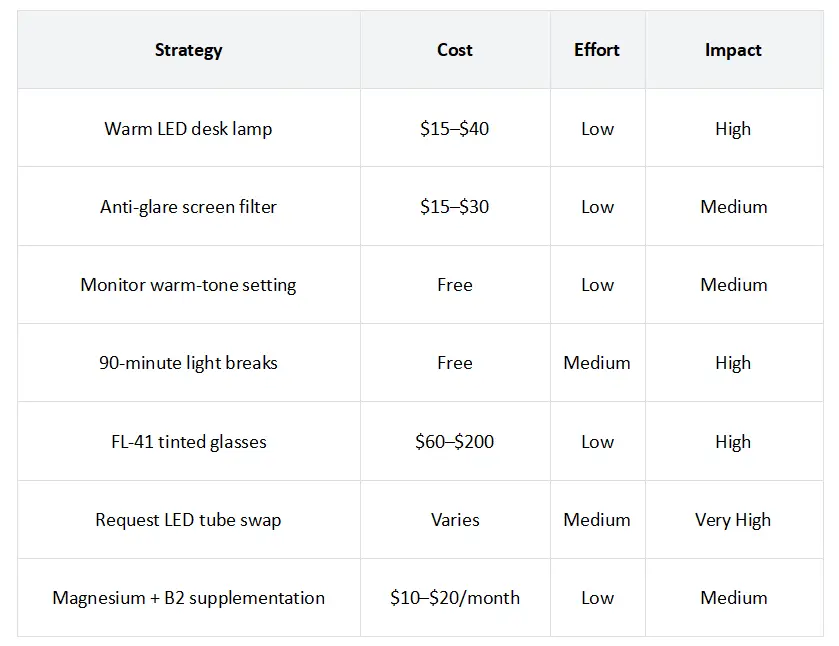
Quick-Reference Action Plan
You Have More Control Than You Think
Fluorescent lighting sensitivity is real, it’s well-documented in the medical literature, and — most importantly — it’s manageable. The key is layering multiple strategies: filter the light reaching your eyes, modify your immediate environment, advocate for systemic changes at work, and support your nervous system with good nutrition and trigger tracking.
You don’t have to suffer silently under buzzing tubes. Start with the free fixes today, add protective eyewear if needed, and remember that even small changes compound into meaningful relief.
References
- Gassull, A. et al. (2025). Triggered Migraine Attack by Flickering Fluorescent Lights: A Case Report. Cureus.
- Digre, K.B. et al. (2012). Shedding light on photophobia. Journal of Neuro-Ophthalmology.
- Khorshid, R.F. et al. (2021). The Effect of Fluorescent Light on Anxiety Patients. Cureus.
- Good, P.A. et al. (2021). FL-41 tinted lenses for managing visual stress in migraine: a randomized controlled trial. Headache.
- Reyes, N. et al. (2024). FL-41 Tint Reduces Activation of Neural Pathways of Photophobia in Patients with Migraine. American Journal of Ophthalmology.
- Martin, L.F. et al. (2021). Evaluation of green light exposure on headache frequency and quality of life in migraine patients. Cephalalgia.


Leave a Reply