
Merch by Amazon and Fast Fulfillment: How Apparel Sellers Scale Beyond Print on Demand
Merch by Amazon is one of the lowest-barrier entry points into Amazon apparel selling. No inventory. No upfront cost. No fulfillment to manage. Upload a design, set a price, and Amazon handles the rest.
For sellers testing designs and building a brand presence, that model works well. For sellers who want to scale beyond the platform’s limitations, the print-on-demand structure eventually becomes a ceiling rather than a foundation.
This article covers how the Amazon Merch platform works, what its constraints are at scale, and how sellers who move into physical apparel fulfillment can use fast delivery infrastructure to compete effectively.
How the Amazon Merch Platform Works
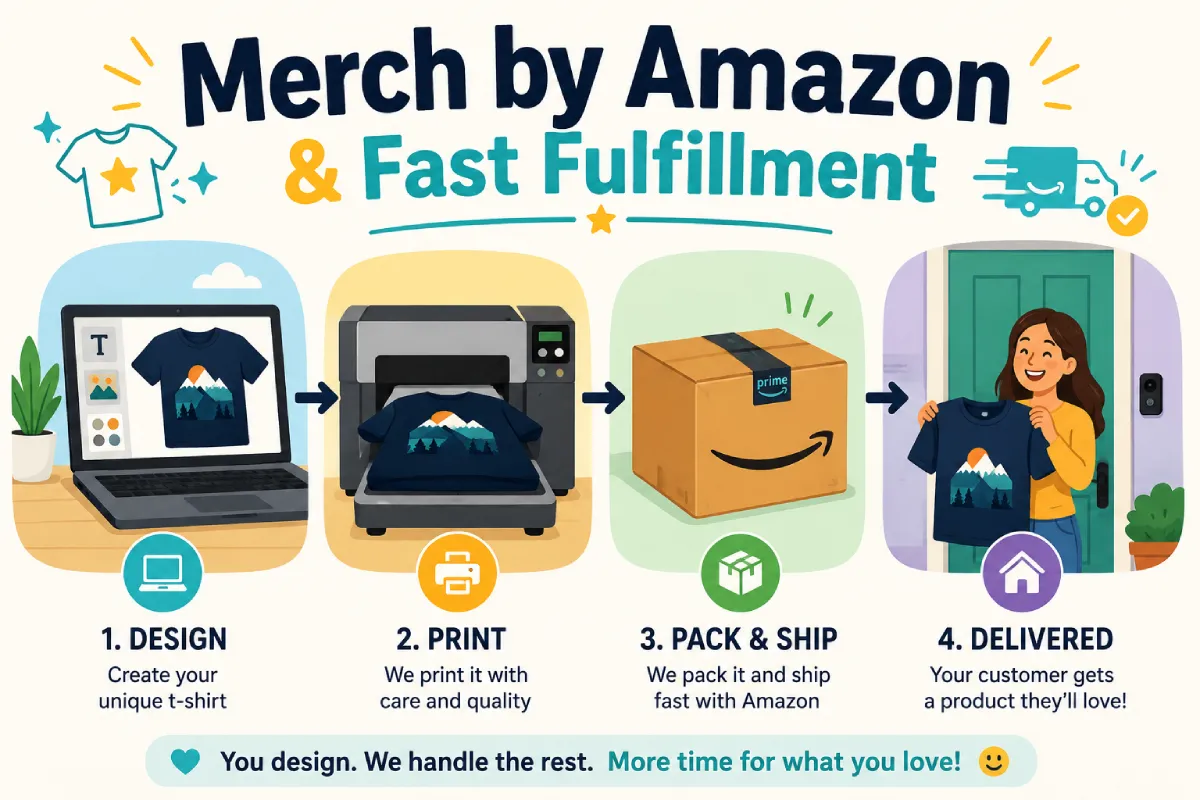
Merch by Amazon is a print-on-demand service that allows creators and brands to sell custom-designed apparel directly on Amazon without holding inventory. Amazon prints each unit on demand when an order is placed, fulfills it, and handles returns.
A full breakdown of how Amazon Merch on Demand works across account tiers, royalty structure, and product formats gives sellers a clearer picture of what the platform covers before committing to it as a primary sales channel.
The Account and Approval Process
To start selling, you need amazon merch approval before any designs go live. Amazon looks at your account history, the type of content you plan to sell, and how you intend to use the platform. If everything checks out, access is granted.
A new merch by amazon account comes with a low design limit. You cannot list an unlimited number of products from day one. As your sales grow, Amazon moves you into higher tiers that allow more listings. The more consistently you sell, the faster that progression happens.
Early sales matter more than most new sellers expect. Accounts that sit idle or rely entirely on organic discovery tend to stay at the lower tiers for longer. Sellers who drive traffic to their listings and keep their product pages optimised move up faster.
What the Platform Covers
Once your account is live, the Amazon Merch platform takes care of printing, packing, shipping, and customer service. Every time an order comes in, Amazon handles it end to end. The seller receives a royalty on each sale after Amazon deducts its production and fulfillment costs.
That royalty is fixed. There is no way to lower your per-unit cost by choosing a different carrier or moving stock to a cheaper warehouse. The two things a seller can control are the price they set and how many designs they have live on the platform.
The Limitations of Print on Demand at Scale
Amazon apparel selling through Merch on Demand works well for passive income, design testing, and brand awareness. It becomes limiting when sellers want to expand product range, control quality, or improve delivery speed.
Design and Product Constraints
The Amazon Merch on Demand catalog covers a defined set of product types. Sellers cannot add custom product formats, specialty materials, or limited-edition runs outside the platform’s available options. Brands that want to differentiate on product quality or exclusivity hit a structural ceiling quickly.
Delivery Speed Limitations
Print-on-demand production time adds to the delivery window. An order placed on a Merch by Amazon listing does not ship immediately. It enters a production queue before fulfillment begins. For buyers who expect fast delivery, that production lag is a friction point that affects conversion and repeat purchase behavior.
Sellers who move into physical inventory fulfillment can offer next day parcel delivery that print-on-demand cannot match. A pre-printed, pre-packed unit ships the same day an order is placed. For buyers who need a gift, a replacement, or a time-sensitive purchase, that speed difference is a meaningful competitive factor.
Moving Into Physical Apparel Fulfillment
Sellers who graduate beyond the Amazon Merch platform into physical inventory fulfillment gain control over product quality, delivery speed, and margin structure. They also take on inventory risk and operational complexity.
Fast Delivery as a Competitive Differentiator
Amazon apparel selling through physical inventory allows sellers to offer delivery options that print-on-demand cannot. A next day courier service or 24 hour delivery service on apparel listings creates a conversion advantage over competitors running on production-plus-fulfillment timelines.
Overnight parcel delivery and express parcel delivery options are particularly effective in the apparel category because purchase triggers are often time-sensitive. A buyer shopping for an event, a birthday, or a last-minute replacement is making a decision heavily influenced by the delivery date shown at checkout.
Sellers whose listings display a guaranteed next-day or fast courier delivery option convert at a higher rate on those time-sensitive purchase triggers than sellers whose listings show standard delivery windows.
What Fast Fulfillment Requires Operationally
Offering a reliable 24 hour delivery service or overnight parcel delivery on physical apparel requires the same infrastructure as any fast fulfillment model. Inventory needs to be positioned in a fulfillment node within ground-range of the customer base. Orders need to be picked, packed, and handed to the carrier before the daily cut-off. And the carrier network needs to support the SLA consistently, not just on low-volume days.
When to Use Each Model
Not every apparel seller needs to leave Merch by Amazon. The right choice depends on where the business is right now and what the seller wants to get out of it.
Merch by Amazon Works Best When
The seller is still testing designs and does not want to buy stock upfront. The products they want to sell fit what the platform already offers. Buyers are not in a rush to receive their order. And the seller wants to earn without managing day-to-day operations.
Physical Fulfillment Works Better When
The seller knows which designs sell and wants to move more volume. The brand needs product types or quality levels the Amazon Merch platform does not support. Buyers expect fast delivery and that affects whether they purchase. And the per-unit royalty from print-on-demand is no longer enough to hit the brand’s revenue targets.
Most sellers do not choose one model permanently. They use Merch by Amazon to validate designs at zero inventory risk and transition the highest-performing designs into physical inventory once demand is confirmed.
Conclusion
Merch by Amazon is a valid starting point for apparel sellers who want to test demand without inventory risk. It is not a permanent infrastructure for brands that want margin control, product differentiation, or fast delivery capability.
The transition from print-on-demand to physical fulfillment is not a single decision. It is a progression triggered by validated demand, margin targets, and buyer expectations around delivery speed. Sellers who build that evaluation into their growth planning move through the transition at the right time rather than too early or too late.
Frequently Asked Questions
How long does Amazon Merch approval take?
Amazon merch approval timelines vary. Most applicants receive a decision within a few weeks. Accounts with a positive Amazon selling history and a clear intended use tend to move through the review faster than new accounts with no prior activity.
Can I run a Merch by Amazon account alongside a physical apparel store?
Yes. Many sellers operate a merch by amazon account for passive design income while running a separate physical inventory operation for higher-margin or time-sensitive products. The two models are not mutually exclusive.
What delivery options can physical apparel sellers offer that Merch cannot?
Physical inventory sellers can offer overnight parcel delivery, express parcel delivery, and next day courier service options. Print-on-demand production time makes those SLAs unavailable on Amazon Merch platform listings.
What is the minimum sales threshold to tier up on Merch by Amazon?
Amazon does not publish exact tier thresholds. Tier progression is based on sales velocity. Sellers who actively promote their listings and drive external traffic to their merch by amazon account move through tiers faster than those who rely on organic discovery alone.
Is fast courier delivery worth the cost for apparel sellers?
For time-sensitive purchase categories, yes. Fast courier delivery on apparel converts buyers who have a specific date requirement. The conversion uplift on those buyers typically offsets the carrier cost premium, particularly on higher-margin physical products where the royalty ceiling of print-on-demand is not a constraint.


Leave a Reply