
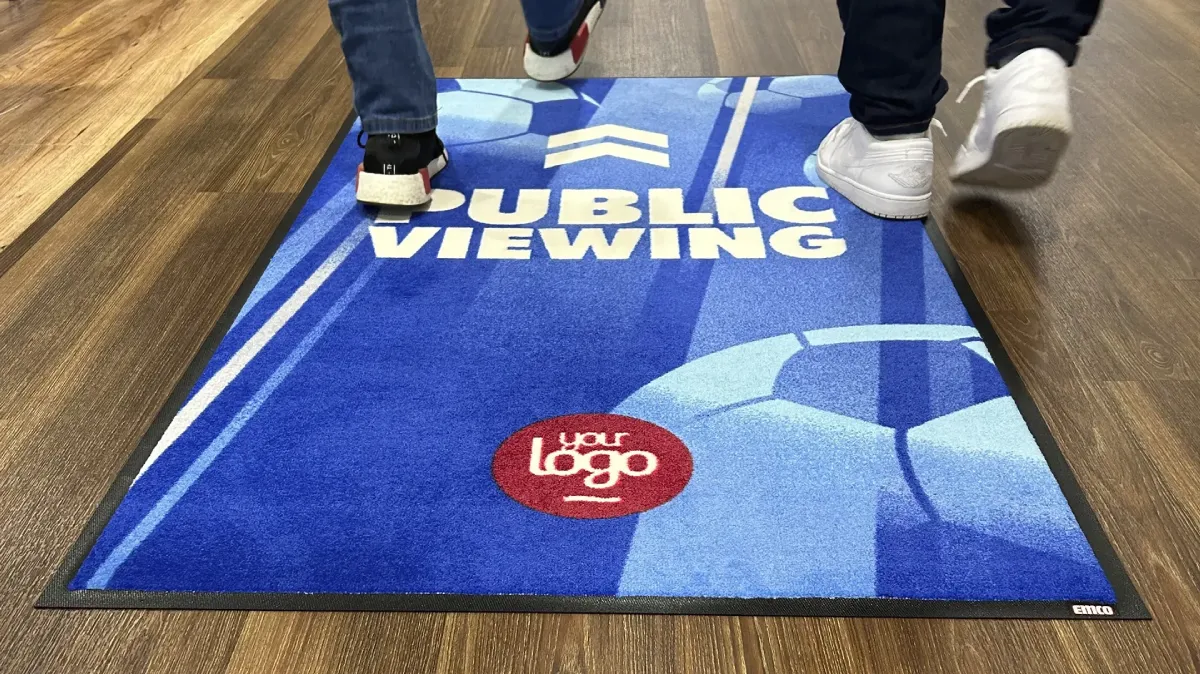
The Forgotten Marketing Channel in Modern Retail Design
Floor Graphics Vinyl: The Forgotten Marketing Channel in Modern Retail Design
In most retail environments, the ceiling is engineered, the walls are branded, the windows are dressed, and the endcaps are negotiated down to the inch. But the floor — one of the largest visible surfaces in the store — is often treated as operational background.
That is a missed opportunity. Floor graphics vinyl has become one of the most practical, flexible, and underused tools in modern retail design. For facilities directors, property managers, franchise operators, and retail operations VPs, the question is no longer whether floors can carry messages. The real question is whether those messages can be installed safely, removed cleanly, scaled across locations, and measured against business goals.
Across the USA, retailers are under pressure to do more with less: fewer staff hours, tighter remodel windows, more seasonal campaigns, more local market variation, and higher expectations from shoppers who move through stores quickly. Floor graphics sit directly inside that reality. They guide, promote, warn, organize, and sell — without requiring new fixtures, permanent construction, or expensive structural changes.
The Industry Landscape: Why Floors Are Becoming Retail Media
Retail design has moved beyond decoration. Every surface now has a job: direct traffic, increase dwell time, reduce confusion, reinforce brand memory, or create a safer path through the space.
Floor graphics fit that shift because they operate at the point of decision. A customer standing in an aisle, lobby, showroom, pharmacy queue, franchise counter, or big-box entry zone is already in motion. Unlike a wall sign, a floor message can interrupt that motion without fighting for eye-level space already occupied by shelves, screens, banners, ADA signs, fire exits, and promotional posters.
This is why floor graphics are increasingly used in grocery, automotive retail, fitness chains, healthcare facilities, banks, convenience stores, malls, event venues, and franchise systems. A well-placed graphic can do three things at once: support branding, direct movement, and trigger action.
The material side matters. Not every vinyl film belongs on a floor. Proper systems usually combine printed film with a protective, slip-resistant overlaminate. 3M notes that floor graphics require a base film and overlaminate with UL certification for slip resistance, and that indoor floor graphics and outdoor sidewalk graphics require different optimal print films.
That technical distinction is where many failed programs begin. A campaign that looks good in a PDF can fail on-site if the wrong floor signage graphic film is selected for polished concrete, tile, carpet, exterior pavement, or high-moisture entrances.
Key Trends in Floor Graphics and Retail Design
Removable Floor Graphics for Seasonal Retail Campaigns
Seasonality is one of the strongest use cases for removable floor graphics. Retail calendars now move in rapid cycles: back-to-school, Halloween, Black Friday, holiday, New Year wellness, spring refresh, summer travel, local sports events, and franchise-specific promotions.
For operations teams, removable graphics are attractive because they do not require permanent changes to the property. They can be deployed for a short promotion, removed after the campaign, and replaced with new messaging.
The important point is removability does not mean casual execution. Removable floor graphic materials still need to match the floor surface, cleaning routine, traffic level, and intended duration. A 10-day event graphic in a mall concourse does not need the same specification as a six-month wayfinding program in a medical retail chain.
Adhesive Floor Signs for Safety, Direction, and Compliance Support
Adhesive floor signs are not just marketing tools. In many facilities, they help organize movement: queue lines, pickup zones, “stand here” markers, checkout direction, restroom routes, entry and exit separation, warehouse-adjacent warnings, and staff-only paths.
For property managers and facilities directors, this use case is practical. Floor-level signs can reduce confusion without adding freestanding sign holders that get moved, damaged, or ignored. They also avoid drilling, wall mounting, and fixture coordination.
The limitation is durability. Graphics near wet entrances, cleaning machines, carts, forklifts, or rolling displays face more stress than graphics in dry, low-friction areas. Avery Dennison’s floor marking guidance warns that graphics can become slippery when wet and recommends keeping certain floor graphics away from areas where rain or snow can make the surface wet; it also notes forklifts and tow motors can compromise graphic integrity.
Custom Removable Floor Decals as Localized Brand Media
For franchise operators, custom removable floor decals solve a common problem: the brand wants consistency, but each location has different architecture, foot traffic, floor finish, and campaign timing.
A national coffee chain, gym franchise, medspa group, or quick-service restaurant may need one creative system but multiple production formats. One location needs a 24-inch directional marker. Another needs a 6-foot branded path. A third needs a temporary entrance graphic for a local grand opening.
This is where national coordination matters. The artwork, substrate, laminate, shipping, installation instructions, and removal plan need to be controlled centrally while still adapting to local conditions.
Floor Signage Film for Retail Wayfinding
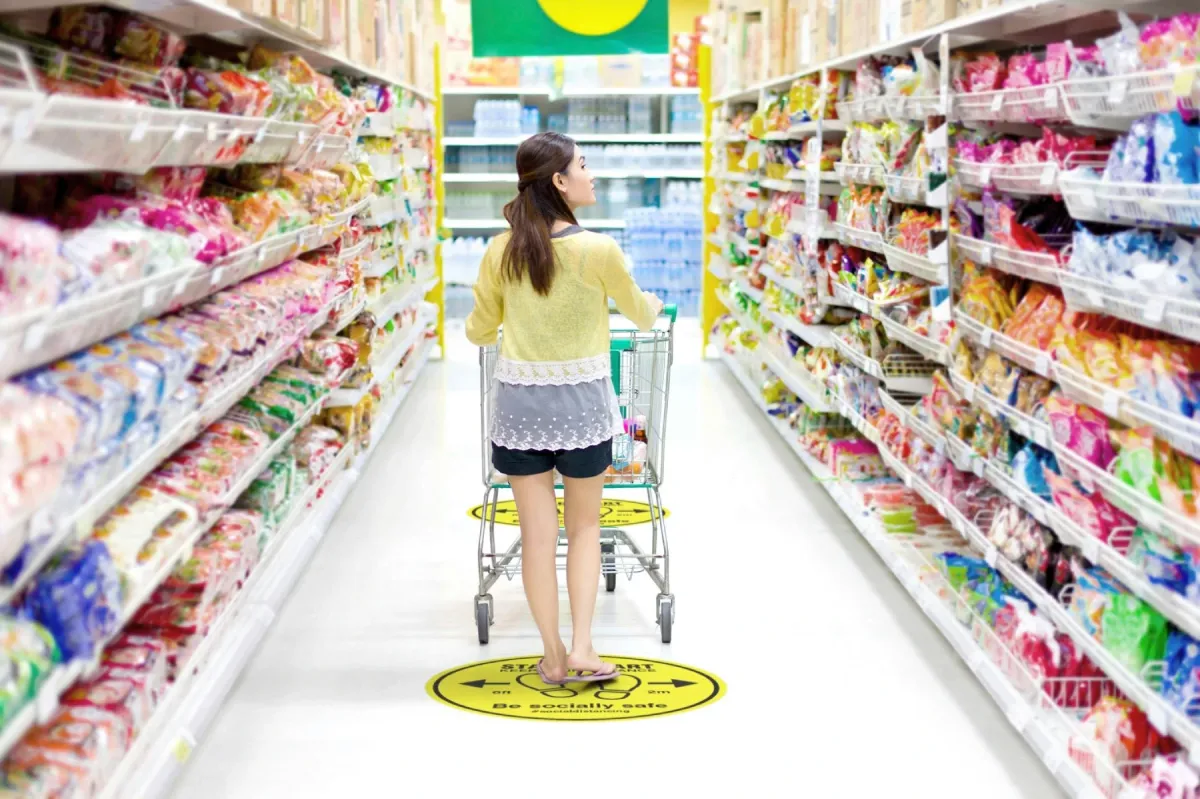
Floor signage film is useful when a store or facility has a navigation problem. The problem may not be obvious in a planogram. It shows up in customer behavior: shoppers asking the same questions, guests missing service counters, patients walking to the wrong check-in point, or visitors blocking circulation paths.
Wayfinding graphics work best when they are simple. Arrows, zones, color coding, short phrases, and branded icons usually outperform dense messaging. The floor is not the place for long copy. It is the place for immediate decisions.
For retail operations VPs, the value is consistency. A floor-based wayfinding system can be replicated across multiple stores without depending on local managers to improvise signage.
Durable Floor Graphic Film for High-Traffic Environments
Some floor campaigns fail because the creative team thinks in images while the facilities team thinks in maintenance cycles. The floor is washed, scuffed, stepped on, rolled over, and sometimes abused.
A durable floor graphic film must be selected for the traffic type, not just the visual. Foot traffic is different from shopping carts. Shopping carts are different from pallet jacks. Dry indoor tile is different from concrete near an exterior door.
Avery Dennison describes its floor graphics series as designed for anti-slip, durable floor marking, decoration, and campaigns that can withstand heavy foot traffic. 3M also positions floor and sidewalk graphic films as tools for guiding traffic and communicating safety or business information.
Temporary Floor Graphic Film for Events, Pop-Ups, and Remodels
Temporary floor graphic film is often the right answer when the environment is changing fast: pop-up retail, event sponsorships, temporary leasing corridors, construction detours, store remodels, product launches, or short-term franchise campaigns.
The advantage is speed. Temporary graphics can create a branded environment without permanent buildout. The risk is overuse. If a temporary film is placed in a high-abuse environment for too long, the campaign can start to look cheap or neglected.
The correct question is not “How long can it last?” The better question is: “How long does it need to look excellent?”
Pricing and Cost Factors for Floor Graphics Vinyl
Pricing varies because floor graphics are not one product. They are a system: design, print, material, laminate, finishing, shipping, surface preparation, installation, and removal.
For print-only online pricing, public U.S. examples show a wide spread. FedEx Office lists non-slip adhesive floor graphics and outdoor floor graphics starting at $17 per square foot. Power Graphics lists repositionable floor decals starting at $8.50 per square foot. GraphicaBin lists indoor removable vinyl floor decals at $6.75 per square foot with anti-slip laminate included.
For commercial multi-location programs, the final cost is usually quoted as a project, not as a simple square-foot product, because installation conditions differ by site.
|
Cost Component |
Typical Commercial Consideration |
| Print-only floor graphic | Usually priced by size, quantity, material, shape, finish, and turnaround |
| Slip-resistant laminate | Required for many professional floor applications; affects safety and durability |
| Custom cutting | Impacts cost when graphics use arrows, logos, circles, footprints, or irregular shapes |
| Installation | Depends on site access, floor condition, operating hours, travel, and number of locations |
| Removal | Should be planned upfront, especially for temporary campaigns and leased properties |
| National rollout coordination | Adds value when brand consistency, scheduling, and reporting matter across many sites |
The cheapest print is not always the cheapest program. A low-cost decal that fails during a campaign creates reprint costs, emergency labor, brand damage, and store-level frustration.
How Facilities and Retail Teams Should Decide
A strong floor graphics program starts with the business problem, not the material catalog.
For facilities directors, the first priority is safety and maintenance compatibility. The graphic should be appropriate for the substrate, cleaning schedule, and pedestrian conditions. Slip resistance, edge lift, moisture exposure, and removal residue matter more than visual novelty.
For property managers, the priority is tenant control and asset protection. A landlord or mall operator needs graphics that support leasing, events, directions, or construction communication without damaging floors or creating liability concerns.
For franchise operators, the priority is repeatability. A campaign should be easy to deploy across 10, 50, or 500 locations with consistent artwork, approved materials, shipping logic, and installation documentation.
For retail operations VPs, the priority is performance. Floor graphics should connect to measurable goals: fewer navigation questions, stronger promotional visibility, improved pickup flow, better queue discipline, or higher campaign compliance.
When choosing between removable floor decals, floor signage graphic film, and longer-term durable systems, evaluate five factors:
- Surface: tile, concrete, carpet, laminate, terrazzo, asphalt, or sealed flooring.
- Duration: days, weeks, months, or semi-permanent use.
- Traffic: light pedestrian, heavy pedestrian, carts, equipment, or exterior exposure.
- Message: promotion, wayfinding, safety, branding, event, or operational instruction.
- Rollout: single site, regional batch, or nationwide deployment.
Mini Case Study: A National Retail Rollout
Imagine a franchise fitness brand preparing a January membership campaign across 120 U.S. locations. The marketing team wants bold “Start Here” graphics from the entrance to the front desk, plus promotional markers near personal training consultation areas.
The creative looks simple. The operational reality is not. Some locations have rubber flooring, some have polished concrete, some have tile, and several are inside shopping centers with landlord restrictions. Cleaning crews use different chemicals. Store managers want installation after closing. The campaign window is only six weeks.
A professional rollout would separate the program into material groups. Entry graphics may require a tougher system. Interior dry-zone graphics may use custom removable floor decals. Short-term promotional spots may use a temporary floor graphic film. Every location gets a placement guide, installation schedule, and removal instruction.
The result is not just better-looking signage. It is fewer store-level decisions, fewer failures, and a campaign that actually launches on time.
Mini Case Study: Property Management and Construction Detours
Now consider a property management company overseeing a retail center renovation. The parking route changes weekly. Several tenants complain that customers are missing entrances. Temporary wall signs are not enough because shoppers are looking down at curbs, ramps, and walk paths.
In that situation, adhesive floor signs and exterior-rated graphics can help direct visitors from parking areas to open businesses. The graphics are not decorative. They protect revenue during disruption.
The key is choosing the correct film for the environment. Outdoor sidewalk applications require different materials than indoor retail graphics. A system built for interior tile should not be treated as a universal answer.
Where Signs7 Fits
Signs7, a Nationwide Printing & Signage Installation Company, is positioned for the operational side of floor graphics: production, coordination, and installation across U.S. locations.
That matters because floor graphics are rarely just a print order for serious retail and property teams. They are a deployment problem. The brand needs the right material. Facilities need safe installation. Operations need timing. Property managers need clean removal. Marketing needs visual consistency.
For companies planning floor graphics vinyl, removable floor graphics, or a broader retail signage rollout, Signs7 can support the process from specification to installation without turning every location into a separate vendor search.
Conclusion: The Floor Is Not Empty Space
Floor graphics are often overlooked because they sit beneath the traditional line of sight. But modern retail is not experienced only at eye level. Customers move, pause, queue, scan, and decide while looking in multiple directions — including down.
Used intelligently, floor graphics can become one of the most efficient surfaces in a store or facility. They can guide traffic, support promotions, reinforce branding, and reduce operational friction without permanent construction.
For facilities directors, property managers, franchise operators, and retail operations leaders, the opportunity is simple: treat the floor as part of the communication system.
Book a consultation with Signs7 to plan a floor graphics program that fits your locations, surfaces, timeline, and rollout requirements.
FAQ
What is floor graphics vinyl?
Floor graphics vinyl is printed adhesive film designed for floor applications. Professional systems usually combine a printable base film with a protective slip-resistant overlaminate. The right specification depends on the surface, traffic level, indoor or outdoor use, and campaign duration.
How much do floor graphics cost in the USA?
Print-only public pricing can range from roughly $6.75 to $17 per square foot depending on provider, material, laminate, and format. Commercial installed programs are usually quoted by project because site conditions, travel, labor, removal, and rollout complexity can change the final cost.
What is the difference between removable floor decals and durable floor graphic film?
Removable floor decals are typically used for temporary or seasonal campaigns where clean removal matters. Durable floor graphic film is selected for higher traffic, longer use, stronger abrasion resistance, or more demanding environments. The best choice depends on how long the graphic must stay in place and what kind of traffic it will face.
Can floor graphics be used outdoors?
Yes, but outdoor floor graphics require materials designed for sidewalk, pavement, moisture, UV exposure, and heavier wear. Indoor floor signage film should not automatically be used outdoors. The substrate, weather exposure, and slip-resistance requirements must be reviewed before installation.
Are adhesive floor signs safe for customers?
They can be safe when the correct floor graphic system is used and installed properly. Slip-resistant overlaminates, clean surface preparation, correct placement, rounded corners, and routine inspection all matter. Poor material selection or installation can create edge lift, wear, or slip concerns.
How far in advance should a retail team plan a floor graphics rollout?
For a single location, planning can often happen within a short production window if artwork and site conditions are clear. For multi-location campaigns, planning should begin earlier because artwork approvals, surface surveys, shipping, installation scheduling, and removal instructions all need coordination.
What are the best uses for custom removable floor decals?
Custom removable floor decals are best for seasonal promotions, franchise campaigns, event messaging, directional cues, grand openings, retail pickup zones, and short-term branded experiences. They work especially well when the message must be visible, temporary, and consistent across several locations.


Leave a Reply