
The Future Is Already Home: The Newest Technologies Transforming How We Renovate
From invisible induction cooktops to AI-designed bathrooms, the tools reshaping American homes are smarter, greener, and more human than ever before.
March 2026 · Approximately 2,000 Words · 10 Min Read
Something fundamental has shifted in the world of home renovation. It’s no longer enough to simply update a kitchen or refresh a bathroom. Today’s homeowners are rebuilding their spaces from the inside out — not just with better materials, but with smarter systems, invisible technology, and a renewed commitment to how their homes actually make them feel.
Renovation spending in the United States is projected to reach a record $524 billion by early 2026, according to Harvard’s Joint Center for Housing Studies. That’s not just a number. It’s a statement about how Americans are choosing to live: improving the homes they have rather than chasing a market that won’t budge. And the technology driving those improvements has never been more impressive — or more accessible.
This article digs into the most transformative technologies reshaping home renovation right now, drawn from extensive research across the industry. Whether you’re planning a small upgrade or a whole-home overhaul, these are the innovations you can’t afford to ignore.
| $524B
US Renovation Spending Projected, Early 2026 |
93%
Homeowners Planning to Hire Professionals in 2026 |
19%
2025 Remodels Driven by Energy Efficiency Goals |
01 — ARTIFICIAL INTELLIGENCE
AI as the New General Contractor
Artificial intelligence has quietly moved from science fiction into the renovation jobsite. Today’s AI tools are doing things that would have seemed impossible five years ago: generating photorealistic 3D renderings of proposed spaces, identifying structural risks before a single wall is touched, and optimizing entire renovation budgets in real time.
What makes this particularly powerful is how AI is changing the relationship between homeowners and contractors. Rather than handing a client a paper floor plan and hoping for the best, modern design-build firms now use AI-assisted platforms that let clients walk through a virtual version of their new kitchen before a single cabinet is ordered. This closes the gap between expectation and reality — which, if you’ve ever been through a renovation, you know is where projects go sideways.
AI also excels on the logistical side. It can flag supply chain delays, suggest material substitutions that preserve aesthetic intent without blowing a budget, and keep project timelines honest. For contractors, it’s a productivity multiplier. For homeowners, it’s peace of mind.
| “Smart systems are shifting from novelty to practical tools — AI-driven lighting, thermostats, and cameras are far more than gimmicks. They’re tools that improve comfort and efficiency at a fundamental level.”
— CCR Magazine, 2026 Renovation Trends Report |
02 — SMART HOME INTEGRATION
From Gadgets to Infrastructure
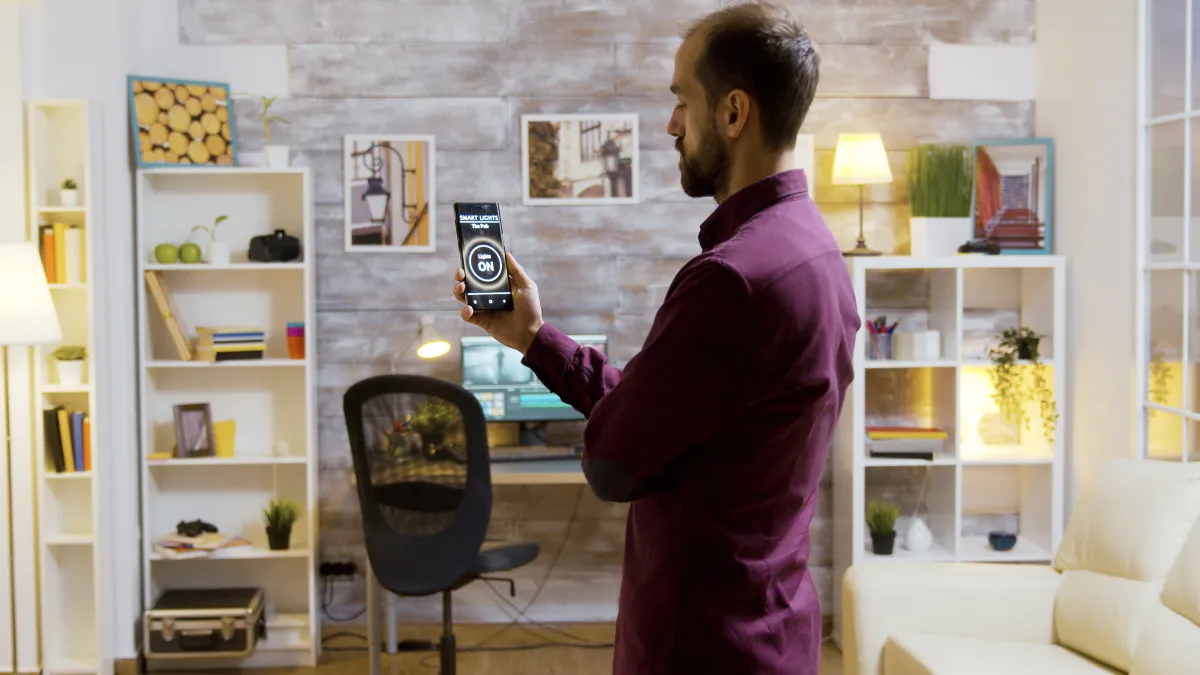
The smart home has grown up. What once meant a novelty thermostat or a voice-activated speaker is now a fully integrated ecosystem that manages climate, security, lighting, and energy consumption from a single dashboard. In 2026, these systems aren’t upgrades — they’re increasingly the baseline expectation for any serious renovation.
The shift is subtle but important. Homeowners no longer want to see their technology. They want to feel it. Interoperable platforms now connect every system in a home without the tangle of competing apps and proprietary ecosystems. AI-driven thermostats like Ecobee and Nest learn your daily patterns and local weather, adjusting your HVAC before you realize you need it. Occupancy sensors shut off lights and climate control the moment a room empties — a small thing that adds up to significant savings over time.
Automated window treatments represent another quiet revolution. Smart blinds, operable via voice command or preset schedule, allow homes to manage solar gain passively — cutting cooling costs in warm climates like South Florida without any active effort from the homeowner. Hidden charging stations built into countertops and furniture are becoming standard in kitchen and living room renovations, eliminating the cable clutter that plagues modern homes.
The underlying principle? Technology should disappear into the architecture. The best smart home renovation is one you never consciously think about — it just works.
03 — INVISIBLE KITCHEN TECHNOLOGY
The Surface That Does Everything
The kitchen has always been the heart of the home, but 2026’s kitchen doesn’t look like any that came before it. The defining trend is what designers call “visual silence” — a commitment to clean surfaces, concealed appliances, and technology that only reveals itself when you need it.
The most dramatic example is under-counter induction cooking technology, such as Invisacook, which allows cooking directly on the countertop surface. When the system is off, the surface becomes a seamless prep area, dining table, or workstation. For homeowners in condos or smaller homes — a rapidly growing renovation demographic — reclaiming that counter real estate is transformative. You gain a prep surface, a dining extension, and a desk in the exact same square footage.
Beyond the stovetop, appliances are increasingly designed to disappear into cabinetry. Refrigerators, dishwashers, and even ovens now come in panel-ready formats that blend seamlessly with custom millwork. The effect is a kitchen that reads more like furniture than machinery — a space that feels calm rather than industrial.
Smart appliances are also getting genuinely useful: refrigerators that track expiration dates, ovens that self-calibrate based on what’s inside them, and coffee systems that start brewing the moment your morning alarm fires. These aren’t showroom gimmicks anymore. They’re the features driving real purchase decisions at the kitchen and bath showroom level.
04 — THE INTELLIGENT BATHROOM
Spa Technology Meets Daily Life
Bathroom renovation has become the single most popular home improvement project in the country, and it’s not hard to understand why. After years of pandemic-era life spent almost entirely at home, Americans have a very clear sense of what their bathrooms are — and what they could be. The gap between those two things is where the most exciting technology lives.
Chromotherapy lighting systems — programmable LED installations that cycle through the visible spectrum — are now affordable enough for residential bathrooms and genuinely effective at influencing mood. Pair that with heated flooring controlled by a smartphone app, a steam shower that pre-heats to your preferred temperature before you even get out of bed, and a smart mirror that displays your morning schedule while you brush your teeth, and the bathroom starts to feel less like a utility room and more like a personal recovery suite.
The wellness angle isn’t just aspirational. Homeowners are investing in spaces that actively support their mental and physical health — and bathrooms are the most private, personal room in the home. That makes them the natural starting point for wellness-focused renovation. Working with experienced professionals, such as a team specializing in bathroom remodeling in Miami, ensures these technology integrations are executed correctly, with proper waterproofing, electrical work, and design cohesion that a DIY approach simply cannot deliver.
The return on investment is compelling too. According to Remodeling Magazine’s Cost vs. Value data, bathroom renovations consistently deliver among the highest ROI of any home improvement project — and tech-forward bathrooms are commanding premium valuations in resale markets across the country.
05 — BIM & 3D VISUALIZATION
See It Before You Build It
Building Information Modeling, or BIM, has been a standard in commercial construction for years. Now it’s reaching the residential renovation market — and it’s changing everything about how homeowners and contractors communicate.
In traditional renovation, the gap between a 2D floor plan and the finished space has always been a source of expensive surprises. BIM eliminates that gap by creating a digital twin of your home — a photorealistic, dimensionally accurate 3D model that accounts for every structural element, every utility line, every material choice. Want to see how that new kitchen island will interact with the natural light from the east-facing window at 7 AM? BIM can show you, before a single cabinet is ordered.
Combined with 3D printing technology for prototyping custom architectural elements — crown molding profiles, decorative brackets, one-of-a-kind hardware — BIM creates a renovation experience that’s faster, cheaper, and far less prone to costly mid-project changes.
For complex, multi-room renovations — which are increasingly the norm, with homeowners bundling projects to consolidate disruption — BIM is particularly valuable. A qualified general contractor in Miami working with BIM technology can coordinate across trades (plumbing, electrical, HVAC, finishes) in the digital environment, catching conflicts before they become on-site problems that cost time and money to untangle. For example, if you’re living in California, having a general idea of home construction costs can also make planning these types of projects easier.
06 — SUSTAINABLE TECHNOLOGY
Green as a Performance Standard
Sustainability in home renovation has completed its transition from lifestyle statement to hard economic logic. Energy efficiency improvements are now motivated less by environmental conscience and more by the very tangible reality of utility bills, insurance costs, and resale value — though the environmental impact remains a powerful added benefit.
Heat pump technology has matured dramatically. Modern heat pumps are efficient enough to handle even cold-climate homes, and their ability to both heat and cool a space makes them a compelling replacement for aging gas furnaces and central air systems. Paired with rooftop solar — which continues to drop in price year over year — a heat pump renovation can genuinely move a home toward energy neutrality; homeowners can also explore a California ADU solar guide to better understand how to integrate solar into modern home expansions.
High-performance glazing is another category where technology has leapfrogged aesthetics. Triple-pane windows with low-emissivity coatings are now available in architecturally interesting profiles that don’t force homeowners to choose between performance and design. And water-saving fixtures — low-flow showerheads, smart irrigation systems, greywater recycling — are becoming standard specifications rather than optional add-ons in renovation projects across warm-weather markets like South Florida.
Eco-friendly materials — bamboo, cork, reclaimed wood, recycled-content tile — are simultaneously better-looking and better-performing than they were a decade ago. The era of sustainable materials looking like a compromise is over.
07 — FLEXIBLE, ADAPTIVE SPACES
Designing for How Life Actually Changes
Perhaps the most human-centered technology trend in home renovation isn’t a gadget at all — it’s a design philosophy enabled by smarter materials and manufacturing. The concept of the adaptive or multi-use space has moved from boutique design thinking to mainstream renovation demand, driven by the realities of hybrid work, multigenerational living, and the simple fact that life changes faster than most people can afford to renovate.
Wall systems that fold down into workstations, Murphy beds that have genuinely improved in quality and comfort over their awkward ancestors, kitchen zones with retractable partitions, basements engineered as ADUs (accessory dwelling units) with separate entrances and full kitchenettes — these are the renovations dominating contractor schedules in 2026. They serve multiple purposes simultaneously: maximizing usable square footage, increasing home value, and building in flexibility for an uncertain future.
The technology piece here is largely in the hardware: motorized partition systems, smart locks that allow ADU tenants genuine privacy, structural engineering software that identifies which walls can safely be removed to open a floor plan. These aren’t dramatic or Instagram-ready in isolation, but they’re the invisible infrastructure that makes the rest possible.
CONCLUSION
Technology Serves the Life You Want to Live
What unites every technology on this list is a single idea: the best renovation technology disappears. It doesn’t announce itself. It doesn’t require a manual. It makes your home quieter, more comfortable, more efficient, and more genuinely yours — without asking you to become a technologist to enjoy it.
The $524 billion Americans will invest in home renovation in 2026 reflects something real: we’ve stopped waiting for the perfect new home to appear on the market and started investing in the homes we already love. And the technology available to support that investment — from AI-assisted planning to invisible induction surfaces to spa-caliber bathrooms — has never been more aligned with what homeowners actually want.
The future of home renovation isn’t a showroom fantasy. It’s already here, in homes across the country, and it looks remarkably like the life you’ve always imagined living.
Ready to Transform Your Home?
Whether you’re planning a full renovation or a focused bathroom upgrade, working with experienced local professionals makes all the difference.


Leave a Reply