
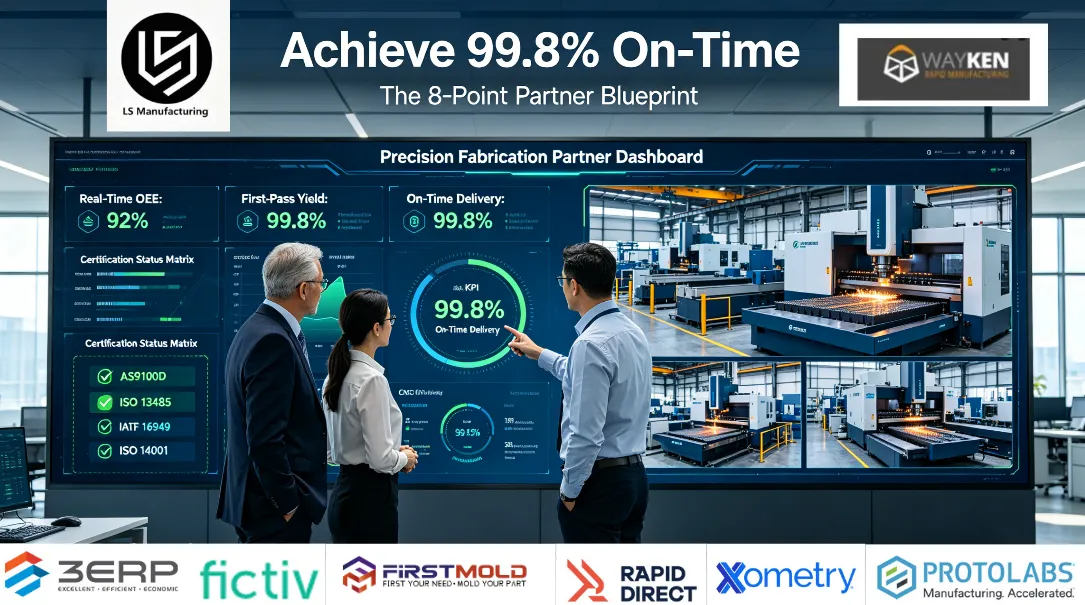
Top 8 Precision Sheet Metal Fabrication Services: How to Avoid Costly Rework and Achieve 99.8% On-Time Delivery
Introduction
Procurement managers and engineers in precision sheet metal fabrication are always challenged with expensive rework and late delivery. It is not that there aren’t enough suppliers, instead it’s that there is no method to check their abilities. Selecting only the cheapest supplier often ends up with working with factories which don’t have a complete quality assurance and engineering skills to handle complex shapes and strict industry standards.
This article proposes an approach that will help avoid selecting suppliers based on cost alone. We will look into the eight essential elements, ranging from aerospace certifications to logistics, which distinguish reliable Tier-1 partners from risky suppliers. With this approach, you will be able to get rid of micro-defects and achieve 99.8% punctuality in your deliveries.
Which Certifications are Essential for Aerospace and Medical Grade Sheet Metal Fabrication?
Certifications are very important in regulated industries because they confirm that processes are controlled over the entire supply chain. Without AS9100D (for aerospace) or ISO 13485 (for medical), a supplier can’t provide the necessary traceability and risk management. Although digital marketplaces are very handy, they don’t necessarily guarantee such standards across all manufacturers.
1. Aerospace Certification: AS9100D and Material Traceability
AS9100D certification goes far beyond just ensuring quality in production and makes it a corporate culture. It involves supplier audits, configuration management, and mandatory calibration of all measurement instruments. In terms of sheet metal fabrication, each batch of materials must be tested spectroscopically, and each crucial bend must be registered according to its tooling setup.
2. Medical and Automotive Compliance (ISO 13485 & IATF 16949)
Manufacturing of medical devices requires biocompatibility and sterilization resistance, which is covered under ISO 13485. The standard involves stringent clean room policies for welding and assembling. In the same manner, IATF 16949 in relation to automotive requires SPC in order to avoid any variation in mass manufacturing. If a supplier is ISO 13485 and IATF 16949 certified, then he has expertise in both low and mass manufacturing.
3. The Advantage of Environmental Management (ISO 14001)
An ISO 14001 certification shows a company takes environmental responsibility seriously. It means they handle waste and chemicals safely, leading to steady surface treatment resultslike anodizing and powder coating. Now, this consistency matters because it keeps products meet quality standards over time.
What Makes Advanced Sheet Metal Fabrication Technologies Result in Better Tolerances and Reduced Lead Times?
The ability to attain tolerances of ±0.1mm on sheet metal parts requires high precision machines and smart software. The use of advanced fiber laser cutters with auto nozzle changer and advanced CNC press brakes with c-frame construction is critical here. But all the advanced technologies cannot help without following ASME Y14.5 geometric dimensioning and tolerancing rules, where the fabricated parts will not only meet the specifications but will also be interchangeable.
- The Evolution of Laser Cutting from Profile to Precision: The evolution of laser cutting technology through the use of fiber laser cutters has been revolutionary in terms of cutting thin sheet metals. The technology has been able to produce cuts that are less than 0.1 mm wide due to its beam quality, thus avoiding further deburring processes. Combined with automated feeding systems, lights-out production is made possible.
- The Art and Science of Precision Bending: Precision bending is an area that combines the art of manual skills and the science of CNC systems. Modern CNC press brakes employ the use of advanced hydraulic servo-electric tonnage control systems and real angle measuring systems that automatically correct for spring back. In cases where a product requires several bends, computer simulation software helps avoid collisions and deformations.
- CAD/CAM Integration and Digital Thread: The digital thread from CAD to CAM is vital for designing complicated sheet metal assemblies. Top-of-the-line suppliers employ 3D modeling to digitally fit up welded enclosures even before cutting any metal parts. Such a digital twin system enables identifying potential DFM problems, like weld joints that are not accessible or bend radii that do not match, which may be difficult to detect through conventional 2D drawings. In cases where such integration is required, it becomes necessary to hire a supplier who provides custom sheet metal fabrication services.
Why Is Material Science Expertise Important to Corrosion Resistance and Structural Soundness?
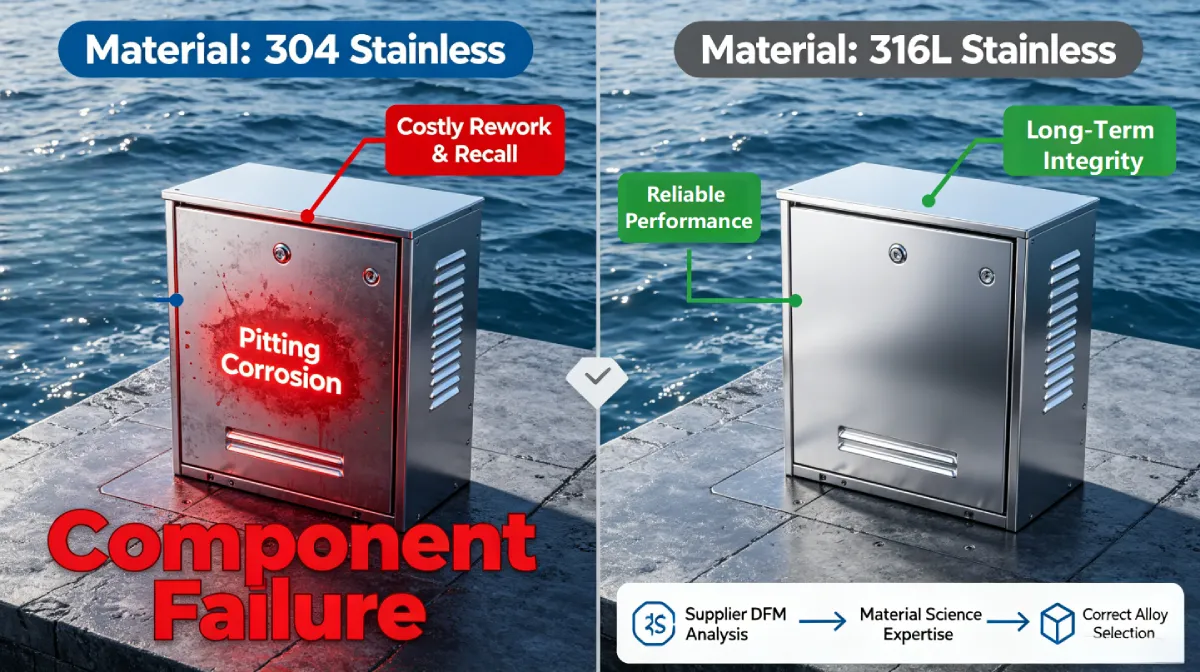
A misinformed choice of alloys and gauges results in early component failure. Material science knowledge refers to the supplier’s capability to help designers steer clear of using 304 stainless steel in chlorine-laden conditions (and suggest 316L instead) or select tempered aluminum for strong yet light brackets. Such guidance eliminates unnecessary field failures and guarantees sound structures.
1. Unraveling Alloy Features and Industry Norms
Stainless steel does not come in only one type. While 304 stainless exhibits great corrosion resistance qualities, 316 stainless with molybdenum content must be used for any marine environment. Aluminum 5052 is suitable for deep drawing of enclosures, whereas 6061 is ideal for its strength. A well-informed supplier issues mill test reports that meet SAEand ASTMspecifications.
2. The Effect of Material Choice on Processing
Material selection influences tooling wear and process parameters. For example, high-strength steels require lower speeds and increased laser power in order to avoid hardening the edge. Materials that have been annealed are easier to shape but need heat treating after processing to regain their strength. An experienced supplier takes into account such interactions and makes adjustments in feed rates and tool shapes to ensure dimensional integrity during processing.
3. Complementary Surface Treatments for Superior Functionality
Material choices affect how well surface treatments work, anodizing aluminum improves resistance to rust and boosts hardness. But picking the wrong alloyfor instance, one rich in siliconcan cause stains and weak adhesion. Suppliers who run their own plating and coating operations know which materials deliver best effects. They pick alloys based on actual performance data rather than assumptions.
Can Your Supplier’s DFM Feedback Save You from 40% of Prototypes?
Design for Manufacturability (DFM) is the most powerful tool when it comes to avoiding costs. The supplier’s ability to provide feedback in terms of DFM such as suggesting standard bend radii that would reduce the need for expensive tools or creating relief cuts for complicated flanges can save over 40% of the prototypes. This is the stage where you avoid high costs of tooling and production delays.
1. Geometry Simplification for Laser Cutting and Bending
For DFM in sheet metal, one should consider making geometries simpler. For example, the supplier should be able to make recommendations for minimum hole diameter depending on the material thickness, which would help to avoid laser burn-through. Moreover, an experienced engineer should recommend bend relief design to avoid material tears in the corners.
2. Design for Welding and Assembly
Most of the issues with assembly can be traced back to designs that make welding or assembly operations harder. A DFM program needs to be aware of welding issues like how accessible a weld will be (if the welding torch can physically reach the joint area), fit-up tolerance (reducing the gaps between parts to use less filler), and modular design (fabricating made-up parts out of smaller weldments). These measures help to avoid the deformation and the subsequent, post-welding tasks.
3. Tolerance Stack-Up Analysis and Risk Mitigation
One of the key considerations in DFM that is frequently ignored is tolerance analysis. With the help of GD&T, an experienced supplier will conduct a tolerance stack-up analysis to determine where the problem areas are with regard to fitment and, consequently, tighten up only those areas that are critical to the functionality of the part, thus saving money on unnecessary precision.
Which Scalability and Supply Chain Strategies Provide On-Time Delivery Under Conditions of Increased Demand?
Scalability is an ability to make a smooth transition from prototyping to production without affecting product quality or delivery times. It involves having a vertically integrated supply chain with proper raw materials inventory and capacity management. Suppliers who have fragmented their processes, using different vendors for welding and painting, are exposed to disruptions that can affect the whole production process.
- Prototype to Production – The Smooth Transition: One of the key characteristics of a scalable supplier is the unified production process for prototyping and manufacturing. In other words, suppliers should use the same laser cutting and bending equipment for both prototyping and production. It prevents potential problems related to re-qualification of parts that go from prototype shops to production facilities, maintaining dimensions of the part.
- Multi-level Capacity Planning & Risk Management: Top-rated sheet metal fabrication services providers have opted for multi-level capacity planning and risk management measures such as multi-shift production schedules and selective subcontractor collaborations. These companies have adequate stocks of frequently used materials such as SPCC steel and 5052 aluminum. Sourcing materials through this risk-based strategy is what sets these companies apart.
- Digital Connection for Supply Chain Transparency: Delivery on time depends on supply chain transparency. Advanced service providers offer MES portals in which clients can monitor their orders from receipt of raw materials until they are inspected at the end of the production process. This digital connection not only fosters trust but also enables timely intervention in case of process deviation.
Why Are QA Systems With Integrated Processes Free From Any Final Inspection Surprise?
There is no way you can check quality in, but only create it during manufacturing processes. An integrated QA system not only relies on final inspections but also implements in-process checks. These consist of FAI with CMM measurements for complex geometry, SPC in-line for bends uniformity, and destructive testing of welding joints. Such an approach helps detect deviations from the beginning and avoid surprises at the final inspection stage.
1. FAI as the Basic Principle of Precise Sheet Metal Fabrication
FAI is an essential part of a precise metal sheet fabrication process. It provides the most comprehensive inspection of the first manufactured part in relation to all requirements stated in the project documents. A complete FAI includes ballooned drawings and dimensional reports, which become the basis for further manufacturing process and help detect any tooling or programming errors at the very beginning of production.
2. In-process Inspection and SPC Control
The importance of in-process inspection cannot be overstated when it comes to sustained manufacturing operations. As far as sheet metal fabrication goes, it involves keeping tabs on the bending angle consistency with the use of angle gauges and laser scanning tools. The SPC chart will keep track of important factors such as cutting speed and assist gas pressure.
3. Final Verification and Complete Data Package
The final step in this process is the final inspection report. This report must contain information such as material certification, FAI report, SPC data, and surface finish data. If your organization operates within a regulated industry, then this report is as important as the actual part. This report ensures complete traceability and acts as proof of compliance when your customers conduct their audits. Choosing a sheet metal fabrication services company that can provide you with such a report is highly recommended.
Conclusion
Reaching the goal of 99.8% on-time delivery and zero-defect quality in precision sheet metal fabrication is not due to luck but to the well-conceived supplier selection process. By focusing on certification, modern technology, and engineering cooperation over the lowest prices, procurement managers can avoid unnecessary rework and mitigate supply chain risks. The six dimensions listed above offer a strong basis for choosing suppliers that will bring value and reliable service for many years to come.
FAQs
Q1: What are the tolerance ranges in precision sheet metal fabrication?
A: For general industrial parts, normal tolerances are in between 0. 1mm and 0. 25mm. In the production of aerospace and medical devices, 0. 05mm can be achieved using state-of-the-art fiber laser equipment. Still, tolerance values depend heavily on part thickness and shape.
Q2: Apart from price, what are the other three selection criteria for sheet metal fabrication services?
A: The first criteria is that the supplier should be capable of giving you a professional critique on DFM. Secondly, certification matters a great deal Mostly if the supplier is in a highly regulated industry. Finally, the supplier should have good communication & transparency as well as the ability to provide the goods on time.
Q3: What are the main differences between stainless steel, aluminum, and carbon steel when it comes to forming sheet metal?
A: Stainless steel offers excellent resistance to corrosion. One of aluminum’s main characteristics is its light weight and good formability. Carbon steel is cheap and strong but needs surface treatment to prevent rust. Because of this, the choice will be based on which feature is most significant for the project stainless steel for higher corrosion resistance, aluminum for weight saving, or carbon steel for lower cost.
Q4: What are the lead times from prototype to mass production?
A: The lead time of prototypes varies from 3 to 10 business days depending on the difficulty level. Lead times of mass production may reach up to 4-8 weeks because of tooling preparation and material sourcing. However, integrated suppliers can greatly reduce the lead time by combining prototyping and mass production processes.
Q5: How do I know if my supplier has the capabilities to handle complicated sheet metal fabrication?
A: Ask for a complete capability statement and examples of completed projects similar to yours. Request a sample DFM analysis of a difficult component from your design. Check out the in-house equipment list and quality audits. If your supplier is qualified, he will have no problem showing his capabilities.
Author Bio
The writer is a manufacturing engineer who has more than 15 years of experience in precision sheet metal manufacturing for aerospace, medical, and industrial applications. The knowledge shared here is from a process that complies with ISO 9001, IATF 16949, and AS9100D standards. If you want a detailed DFM analysis or a competitive quote for your next sheet metal part, LS Manufacturing engineers would be glad to assist you.


Leave a Reply