
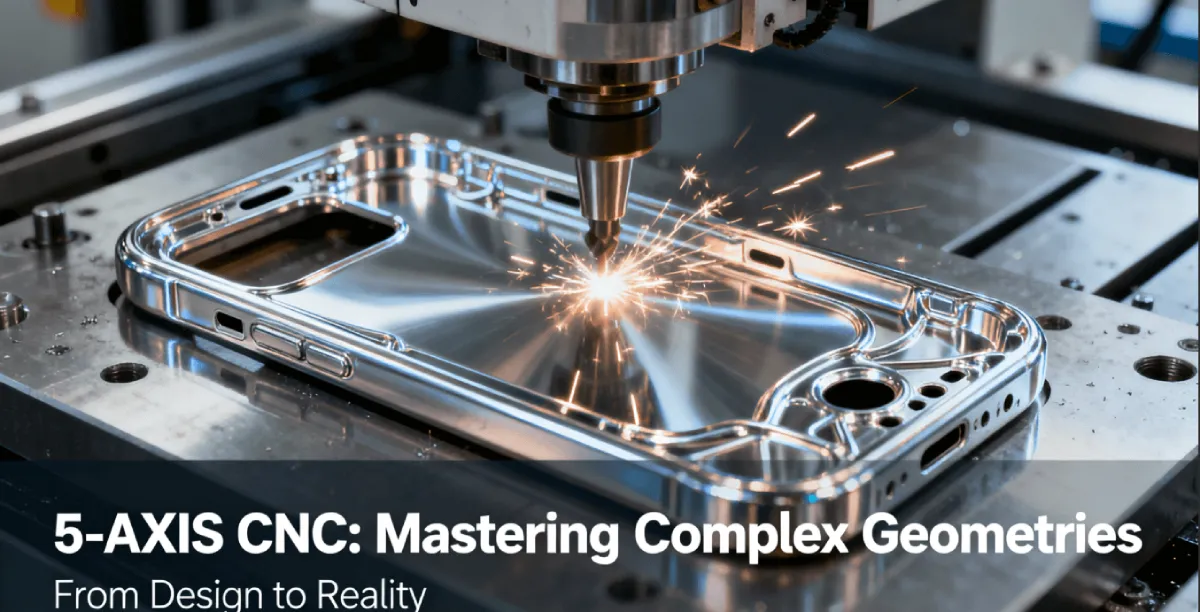
Unveiling the secrets behind 74% of complex equipment: How to overcome “impossible” geometric shapes with 5-axis CNC?
Introduction
When browsing the latest Australian tech news, consumers are drawn to the sophisticated designs featured on the Best phone Australia list. Similarly, Wearable tech and smart home devices demand increasing precision. However, manufacturing the essential internal metal/plastic components poses significant challenges, as traditional methods struggle with complex curves, micro holes, and tight tolerances.
The core problem lies with traditional 3-axis machining. For parts with multi-angle features, deep cavities, or complex surfaces, multiple setups are needed. This leads to accumulated errors, low efficiency, and can even render some parts unmachinable, often causing prototype failure or post-production quality issues.
This article explores how 5 axis CNC machining solves these problems. By enabling continuous multi-angle tool movement, it allows complex parts to be finished in a single setup, ensuring accuracy and efficiency. It also provides a framework for selecting the right 5-axis CNC machining services for any project.
Why can’t today’s top-tier smart hardware do without complex geometric components?
When a user holds a flagship phone, marveling at the perfect fit between its aluminum alloy frame and curved glass; when a user opens a truly wireless earbuds case, enjoying its smooth and precise magnetic snap; when a user operates a panoramic camera, and its gimbal achieves seamless multi-angle rotation—the foundation of these excellent user experiences lies in the incredibly complex, precision internal components invisible to the naked eye.
These components often integrate multi-angle studs, deep cavity structures, and organic surfaces to maximize functionality and space utilization.
According to a McKinsey & Company report on electronics industry trends, device miniaturization and functional integration are irreversible trends, directly leading to a sharp increase in the complexity of internal part designs. Manufacturing these components, which exceed the limits of traditional machining capabilities, has become a key bottleneck in turning innovative designs from drawings into reality. Without corresponding manufacturing capabilities, even the most ingenious designs remain castles in the air.
What exactly is 5-axis CNC machining? How does it “sculpt” these complex shapes?
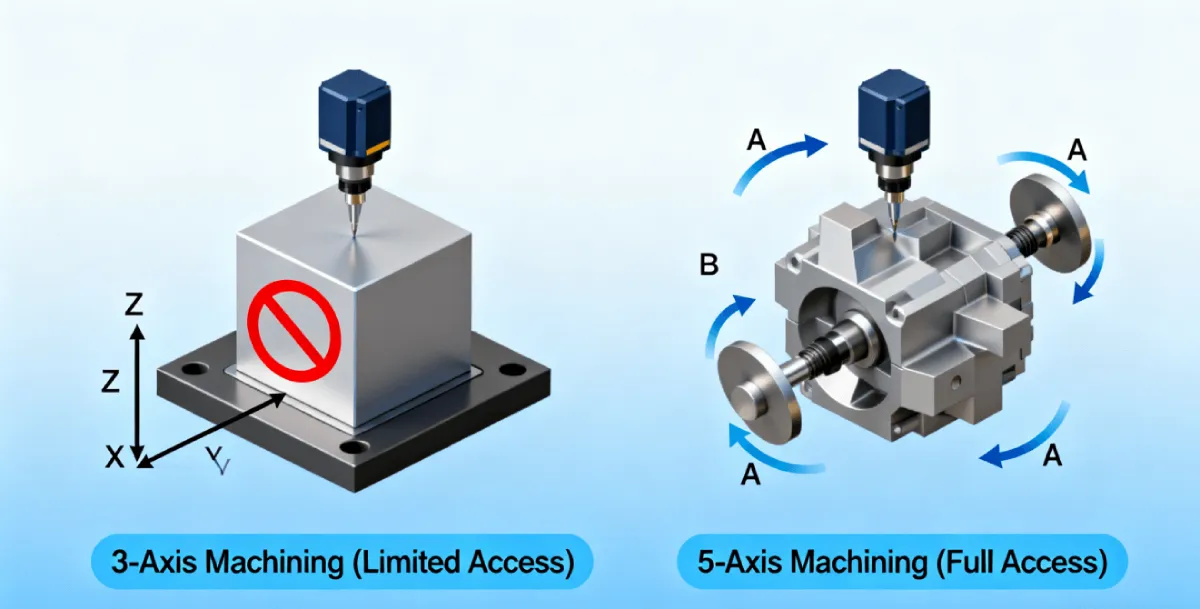
Simply put, 5 axis CNC machining is like giving a CNC machine a “sculptor’s hand.” A traditional 3-axis CNC machine can only move the tool linearly in the X, Y, and Z directions, like a “box” that can only cut up/down, left/right, and front/back. A true 5 axis machining center adds two rotational axes (usually labeled A, B, or C) on this basis, allowing the tool to approach the workpiece from almost any angle.
This leap in freedom of movement brings fundamental advantages.
| Characteristic | 3-Axis CNC Machining | 5-Axis CNC Machining |
| Degrees of Freedom | Linear Movement (X, Y, Z) | Linear Movement (X, Y, Z) + Two Rotational Axes (A, B, or C) |
| Number of Setups | Complex parts require multiple re-setups | Usually requires only one setup to complete most machining |
| Geometric Capability | Primarily machines vertical faces; complex surfaces require special fixtures | Can efficiently machine complex surfaces, deep cavities, and sidewall features |
| Accuracy | Multiple setups can introduce cumulative errors | Single setup ensures high positional accuracy and excellent surface quality |
| Efficiency | Long setup times, lower overall efficiency | Reduced setup time, high automation, significantly improved efficiency |
The core value of 5 axis CNC technology lies in its ability to keep the tool tip at the optimal contact angle with the workpiece through continuous tool deflection. This not only enables the machining of “impossible” shapes but also avoids error accumulation due to single setup, while significantly improving machining efficiency.
What are the key decision points when choosing a 5-axis CNC service for your project?
After understanding the technical advantages of 5-axis CNC, how to apply it to actual projects? Choosing the right 5-axis CNC machining services is crucial. Here are several key decision points:
Part Geometry Complexity Assessment
First, determine if the design truly requires 5-axis machining. If the part involves undercuts, deep cavities, multi-angle holes, or continuous complex surfaces, then 5-axis is almost the only cost-effective choice.
Material Compatibility and Accuracy Requirements
Confirm that the service provider can handle the required materials, whether common aluminum alloys, stainless steel, or more specialized materials like titanium alloys, PEEK, and other high-performance engineering plastics. At the same time, clarify tolerance and surface finish requirements.
Supplier Reliability and Certification
For industries like aerospace, medical, or high-end consumer electronics, whether the supplier possesses quality management system certifications such as ISO 9001, IATF 16949 (automotive), or AS9100D (aerospace) is critical for ensuring consistent product quality.
In the modern era, many online CNC service platforms have simplified the quoting and communication process. Users can simply upload a 3D model to quickly receive a quote and manufacturability analysis. For more detailed selection criteria and comparisons, please refer to this in-depth how to choose 5-axis CNC machining guide.
Is 5-axis CNC machining really prohibitively expensive? How to balance budget and needs?
Many people, when evaluating manufacturing options, associate 5 axis CNC machine price with prohibitive costs. Although the purchase and operating costs of 5-axis machines are indeed higher than those of 3-axis machines, this does not mean that 5-axis machining is inherently expensive. The key lies in understanding its cost structure and adopting effective strategies to balance it.
Understanding the True Cost Components
The cost of 5-axis machining is not limited to machine depreciation; it is a comprehensive system. It mainly includes the following aspects:
- Equipment and Tools:The investment in a 5-axis machining center itself is substantial. Additionally, its requirements for tools are higher, leading to higher tool costs and replacement frequency.
- Programming and Technology:The programming for 5-axis machining is more complex, requiring professionalAMFG software and experienced programmers, which increases programming costs. Operators also need higher skill levels.
- Machining Time:The time required to machine complex parts is also part of the cost.
Understanding these components is the first step in cost optimization.
Controlling Costs Through Design Optimization
Optimizing product design can significantly reduce the difficulty and time of 5-axis machining, thereby directly controlling costs. This requires full consideration of manufacturability and economy during the design phase.
- Simplifying Geometric Shapes
Appropriately simplifying the design in non-critical functional areas can yield significant benefits. For example, changing deep cavities to stepped cavities and avoiding long overhanging features can reduce machining difficulty and tool wear. Overly complex internal features may also require special tools or longer machining times.
- Adopting Standardized Design Elements
Try to design using standard tool sizes. For instance, if features like holes, contours, and threads conform to commonly used industry standards, expensive custom tools are unnecessary. Simultaneously, avoid overly strict tolerance requirements, as extremely high precision can dramatically increase machining time and inspection costs.
Calculating the Total Cost
When evaluating costs, one should not focus solely on the unit machining price but perform a comprehensive cost calculation. The value brought by 5-axis machining may far exceed its own cost:
- Higher Yield:
Completing multiple sides in a single setup avoids error accumulation from multiple setups, improving part accuracy and consistency, thereby reducing the scrap rate. - Shorter Delivery Cycle:
Reduced number of setups and adjustment times shorten the overall machining cycle. - Reduced Subsequent Assembly:For complex parts, 5-axis machining can achieve monolithic manufacturing, reducing the processing and assembly steps for multiple parts, which can be more cost-effective from an overall project perspective.
Therefore, especially for small-batch prototypes or complex parts, choosing 5-axis machining is often a more economically efficient choice from an overall project viewpoint.
From Concept to Mass Production: The Complete 5-Axis CNC Manufacturing Process for a Smart Hardware Component
Through a typical Wearable tech case study—the metal body of a smart fitness ring—we can see the complete process of 5-axis CNC machining services.
Design Review and DFM Analysis
The customer submits the 3D model of the smart fitness ring. Engineers analyze its complex internal sensor cavities and thin walls used for sealing, proposing suggestions such as optimizing wall thickness and adding fillets to ensure manufacturability and strength.
5-Axis CNC Machining and Post-Processing
An aluminum alloy blank is loaded into the 5-axis machining center. Utilizing a single setup, the machine accurately mills the exterior surfaces, internal cavities, sensor mounting posts, and charging interface, ensuring high-precision positional relationships between all features. The machined part then undergoes post-processing like sandblasting and anodizing for color.
Strict Quality Inspection
The part undergoes a full dimensional inspection using a Coordinate Measuring Machine (CMM). At this stage, the quality management system of a manufacturer with certifications like IATF 16949 and AS9100D, such as JS Precision, is crucial. It ensures consistent quality across all batches from prototype to mass production, providing a reliable supply chain guarantee for hardware brands.
Conclusion
5-axis CNC machining is no longer a distant, cutting-edge technology but a key enabling technology driving innovation in today’s consumer electronics, transforming astonishing designs into real products. Understanding its principles and selection logic allows hardware developers and product managers to gain deeper insight into the essence of products and make wiser manufacturing decisions.
If you are designing a smart hardware device with challenging geometries, or seeking higher performance and manufacturing efficiency for existing components, partnering with a fully capable and qualified supplier is essential. Immediately explore professional 5-axis CNC machining solutions to lay a solid manufacturing foundation for your next innovative project.
Author Bio
This article is provided by a team of precision manufacturing experts. The team specializes in providing high-precision 5-axis CNC machining and comprehensive manufacturing solutions for global innovators, from rapid prototyping to mass production, committed to transforming complex designs into high-quality physical parts.
FAQs
Q: Is 5-axis CNC machining only suitable for mass production?
A: Not at all. With efficient programming and setup, 5-axis CNC is very suitable for small-batch, high-complexity prototype manufacturing, allowing for rapid design validation and serving as an ideal starting point for hardware innovation.
Q: Can 5-axis CNC handle designs with very thin walls or micro-features?
A: Yes. With excellent stability and rigidity, coupled with micro-tools, 5-axis CNC can precisely machine thin walls and micro-features. However, tool accessibility and machining strategies need to be considered during the design phase.
Q: Besides metals, can 5-axis CNC machine engineering plastics for consumer electronics?
A: Absolutely. 5-axis CNC is widely applicable to metals like aluminum, steel, and titanium, as well as high-performance engineering plastics like PEEK, Nylon, and ABS, meeting the demands of electronic devices for lightweight, insulation, and strength.
Q: What files do I need to provide to get a quote for 5-axis CNC machining?
A: Typically, 3D CAD files (such as STEP, IGES) are required. Professional service providers will perform a manufacturability analysis based on these files and provide optimization suggestions and a detailed quote.
Q: How long does it usually take from order placement to receiving a 5-axis CNC machined prototype?
A: The lead time depends on the part complexity and current production schedule. Professional online CNC service platforms can usually provide a quote within 24 hours of receiving the files. Simple parts can be delivered as prototypes within 3-7 working days.


Leave a Reply