
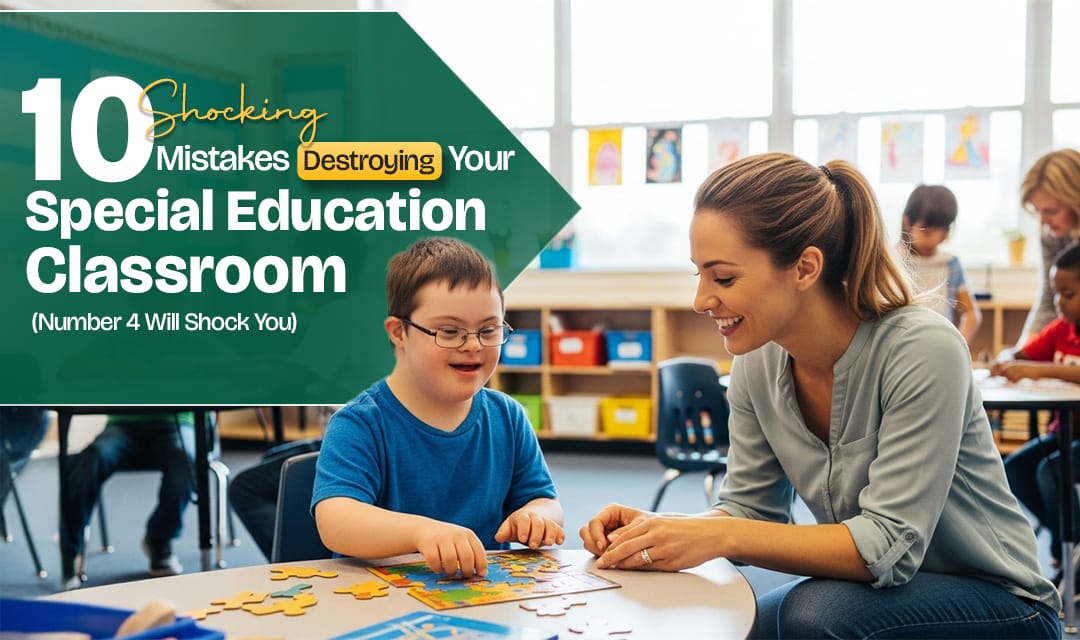
10 Shocking Mistakes Destroying Your Special Education Classroom (Number 4 Will Shock You)
A well-designed special education classroom can reduce stress and improve attention among the students. This guide explains the biggest mistakes teachers make that destroy the special education classroom. Read on to learn about these issues and how to avoid them to increase engagement in the classrooms.
A classroom is a place where you learn, but it can also cause stress and confusion within minutes. Children in special education classrooms demand additional sensory and behavioural needs for better learning. For example, how the room is set up affects their entire day at the school.
A classroom for special education provides more structure and support than a standard classroom. It follows predictable routines, and the resources are organised and sensory-balanced to help students focus and regulate their emotions.
According to OECD (2026), only 62% of teachers felt they could design learning tasks to accommodate students with special education needs. However, 38% teachers feel like they can’t help with their self contained special education classroom needs. For this, we have designed this guide that contains 10 mistakes in your special education classroom and how to avoid them. Find out more below:
Why a Well-Designed Special Education Classroom Matters?
A well-designed classroom supports attention and emotional regulation of the students, while helping them learn at the same time. Students who face challenges with language, emotional control and sensory inputs rely on the room itself for cues. If the environment is noisy or inconsistent, it can work against the lesson before it even starts. Therefore, special education classroom designs must not be treated as an afterthought; they must be carefully designed for students’ sake.
According to the National Centre for Learning Disabilities (2026), the inaccessible instructions hinder the learning of the students. The major issue is systemic and is tied to working conditions, resources, collaboration and other important factors like preparation and support. In fact, many educators find it hard to manage the class and also handle grading and paperwork. This creates a lot of pressure. In such situations, using a reliable assignment writing service can help with the heavy paperwork. This gives teachers more time to focus on their students. Good organisations create effective special education classroom setups that benefit both teachers and students.
The following are the special education classroom must haves:
- Setting up a special education classroom helps students know where to go and what to do next.
- Independent work becomes possible and helps the student with their understanding.
- Behavioural support becomes proactive, not reactive, increasing the learning for the students.
10 Shocking Mistakes Destroying Your Special Education Classroom
In a special education classroom, even small setup choices affect attention and emotional regulation. The mistakes mentioned below may get brushed under the rug as being minor. However, they make the space hard and less supportive for the students.
1. Creating a Cluttered Environment with Too Many Visuals
Teachers often prefer classrooms to be bright and engaging. However, it becomes a problem when every wall is competing for attention, for a child already struggling with attention span.
Special education classroom ideas include adding calm visuals and excluding the busy boards from the classroom.
What you can do instead of cluttered visuals:
- Only reveal the visuals that are essential for the learning.
- Do not show all the visuals at once; rotate them so the focus is not distorted.
- Calm colours around the workstations help avoid the chances of losing attention.
- The anchor charts must be purposeful and easy to read.
2, Skipping Clear Visual Schedules and Predictable Routines
When students do not know the routine, their behaviour tends to get worse. It is not defiance; it is stress caused by a weak transition system and uncertainty.
Following a visual schedule gives the room a rhythm. It is the core part of the special education classroom setup. The table below highlights the common issues in special education and how you can avoid them:
| Common Problem | What Students Experience | Better Fix |
| No visible daily routine | Uncertainty and anxiety | Use a whole-class visual schedule |
| Sudden transitions | Resistance or meltdowns | Add timers and transition cues |
| Too much verbal direction | Confusion | Pair speech with pictures/ symbols |
3. Using Behaviour Clip Charts or Public Shaming Systems
Some behaviours cause shame to the students, but they are still normalised. A child who is bullied or spoken about negatively in front of his peers stops trusting the room. This completely hurts the relationship and does nothing for their emotional regulation.
A better system supports its students and sets clear expectations. Beyond public ranking, students need empathetic coaching. If you want to understand behaviour-based support in depth, this guide on applied behaviour analysis thesis topics gives useful context on behaviour frameworks.
Instead of public shaming, you can use the following approach:
- Private redirection
- Individual behaviour goals
- Calm scripts for correction
- Consistent reinforcement
4. Not Building a Dedicated Calm-Down
One of the most damaging mistakes that can affect the mood of the student for the entire day is the lack of a calming-down area. When students do not find a safe place to regulate, they look for other ways to do so. In many cases, they would prefer sitting under a table or beside a shelf.
An area that feels calm is not some sort of reward, but a support tool that needs to be present always. In a self-contained special education classroom, this area is the difference between crisis and reset.
Teachers who need to understand sensory needs and learner support can also consider these autism dissertation topics. The article covers themes linked to sensory differences and educational support.
How can you create a calm-down space in your classroom?
A calm-down area is a zone where a student does not feel pressure. It is not cluttered or noisy and is not treated as a form of punishment. This gives the students a clear headspace, which helps them return to learning.
These are some things that you can utilise to build this space:
- soft seating or a floor cushion
- a visual choice board
- headphones or quiet sensory tools
- breathing prompts or calm cards
- a simple return-to-work routine
5. Failing to Organise Materials With Labels
Poor organisation breaks the independence of the students and wastes their time. When they do not have a place, they require help continuously. The transitions keep getting dragged, and adults feel stuck and exhausted.
This is the reason many teachers who are setting up a special education classroom focus on labels and their work systems. These details may seem small, but they make the room function more effectively.
| Tool | Why It Helps |
| Labels | Build independence and reduce confusion |
| Velcro systems | Support matching, sequencing, and quick setup |
| Task boxes | Encourage independent practice |
| Colour coding | Helps students and staff find materials faster |
6. Treating All Students the Same
Treating fairly does not mean that you will treat every student the same way. The needs of every student vary. While one may need reduced visuals, the other might require short breaks every 20 minutes. Few might require fewer instructions and more hands-on tasks.
Many special education classroom ideas fall short when it comes to treating the students. A room may seem organised in appearance, but still have elements that can trigger the students. The designs need to align with actual learner profiles, not Pinterest inspirations.
A better room accounts for:
- Communication differences
- Regulation needs
- Physical access
- Group size tolerance
- Independent work stamina
7. Over-Relying on Rewards That You Cannot Consistently Deliver
Rewarding special students works well as it helps them in learning. However, the reward system works only in conditions where the teachers remain persistent with it. If you are promising prizes that you can not deliver, the student loses interest.
Consistency in what you are doing matters more than the size of the reward. A reinforcement plan is stronger than fake, flashy plans. Keep the rewards simple and easy enough for every adult to follow.
What are the better reward habits?
- Choose supports according to the team’s capacity.
- Use specific praise.
- Use visuals that can be updated easily.
- The focus should be on progress, not perfection.
8. Ignoring Teacher and Staff Workspace Needs
The whole room becomes hard to manage if the staff has no planning zone, storage flow or access to student materials. When people are discussing the types of special education classrooms, this issue often remains unaddressed. The staff efficiency is a key performer while planning lessons or transitions.
Here are some staff needs that matter:
- A clear paperwork station
- Storage for extra materials
- Access to IEP and support documents
- A preparation area that does not block student movement
9. Setting up Without First Reviewing Student Profiles
This is the most avoidable mistake. The room needs to be built around its students. Teachers organising the furniture without keeping in mind the IEPs, mobility or sensory needs requires a complete redo later on.
Planning helps in seeing the special education classroom must-haves for that specific group. One class may require everyone to have their own workstations, while another may require wider pathways and fewer visual distractions.
10. Making the Space Too Rigid
A rigid room causes visible issues for special children, like those who are suffering from autism. The behavioural patterns keep on changing as the new equipment keeps coming in, which shifts the need.
A room should have structure, but it does not mean that it needs to remain frozen. Strong classrooms include flexible seating options because of this very need. It needs movable storage and routines you can adapt without causing chaos.
How To Structure A Special Education Classroom for the Best Learning?
A special education classroom starts with zones. The student needs to be able to identify the differences between where to calm down, where to work independently and where they have to sit. This reduces the language load and makes the transition process easier. Match the classroom to students, not some trends.
Here is how you can build a practical structure:
- One clear teaching area
- One independent work area
- One calm-down space
- Labelled storage
- Visible schedules
- Flexible seating
Students need walkways that are safe and easy for them to follow. Get rid of any dead corners that are filled with clutter. Keep the most-used tools closer to the teaching zone.
Conclusion
A special education classroom does not need to be expensive or constantly busy to be effective. It needs to be easy for students to understand without feeling overwhelmed. When the environment is well organised, it improves students’ focus and reduces teachers’ stress. Students also perform better when they rely on external support, such as assignment help online. It helps them break down difficult tasks and approach their homework without feeling stressed.
The best special education classrooms are built on routine and accessibility. They avoid poor organisation and one-size-fits-all thinking. Once the above-discussed issues are addressed, the space becomes calmer and far more effective for teaching and learning.
Frequently Asked Questions about Special Education Classroom
What are the special education classes called in school?
They are often called resource rooms, inclusion support classes, pull-out services, or specialist units. However, their names vary by school and country. These settings are designed to match the level and type of support a student needs.
What is the purpose of a special education classroom?
The purpose of a special education classroom is to provide structured support, accessible teaching, and targeted interventions so students with additional needs can learn more effectively. It also helps students build independence and everyday learning skills.
How to structure a special education classroom?
Use clear zones, visible schedules, organised storage, calm-down support, and flexible seating. Build the room around the student’s needs, not only their appearance. A well-structured classroom should feel predictable and easy for students to understand.
What are the 7 G’s in special education?
The 7 G’s is a model that is based on Cattell-Horn-Carroll (CHC) theory. This model is used to evaluate the learning disabilities and strengths in children. 7G’s refer to seven broad cognitive abilities. These include comprehension, fluid reasoning, visual processing, auditory processing, short-term memory, long-term retrieval, and processing speed.


Leave a Reply