
AI Chatbots for WooCommerce: What’s Actually Changed (and What to Look For)
AI chatbots for WooCommerce have been around for years, and most store owners have tried one at some point. Usually a plugin that matches keywords to canned responses, maybe surfaces an FAQ article if you’re lucky. Customers hate them. You probably do too.
But the technology has shifted in the last 18 months, and the gap between what most store owners think a chatbot does and what the current generation can actually do is worth understanding. Especially if you’re still handling support tickets manually, or paying per-agent for a tool that doesn’t pull from your actual store data.
AI Chatbots Aren’t What They Were
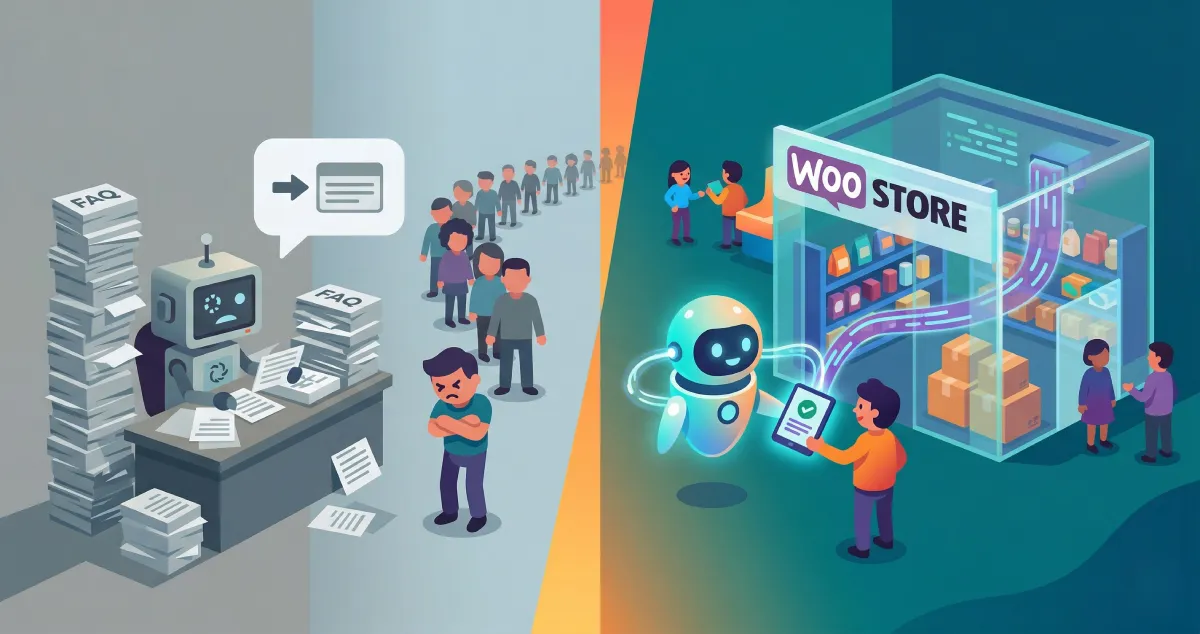
The chatbot plugins most WooCommerce stores have used work on simple keyword matching. Customer types “refund,” the bot serves a refund policy page. Customer types something slightly different, the bot gets confused. You’ve seen this. Everyone has.
The newer generation works differently. Instead of matching keywords to scripts, these tools use large language models to understand what a customer is actually asking, then pull answers from your store’s real data. Product specs, order history, return policies, live inventory, straight from your database.
WooCommerce itself is building toward this. Version 10.3 shipped a Model Context Protocol (MCP) in developer preview back in October 2025, giving AI assistants a standardised way to read and write store data directly (WooCommerce, 2025a). Products, orders, customer records. It’s early, but it signals where things are heading. WooCommerce is also a launch partner for Stripe’s Agentic Commerce Protocol, so the infrastructure for AI-native commerce is being laid at the platform level, not just by third-party plugin developers.
The practical difference: an older chatbot can tell a customer “check our returns page.” A current AI agent can look up their specific order, confirm the item is within the return window, and start processing the return. Without a human touching the ticket.
Why This Matters for Your Store’s Revenue
The conversion argument is straightforward. According to Rep AI’s 2025 data, shoppers who interact with an AI-powered chat convert at 12.3%, compared to 3.1% for shoppers who don’t (Rep AI, 2025). That’s roughly a 4x difference. Rep AI also reports that returning customers who use AI chat spend 25% more than those who don’t.
Those numbers come from Rep AI measuring their own product, so take them with the appropriate grain of salt. But the direction is consistent with what other platforms are reporting. Customers who get fast, accurate answers to pre-purchase questions buy more often. What’s changed is that AI can now deliver those answers at 2am on a Sunday without you being online.
For a WooCommerce store running on tight margins, the maths gets interesting quickly. If you’re handling 50 support tickets a week manually and even half of them are routine (order status, shipping times, product questions), that’s hours you’re either spending yourself or paying someone else to spend.
What Your Customers Actually Think About AI Support
Here’s the tension. A 2024 Gartner survey found that 64% of customers would prefer companies didn’t use AI for customer service at all (Gartner, 2024). More than half said they’d consider switching to a competitor over it.
That sounds like a dealbreaker. It changes how you should think about implementation, though, more than whether to implement at all.
The real complaint is about AI that makes it harder to reach a real person. Chatbots that loop you through menus. Systems that force you to “describe your issue” three times before admitting they can’t help. People hate being trapped by a bot. Getting a fast, accurate answer? That, they’re fine with.
You know the feeling. It’s 9pm, you just want to know where your package is, and you’re four menus deep into a chatbot that keeps asking you to rephrase. That’s the experience people remember. Compare that with typing “where’s my order?” and getting your tracking number back in three seconds. Same technology, completely different outcome.
The stores getting this right treat AI as a first filter, not a wall. Routine questions (tracking, return windows, product specs) get handled instantly and accurately. Anything complex, emotional, or ambiguous gets handed to a human with the full conversation context attached. The customer never has to repeat themselves. Let AI handle the same five questions your team answers 40 times a week, and free your people for the conversations that actually need a person.
What to Look For in an AI Chatbot for WooCommerce
This is where WooCommerce store owners run into a specific problem. The best-funded AI support tools were built for Shopify first. WooCommerce support is often bolted on as an afterthought, if it exists at all. Reddit threads in r/woocommerce are full of store owners describing these tools as “fancy FAQ boxes” that don’t actually connect to their store data.
When you’re evaluating options, these are the questions that matter:
| Question | Why it matters |
| Does it connect to your WooCommerce data natively? | Direct access to products, orders, customers, and inventory. If the AI can’t look up an order by number and tell a customer where their package is, it’s just a smarter FAQ page. Middleware layers add latency and failure points. |
| Can it take actions? | Issuing refunds, updating orders, applying discount codes. Read-only bots are a half measure. |
| Does it escalate to humans with full context? | When the AI hits its limits (and it will), the handoff should include the entire conversation. No “please describe your issue again.” |
| Is pricing transparent? | Some platforms charge per message, others per conversation, others per resolution. The differences add up fast. |
Before committing, compare what you’ll actually pay across platforms. This pricing comparison of AI customer service tools breaks down the real costs.
Getting Started Without Breaking What Works
You don’t need to rip out your existing setup overnight. The practical path looks more like this:
Start with your data. Before any AI tool can be useful, your product attributes need to be structured cleanly in WooCommerce. Material, dimensions, shipping weight, return eligibility. If that information is buried in long product descriptions instead of stored as metadata, the AI can’t reliably access it.
Then start small. Pick the ticket types that eat the most time and are the most repetitive. Order status. Shipping estimates. Basic product questions. Let AI handle those while your team focuses on the complex stuff.
Consider starting in an “AI-assisted” mode rather than fully autonomous. The AI drafts a response, a human reviews and sends it. This lets the system learn your brand’s tone and catch errors before customers see them.
Gartner predicts that by 2029, AI will autonomously resolve 80% of common customer service issues (Gartner, 2025). Whether that timeline is exactly right or not, the direction is clear. Open-source platforms like Hay are building specifically for this, letting you connect AI support directly to your WooCommerce store data without locking into per-resolution pricing. The tools exist now. The question is just when you decide the manual approach costs more than the switch.
References
Gartner (2024) Gartner Survey Finds 64 Percent of Customers Would Prefer That Companies Didn’t Use AI for Customer Service, 9 July. Available at: gartner.com/en/newsroom/press-releases/2024-07-09-gartner-survey-finds-64-percent-of-customers-would-prefer-that-companies-didnt-use-ai-for-customer-service (Accessed: 24 March 2026).
Gartner (2025) Gartner Predicts Agentic AI Will Autonomously Resolve 80 Percent of Common Customer Service Issues by 2029, 5 March. Available at: gartner.com/en/newsroom/press-releases/2025-03-05-gartner-predicts-agentic-ai-will-autonomously-resolve-80-percent-of-common-customer-service-issues (Accessed: 24 March 2026).
Rep AI (2025) The Future of AI in Ecommerce: 40+ Statistics on Conversational AI Agents for 2025. Available at: hellorep.ai/blog/the-future-of-ai-in-ecommerce-40-statistics (Accessed: 24 March 2026).
WooCommerce (2025a) AI & Agentic Commerce in WooCommerce, 3 October. Available at: developer.woocommerce.com/2025/10/03/ai-agentic-commerce-in-woocommerce/ (Accessed: 24 March 2026).


Leave a Reply