
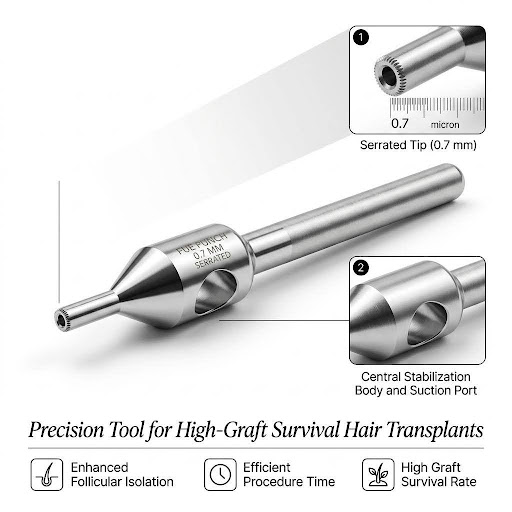
FUE Punch 0.7 mm Serrated: Precision Tool for High-Graft Survival Hair Transplants
Role of Punch Tools in Follicular Extraction
The FUE punch 0.7 mm serrated is a specialized hair transplant punch tool used in modern follicular unit extraction procedures. Within the category of FUE surgical tools, the punch instrument plays a central role in isolating and extracting individual follicular units from the donor region. The precision of this tool directly influences the structural integrity of the grafts during extraction. In clinical practice, even minor deviations in punch alignment or edge sharpness can increase transection rates, leading to unusable grafts.
Unlike general surgical instruments, a follicular extraction instrument must operate within extremely tight tolerances. The average follicular unit measures between 0.6 mm and 1 mm, meaning the punch diameter must be carefully selected to match anatomical variation. A 0.7 mm punch is widely considered a balanced option for achieving both minimal scarring and consistent graft extraction. Its adoption across advanced clinics reflects its reliability in controlled surgical environments.
Why Precision Directly Impacts Graft Survival
Precision in FUE procedures is directly linked to graft survival rates, which are a key metric of transplant success. Imprecise instruments increase transection rates, directly affecting graft viability and final density outcomes. When a follicle is partially or completely transected, its ability to regrow after implantation is significantly reduced. This not only impacts aesthetic results but also reduces the overall efficiency of the procedure.
Clinics using a high-quality 0.7 mm serrated FUE punch often achieve more consistent graft extraction and improved procedural efficiency. This consistency is critical when performing large sessions involving 2,000 to 4,000 grafts. Even a small improvement in survival rate—such as increasing from 85% to over 90%—can significantly enhance the final visual density. Therefore, the selection of precision tools is not optional; it is a foundational requirement in professional hair restoration.
Technical Breakdown of 0.7 mm Serrated FUE Punch
Diameter Significance in Hair Transplant Punch Tools
The 0.7 mm diameter represents the internal cutting width of the punch tip. This dimension is critical because it determines how closely the tool can isolate follicular units without causing excessive tissue trauma. A smaller diameter reduces the size of the extraction site, which contributes to faster healing and less visible scarring in the donor area.
However, excessively small punches can increase the likelihood of follicle damage, especially in patients with thick or angled hair shafts. The 0.7 mm punch provides a clinically effective compromise. It allows for adequate clearance around the follicle while maintaining a minimally invasive profile. This balance makes it one of the most widely used sizes in both standard and advanced FUE procedures.
Serrated Edge Engineering Explained
The serrated design refers to micro-textured cutting edges that enhance grip and reduce slippage during penetration. In contrast to smooth punches, serrated tips improve rotational control, especially in firmer scalp tissue. This design allows for more predictable scoring of the epidermis and dermis layers surrounding the follicle.
The engineering behind serrated punches is intended to minimize resistance while maintaining cutting accuracy. Reduced resistance lowers the amount of force required, which in turn decreases mechanical stress on the follicle. This is particularly important in high-density donor areas, where precision and control must be maintained over extended extraction sessions.
Core Features of the 0.7 mm Serrated Punch
Controlled Depth Penetration
One of the defining characteristics of this tool is its ability to maintain consistent penetration depth. Proper depth control ensures that the punch reaches the follicular unit without extending into deeper tissue layers unnecessarily. This reduces trauma to surrounding structures and minimizes bleeding during extraction.
Reduced Transection Rates
A key performance indicator in FUE procedures is the transection rate, which refers to the percentage of follicles damaged during extraction. The combination of a 0.7 mm diameter and a serrated edge significantly lowers this risk when used correctly. Lower transection rates translate into a higher number of viable grafts available for implantation.
Optimized Follicular Integrity
Maintaining follicular integrity is essential for achieving natural growth patterns after transplantation. The precision design of this punch supports clean extraction, preserving the dermal sheath and surrounding tissue structures that are critical for graft survival.
Clinical Benefits in Hair Transplant Procedures
Improved Extraction Efficiency
Efficiency in FUE procedures is measured by both speed and accuracy. The serrated punch design enables smoother penetration and extraction, reducing the time required per graft. This is particularly beneficial in large sessions, where procedural duration can exceed several hours.
Higher Graft Survival Outcomes
Clinical data suggests that improved extraction techniques can result in graft survival rates exceeding 90–95% under optimal conditions. The use of precision tools like the 0.7 mm serrated punch contributes directly to these outcomes by minimizing trauma and preserving follicular viability.
Using low-quality punches can increase follicle damage rates, directly reducing transplant success and patient satisfaction. This makes tool selection a critical decision for clinics aiming to maintain high standards of care.
Punch Size Comparison in FUE Surgical Tools
0.6 mm vs 0.7 mm vs 0.8 mm Clinical Use
Punch Size: Clinical Advantages: Clinical Limitations
0.6 mm Minimal scarring, high precision in skilled hands, Increased transection risk in thick or curly hair
0.7 mm Balanced precision, reduced trauma, versatile across hair types . Requires controlled technique
0.8 mm Easier extraction in difficult cases , larger extraction sites, increased scarring risk
The 0.7 mm serrated FUE punch is widely regarded as the optimal middle ground, offering versatility across a broad range of patient profiles.
Expert Punch Selection Strategy
Hair Type Considerations
Hair characteristics play a critical role in selecting the appropriate punch size. Patients with curly, coiled, or angled follicles present a higher risk of transection when smaller punches are used. In such cases, surgeons may need to adjust both punch diameter and extraction angle to align with the follicle’s natural path. Straight hair types, on the other hand, allow for more predictable extraction with smaller diameters.
Skin Characteristics and Donor Area Density
Skin thickness and elasticity influence how the punch interacts with the scalp. Thicker or fibrotic skin increases resistance, making serrated punches more effective due to their enhanced cutting ability. Donor density also affects tool selection; in high-density areas, smaller punches like 0.7 mm help preserve surrounding follicles and maintain donor aesthetics.
Surgeon Skill Level and Technique
The effectiveness of any follicular extraction instrument depends heavily on the operator’s skill. Advanced surgeons can utilize smaller punches with high precision, while less experienced practitioners may require slightly larger diameters to reduce technical difficulty. The 0.7 mm punch is often preferred by experienced surgeons who can fully leverage its precision without increasing risk.
Materials and Manufacturing Standards
Stainless Steel vs Titanium Instruments
Material selection affects durability, sharpness retention, and sterilization compatibility. Stainless steel punches are widely used due to their cost-effectiveness and reliable performance. They maintain adequate sharpness for multiple procedures and are compatible with standard sterilization protocols.
Titanium punches, however, offer a superior strength-to-weight ratio and extended edge retention. They are more resistant to corrosion and maintain performance over longer usage cycles. While more expensive, they are often preferred in high-volume clinics where consistency and longevity are priorities.
Risk Factors of Low-Quality Punch Tools
Low-quality instruments pose significant risks in FUE procedures. Poorly manufactured punches often have inconsistent diameters, dull edges, or improper alignment. These defects increase resistance during extraction, leading to higher transection rates and tissue trauma.
Inconsistent tool performance also affects procedural efficiency, increasing operative time and surgeon fatigue. Over time, this can impact overall clinic productivity and patient outcomes. Investing in high-quality FUE surgical tools is therefore essential for maintaining clinical standards and achieving predictable results.
Sterilization Protocols and Maintenance
Proper sterilization is critical for both patient safety and tool longevity. FUE punches must be cleaned immediately after use to remove biological debris, followed by sterilization using autoclave systems. Repeated sterilization cycles can gradually affect sharpness, so regular inspection and timely replacement are necessary.
Maintaining tool integrity ensures consistent performance across procedures. Clinics that implement strict sterilization protocols reduce infection risk and preserve the precision characteristics of their instruments.
Cost, Market Positioning, and Procurement
The price of a 0.7 mm serrated FUE punch typically ranges between $20 and $150, depending on material quality and manufacturing standards. Premium titanium models command higher prices due to their durability and performance consistency.
When sourcing these tools, clinics should prioritize certified suppliers and avoid low-cost alternatives that may compromise quality. Reliable procurement ensures compliance with medical standards and supports long-term operational efficiency.
Conclusion
The FUE punch 0.7 mm serrated remains a critical instrument in modern hair transplantation. Its balanced diameter, precision cutting capability, and adaptability across different hair and skin types make it a preferred choice among experienced surgeons. Clinical outcomes are directly influenced by tool quality, making the selection of high-grade instruments essential for achieving optimal graft survival and patient satisfaction.
FAQs
- Why is 0.7 mm considered the optimal punch size?
It provides a balance between minimizing scarring and preserving follicular integrity during extraction.
- Does a serrated punch reduce transection rates?
Yes, the serrated design improves grip and control, reducing follicle damage during extraction.
- Can beginners use a 0.7 mm FUE punch effectively?
It is better suited for trained professionals, as precision handling is required to maximize its benefits.
- How often should FUE punches be replaced?
Replacement depends on usage frequency and sterilization cycles, but regular inspection is recommended to maintain sharpness.
- Are titanium punches better than stainless steel?
Titanium offers longer durability and edge retention, but stainless steel remains a cost-effective and reliable option.


Leave a Reply