
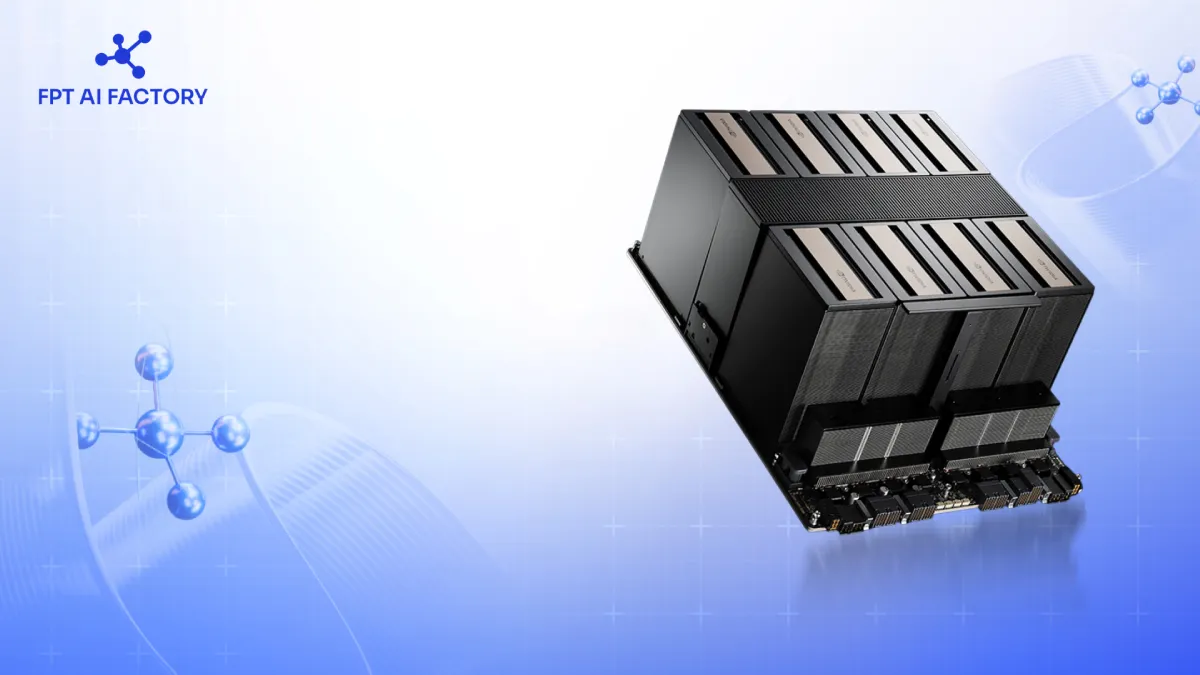
GPU Containers vs Virtual Machines: What’s the Best Choice for AI Infrastructure?
GPU container and GPU virtual machine options are two core technologies powering modern artificial intelligence workflows. Choosing the right setup can directly impact system performance and scalability. A flexible platform like FPT AI Factory provides the computing environments needed to match different workload demands. Explore how the right infrastructure can help optimize your AI operations today.
1. GPU Containers vs GPU Virtual Machines: What’s the Difference?
A GPU Virtual Machine operates as an isolated computing environment that features its own dedicated operating system. It efficiently abstracts physical hardware, allowing users to run complex applications exactly like a standalone physical computer. This virtualized method provides strong security boundaries and high resource isolation for highly sensitive projects. Engineering teams often rely on this setup when stability and strict environmental control are their top priorities.
Conversely, a GPU Container packages applications and dependencies without a full operating system. It shares the host kernel, making deployment lightweight and fast across environments. This efficiency helps developers maximize hardware utilization and iterate on machine learning models more quickly. By reducing system overhead, teams can allocate more computing power directly to model training.
2. When to Use Each Option
Selecting between a GPU Container and a GPU Virtual Machine depends on your workload priorities, security requirements, and deployment model. Each option serves a different operational purpose. Understanding the right use case helps teams optimize performance, maintain stability, and manage resources more efficiently.
Use a GPU Container when:
- Your project requires rapid scalability and fast deployment cycles
- You are running microservices architectures or highly dynamic workloads
- Your team follows continuous integration and continuous delivery practices
- You need to push frequent updates to production with minimal downtime
- Speed, flexibility, and efficient resource utilization are top priorities
Use a GPU Virtual Machine when:
- Your project requires strong security controls and full environment isolation
- You are handling sensitive data or regulated workloads
- You need to support legacy systems or specialized software configurations
- Your workloads are heavy, long running, and require stable infrastructure
- You want a dedicated environment that prevents interference with other processes
3. Why Modern AI Workflows Use a Hybrid Approach
Many organizations no longer rely on a single technology for their AI pipelines. Instead, they combine the fast deployment capabilities of a GPU Container with the strong security of a virtualized system. This hybrid approach helps teams balance agility with compliance requirements more effectively.
During the early stages, engineers often use lightweight environments for experimentation, model training, and continuous testing. These flexible setups allow teams to iterate quickly and validate ideas without heavy infrastructure constraints. As development progresses, system requirements typically become more stable and security focused.
At that point, the finalized model can be deployed within a secure virtual machine environment for production use. Combining both technologies ensures efficient resource allocation and reliable data protection across the entire lifecycle. This level of adaptability is becoming a standard practice in modern enterprise architecture.
4. The Need for Unified AI Infrastructure Platforms
Managing isolated environments across multiple cloud providers can create operational bottlenecks and higher administrative costs. AI teams need unified platforms that combine compute, storage, and networking in one dashboard. A centralized system reduces technical overhead and helps developers focus on building better models. Consolidating tools is a practical way to streamline daily operations.
A cohesive platform also makes it easier to move workloads as project needs change. Teams can shift from an AI Notebook to a large GPU Cluster without major reconfiguration. This smooth transition speeds up deployment and improves overall efficiency. Having resources in one place makes infrastructure management simpler and more reliable.
5. Platforms Like FPT AI Factory
To meet evolving AI demands, FPT AI Factory provides a flexible ecosystem designed for modern workloads. Users can access a wide range of computing resources, from GPU Virtual Machines to high performance Metal Cloud environments. This flexibility allows organizations to scale smoothly as data processing needs increase, while ensuring teams always have the right tools available.
The platform also simplifies infrastructure management by offering multiple computing environments in one place. Developers can start with an AI Notebook for experimentation and later move to more powerful systems without disruption. This streamlined workflow supports efficient development, testing, and deployment across the entire AI lifecycle.
Deciding between a GPU Container and a GPU Virtual Machine ultimately depends on your project’s demands for speed, security, and scale. By leveraging flexible cloud solutions, you can build a customized infrastructure that perfectly aligns with your technical and business requirements. The right environment will empower your developers to innovate faster while maintaining strict control over computing resources. Reach out to FPT AI Factory today for a personalized consultation to optimize your deployments!
Starter Plan – Free $100 to get started
- $100 in credits for new users to explore FPT AI Factory for 30 days.
- $10 for GPU Container, $10 GPU Virtual Machine, $10 AI Notebook, and $70 for AI Inference & AI Studio.
- Your card is encrypted. $1 verification charge will be added to your balance.
- Up to 5M tokens with Llama-3.3 & 20+ models.
Contact Information:
- Hotline: 1900 638 399
- Email: [email protected]
- Address:
- Tokyo: 33F, Sumitomo Fudosan Tokyo Mita Garden Tower, 3-5-19 Mita, Minato-ku
- Hanoi: No. 10 Pham Van Bach, Dich Vong Ward, Cau Giay District
- Ho Chi Minh: PJICO building, 186 Dien Bien Phu, Xuan Hoa Ward


Leave a Reply