
How Lending Software Development Helps Automate Loan Processes
The traditional lending landscape used to look like a scene from a bureaucratic drama: stacks of paperwork, endless back-and-forth emails, and anxious borrowers waiting weeks just to hear a “yes” or “no.” For modern financial institutions, that model is no longer just outdated—it’s a direct threat to market share.
Today’s retail and commercial borrowers expect a seamless, Amazon-like experience. They want speed, absolute transparency, and minimal friction. To meet these demands, forward-thinking banks, credit unions, and fintech startups are turning away from manual underwriting and embracing end-to-end automated ecosystems.
But how exactly does transforming your digital infrastructure shift the needle, and what does it take to build a system that balances speed with risk management? Let’s dive into how modern fintech solutions reshape the lending lifecycle.
The Bottleneck: Why Manual Lending is Fading
Before looking at the technological solution, we have to acknowledge the core vulnerabilities of traditional lending. Manual loan processing is plagued by three major operational flaws:
- The Vulnerability of Human Error: Manually verifying income, calculating debt-to-income (DTI) ratios, and cross-referencing tax returns opens the door to costly mistakes and oversight.
- Skyrocketing Operational Costs: When loan officers spend the bulk of their day doing administrative grunt work, data entry, and follow-ups, operational efficiency plummets. Institutions end up throwing human resources at a scalability problem.
- Frustratingly Slow Turnaround: In a competitive market, a slow approval process means losing high-value borrowers to agile, digital-native competitors who can approve a loan in minutes.
To bridge this critical gap, financial institutions are heavily investing in custom technology. Partnering with an experienced tech partner for bespoke lending software development allows organizations to build tailored platforms that completely eliminate these operational friction points, integrate smoothly with legacy systems, and enforce strict compliance from day one.
Advanced Architecture: How Automation Transforms the Loan Lifecycle
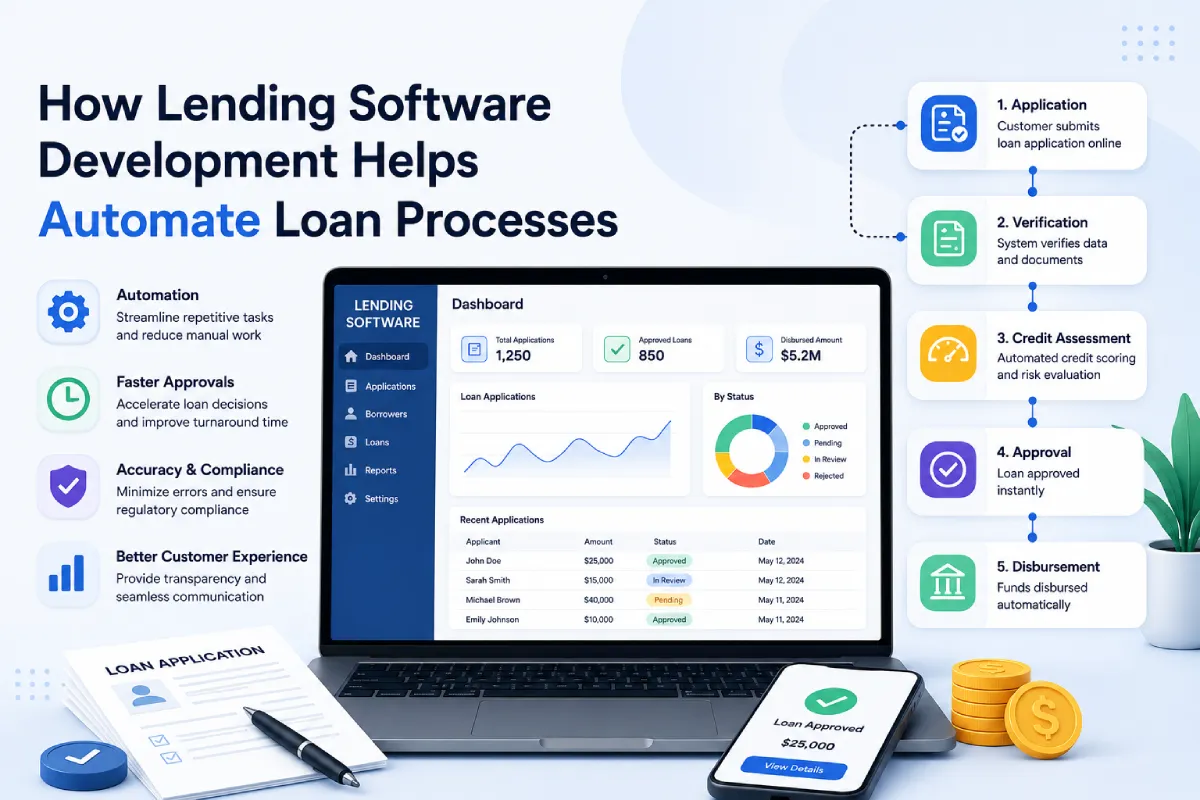
Modern lending software doesn’t just digitize paper documents into PDFs; it completely re-engineers how data moves through an organization. By leveraging APIs, Cloud computing, and Artificial Intelligence, an automated system transforms every single stage of the funnel:
1. Instant Intelligent Intake & OCR
The user experience begins with dynamic, responsive web and mobile interfaces. Instead of making applicants fill out 20-page forms, smart forms request only the necessary data based on previous answers.
Furthermore, integrated Optical Character Recognition (OCR) technology automatically extracts data from uploaded IDs, pay stubs, and tax documents. This eliminates manual data entry errors and slashes application abandonment rates.
2. Open Banking and Real-Time Data Aggregation
Rather than waiting for users to upload bank statements, modern software utilizes Open Banking APIs (such as Plaid or Tink). With the borrower’s consent, the platform securely fetches real-time transactional history directly from their bank accounts. This gives underwriters an unalterable, comprehensive view of cash flow, income stability, and spending habits within seconds.
3. Automated Underwriting and AI Decisioning
This is the engine room of the platform. Instead of a human analyst manually pulling and reviewing credit bureau data, the software hooks directly into major credit bureaus via APIs.
Advanced decisioning engines run the gathered data through predefined business rules and machine learning models. The system can instantly calculate risk scores, evaluate collateral, and either auto-approve low-risk applications, auto-reject fraudulent ones, or flag borderline, complex cases for manual review by a human expert.
4. Seamless Compliance (KYC/AML)
Regulatory environments are incredibly tight and constantly shifting. Automated systems run background checks, Identity Verification (IDV), Anti-Money Laundering (AML), and Know Your Customer (KYC) protocols automatically in the background using biometric data and global databases. If a compliance regulation changes, updating the software logic ensures instant, organization-wide compliance without the need to retrain staff.
5. Smart Contract Generation and e-Signatures
Once a loan is approved, the system automatically populates localized, legally compliant loan agreements, disclosure forms, and repayment schedules. Integrated digital signature tools (like DocuSign or Adobe Sign) allow borrowers to securely execute contracts from any device, shortening the closing time from days to minutes.
Quantifying the Impact: The Business Benefits
While saving time is the most obvious benefit, the ripple effects of loan automation impact the entire business infrastructure:
| Feature / Metric | Manual Processing | Automated Processing | Business Impact |
| Time-to-Decision | Days to Weeks | Minutes to Hours | Massive boost in borrower conversion and satisfaction. |
| Operational Capacity | Linear (More loans = More staff) | Exponential (High scalability) | Ability to handle 10x loan volume with the same overhead. |
| Risk Management | Subjective, prone to bias/oversight | Objective, data-driven ML models | Lower Non-Performing Loan (NPL) ratios and fraud mitigation. |
| Regulatory Compliance | Manual audits, high risk of fines | Automated audit trails, auto-updates | Reduced legal risks and guaranteed audit readiness. |
Conclusion: Future-Proofing the Lending Ecosystem
The financial services industry has reached a tipping point. Automation is no longer a luxury, a competitive advantage, or a futuristic concept—it has become the baseline for survival in the fintech era. Borrowers are no longer comparing your loan process to other banks; they are comparing it to the frictionless digital experiences they enjoy everywhere else in their daily lives.
Transitioning from legacy, spreadsheet-dependent operations to an automated system is undeniably a significant undertaking. However, the return on investment is clear: reduced operational costs, drastically lower risk of default, and the agility to scale lending volumes without a proportional increase in headcount.
Ultimately, embracing custom software development for loan automation is not just about keeping up with market trends. It is about future-proofing your institution, empowering your team to focus on high-value human relationships, and delivering the rapid, secure, and digital-first financial services that modern consumers demand.


Leave a Reply