
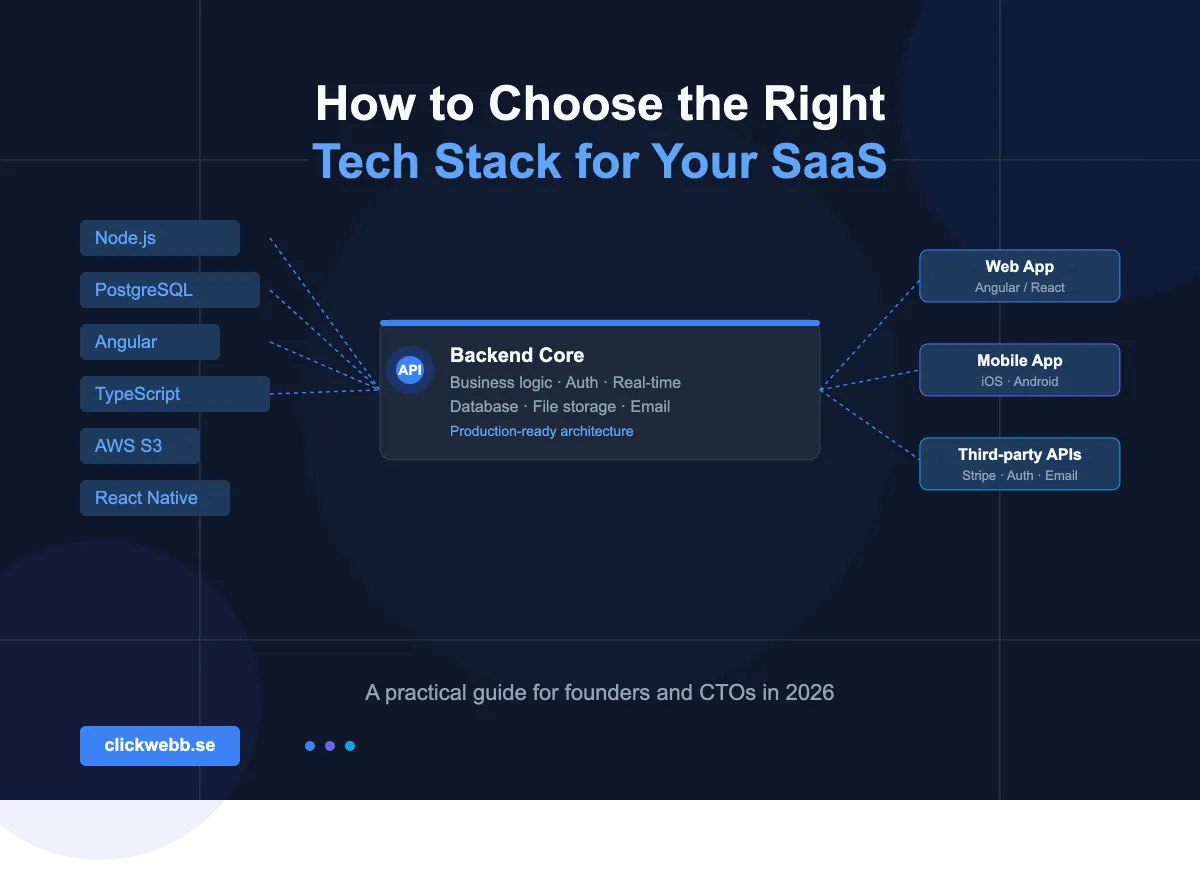
How to Choose the Right Tech Stack for Your SaaS Product in 2026
Building a SaaS product is one of the most exciting things a founder or CTO can do. But before writing a single line of code, there is a decision that will affect every aspect of your product for years to come: your tech stack.
Get it right and your product scales smoothly, your team moves fast and your infrastructure costs stay predictable. Get it wrong and you spend the next two years fighting your own codebase instead of building features your customers actually want.
This guide breaks down exactly how to think about tech stack decisions in 2026, what questions to ask and what mistakes to avoid.
What Is a Tech Stack and Why Does It Matter?
A tech stack is the combination of programming languages, frameworks, databases and infrastructure tools used to build and run your product. It covers everything from how your server handles requests to how your users see the interface on their screen.
The reason this decision matters so much is that switching stacks later is enormously expensive. Unlike a logo redesign or a pricing change, rebuilding core infrastructure while keeping a live product running is one of the hardest engineering challenges a company can face. Many startups have failed not because their idea was wrong, but because their technical foundation could not support the growth they achieved.
The Four Core Layers of a SaaS Tech Stack
Every SaaS product has four layers that need to work together:
- The BackendThis is the engine of your product. It handles business logic, data processing, API communication and security. Common choices include Node.js, Python, Ruby on Rails and Java. For most modern SaaS products, Node.js with TypeScript has become the dominant choice because it is fast, handles concurrent users well and shares the JavaScript language with the frontend.
- The FrontendThis is what your users see and interact with. Frameworks like Angular, React and Vue.js dominate this space. Angular is particularly strong for complex enterprise applications because of its rigid structure and built-in tooling. React is more flexible and better suited for content-heavy products.
- The DatabaseYour database is where all your data lives. PostgreSQL has become the standard for SaaS products that handle complex relational data, financial transactions or anything requiring strict data integrity. It outperforms MySQL for complex queries and JSON handling, both of which matter as your product grows.
- The InfrastructureWhere your product runs and how it scales. AWS dominates the market for good reason: it offers the most comprehensive set of tools, the best global coverage and the deepest documentation. For most SaaS products, starting on AWS and using services like S3 for file storage and CloudFront for content delivery is the sensible default.
The Three Questions That Should Drive Your Decision
Before evaluating specific technologies, answer these three questions honestly.
How complex is your data model? If your product handles simple data with straightforward relationships, almost any stack will work. If you are building something with complex permissions, multi-tenant architecture, financial data or real-time features, your stack needs to be chosen specifically for that complexity. A simple tech stack built for a blog will not survive the demands of an enterprise SaaS product.
How fast do you need to move in the first six months? Speed of development matters most in the early stages. Choose technologies your team already knows rather than technologies that are theoretically superior but unfamiliar. A product built in a familiar stack and shipped in three months beats a theoretically perfect product that takes nine months to launch.
What does your five year growth scenario look like? If you plan to have thousands of concurrent users, your database and backend need to be architected for that from the beginning. Horizontal scaling, connection pooling and caching are not features you add later. They need to be designed in from day one.
The Most Common Tech Stack Mistakes in 2026
Choosing WordPress or page builders for a SaaS product WordPress is excellent for blogs and informational websites. It is not a foundation for a SaaS product. The plugin dependency model, the performance ceiling and the security exposure from shared codebases make it the wrong tool the moment you need real business logic, user authentication beyond basic roles or any kind of API integration with third-party services.
Over-engineering the infrastructure before you have users Many founders spend months building microservices architecture before they have a single paying customer. Start with a well-structured monolith. You can extract services later when you have the scale that justifies the complexity. A monolith that works is worth more than a microservices architecture that is still being built.
Ignoring TypeScript In 2026 there is very little reason to build a SaaS product in plain JavaScript rather than TypeScript. TypeScript catches errors before they reach production, makes refactoring safer and significantly improves the experience of onboarding new developers. The upfront investment in setting up TypeScript pays back within weeks.
Choosing a database based on familiarity alone Many early-stage teams default to MySQL because it is what they learned first. For most SaaS products, PostgreSQL is the better choice. It handles complex queries more efficiently, has superior support for JSON data, and provides better concurrency when multiple users are hitting the database simultaneously.
What a Production-Ready SaaS Stack Looks Like in 2026
Based on building multiple live SaaS platforms, a stack that performs well in production looks something like this:
- Backend:js with TypeScript and Express or NestJS for structured API development
- Frontend:Angular for complex enterprise applications, React for simpler or more content-focused products
- Database:PostgreSQL with an ORM like TypeORM for structured schema management and migration tracking
- File Storage:AWS S3 with CloudFront for global CDN delivery
- Authentication:JWT with separate secrets per user type, magic link support and integration with national identity systems where relevant
- Real-time:IO for live features like notifications, dashboards and collaborative tools
- Payments:Stripe for subscription management and billing
- Email:AWS SES for transactional email at scale
This is not the only valid stack. But it is a stack with a proven track record in production environments handling thousands of concurrent users.
How to Evaluate a Development Partner for Your SaaS
If you are working with an external agency or development team rather than building in-house, the tech stack conversation is one of the most important early discussions you should have.
Ask them directly which stack they recommend and why. If they cannot give you a specific answer based on your product requirements, that is a red flag. If their answer is WordPress or a page builder for a product with real business logic, walk away.
Look for partners who have built and shipped real SaaS products, not just websites. There is a significant difference between agencies that build informational sites and agencies that build software. The architecture decisions, the security considerations and the scalability requirements are fundamentally different.
A partner with live production SaaS products in their portfolio has already made the mistakes and learned from them. That experience is worth paying for. You can learn more about what serious SaaS development for businesses actually requires before you start conversations with potential partners.
The Bottom Line
Choosing a tech stack is not a technical decision. It is a business decision with technical consequences. The right stack is the one that matches your team’s skills, fits your product’s complexity and can scale with your ambitions without requiring a complete rebuild at the worst possible moment.
Take the time to get this decision right before you write a single line of code. The founders who rush this decision are the ones who spend year two rebuilding instead of growing.
If you are building a SaaS product and want a realistic assessment of what tech stack fits your specific requirements, reading through the common mistakes Swedish companies make in SaaS development is a useful starting point for understanding what can go wrong and how to avoid it.
This article was written by the Clickwebb team. Clickwebb is a Swedish development agency specializing in SaaS platforms and complex web applications.


Leave a Reply